
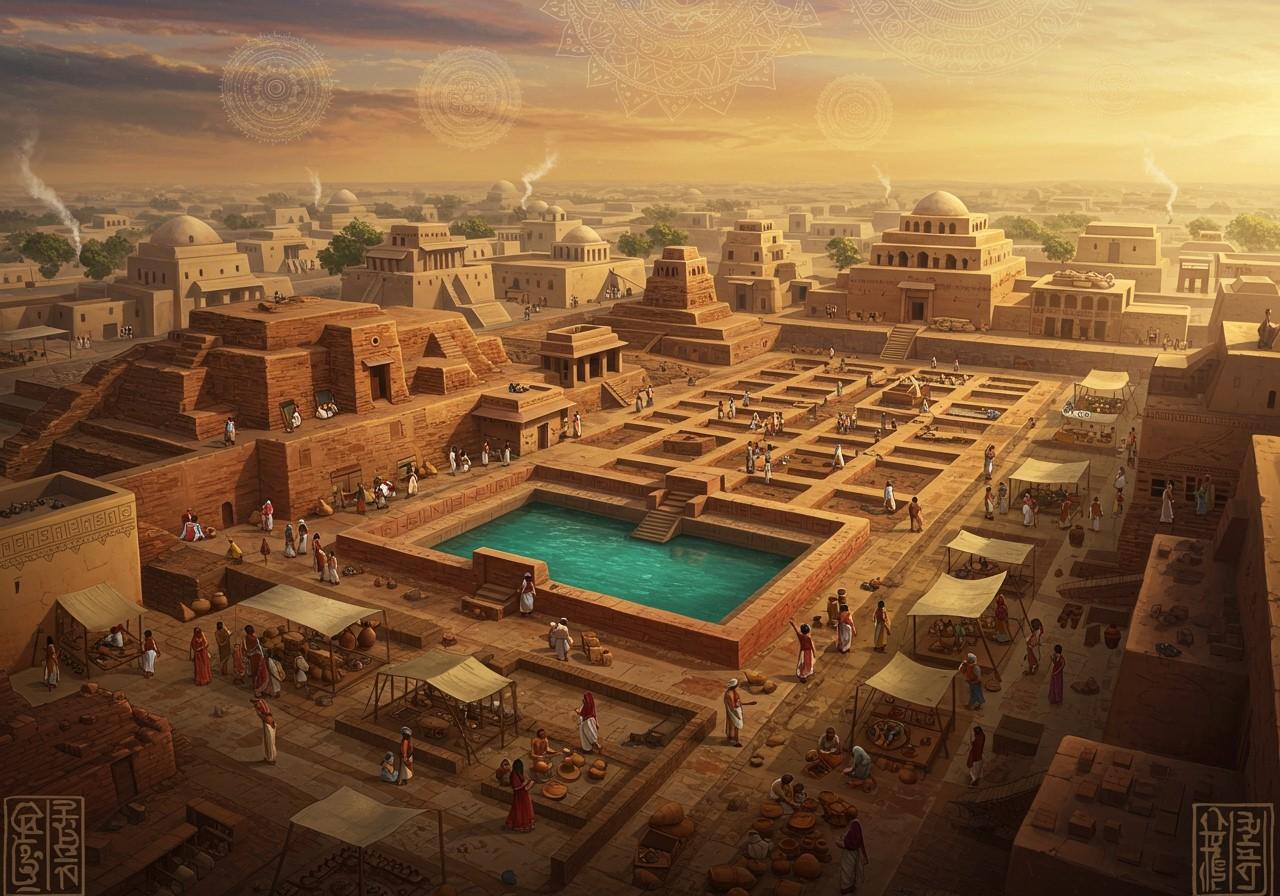
In a landmark interdisciplinary study that seamlessly weaves together archaeology, biochemistry, and climate science, an international consortium of researchers has presented compelling new evidence that fundamentally rewrites the final chapter of one of the ancient world’s greatest enigmas: the decline of the Indus Valley Civilization. Published today in the journal Nature, the research culminates a decades-long quest to understand why this sophisticated, urbanized culture, which flourished across modern-day Pakistan and northwest India from approximately 3300 to 1300 BCE, underwent a dramatic transformation and eventual dissipation. The new findings decisively shift the narrative away from a single catastrophic collapse—whether by invading armies, catastrophic climate change, or sudden river avulsion—and toward a complex, centuries-long process of eastward migration and cultural adaptation in response to prolonged, multifaceted environmental pressures.
The breakthrough hinges on a novel application of lipid residue analysis and isotopic tracing on pottery shards collected from a vast network of Indus sites, combined with high-resolution paleoclimate data from the region. For years, the story of the Indus decline was dominated by a handful of competing theories. The once-popular “Aryan Invasion” hypothesis, suggesting conquest by nomadic tribes from the north, has long been dismissed by most scholars due to a lack of archaeological evidence for widespread violence. More recent theories pointed to a prolonged drought caused by shifts in the Indian Summer Monsoon, or the supposed drying up or catastrophic flooding of the mighty Saraswati River, a hypothesis deeply intertwined with Indian cultural history. However, these theories often struggled to explain the full archaeological record, particularly the absence of clear evidence for a sudden, society-ending catastrophe and the simultaneous rise of vibrant new cultural complexes further east and south on the Indian subcontinent.
The new research, led by teams from the University of Cambridge, the Banaras Hindu University, and the Indian Institute of Technology, Kharagpur, provides the missing link. By analyzing the molecular fossils of food fats absorbed into thousands of ceramic cooking vessels over 4,000 years ago, the scientists were able to reconstruct precise dietary patterns across the entire lifespan of the civilization. Crucially, they tracked a clear, time-stamped shift in food sources, moving from a diet heavily reliant on winter crops like wheat and barley, which depend on reliable river irrigation from the Indus and Saraswati-Ghaggar-Hakra systems, to one increasingly dominated by drought-resistant summer crops like millet and rice, which are better suited to variable monsoon rains and smaller water systems. This dietary revolution, the study argues, was not a rapid change but a strategic, generational adaptation. “What we are seeing is not an overnight abandonment of cities, but a conscious, gradual reorientation of agricultural and culinary practices,” explained lead archaeologist Dr. Cameron Petrie. “The lipid residues are like ancient kitchen receipts, telling us exactly what people were cooking and eating. They show us a population intelligently responding to changing environmental conditions by shifting their subsistence base.”
This dietary shift is powerfully correlated with new, ultra-high-resolution paleoclimate data extracted from stalagmites in Himalayan caves and sediment cores from the Arabian Sea. This data reveals not a single, abrupt megadrought, but a complex pattern of climatic instability beginning around 2100 BCE. The monsoon system became increasingly unpredictable, with periods of intense rainfall followed by severe dry spells, disrupting the delicate hydrological balance upon which the large, planned Indus cities like Mohenjo-daro and Harappa depended. The great rivers, including the hypothesized Saraswati, likely became less reliable for large-scale agriculture, their flows becoming more seasonal or fragmenting into smaller channels. “The cities were hyper-specialized for a certain environmental niche—stable, predictable river water,” stated paleoclimatologist Dr. Anika Sharma. “When the climate became ‘noisier’ and less predictable, the very foundation of their urban economic model was undermined. The data shows a move away from precarious, centralized systems toward more resilient, localized forms of food production.”
The study’s most significant contribution is mapping how this adaptive process physically moved populations. The pottery evidence, characterized by both lipid residues and evolving stylistic signatures, shows a clear trail. As the stability of the northwestern core areas waned, communities began a prolonged eastward and southward movement into the more monsoon-fed landscapes of the Ganga-Yamuna basin and towards the Indian peninsula. This was not a disorganized flight, but a diffusion of people, technologies, and ideas. They carried with them key Indus innovations: brick-making, standardized weights, and pottery techniques, which gradually intermingled with local traditions. “We can now trace a direct cultural and demographic link between the declining Indus populations and the rise of the early ‘Vedic’ communities and other cultural complexes in the Ganges plain and beyond,” said co-author Dr. Kalyan Sekhar Chakraborty. “The so-called ‘collapse’ was, in essence, a vast demographic and cultural transformation. The Indus civilization did not simply vanish; it transformed and contributed fundamentally to the genetic and cultural mosaic of ancient India.”
This process of de-urbanization and ruralization led to the eventual abandonment of the mega-cities, but not a disappearance of the people. Life continued in smaller, more sustainable villages practicing the new, diversified agricultural strategy. The famous urban planning, sewage systems, and centralized grain storage faded, as social organization became less hierarchical and more localized. The study posits that the famed Indus script, still undeciphered, may have fallen out of use not because of an invasion, but because the intricate administrative and trade networks that required such complex record-keeping were no longer necessary in a more decentralized, agrarian society.
The implications of this research are profound, extending far beyond South Asian history. It offers a new paradigm for understanding how ancient civilizations respond to environmental stress. The Indus case study demonstrates that the end of a civilization’s urban, centralized phase does not equate to the end of its people or their cultural legacy. Instead, it highlights resilience, adaptability, and the transformative power of migration. “This research fundamentally changes how we understand civilizational continuity and collapse,” reflected Dr. Petrie. “The people of the Indus were not passive victims of climate change; they were active agents in their own history. They made choices—difficult, generational choices—to alter their way of life profoundly to survive and ultimately seed future cultures. It’s a story of metamorphosis, not annihilation.”
In conclusively solving this 4,000-year-old mystery, the scientists have done more than fill a gap in the history books. They have provided a nuanced, human-centered narrative of adaptation in the face of climatic adversity, a narrative that resonates deeply in today’s world confronting its own environmental challenges. The Indus Valley Civilization’s legacy, it turns out, is not only in its impressive ruins but in the enduring resilience of its people, whose strategic pivot so long ago helped shape the course of South Asian history for millennia to come.