
December 23, 2025; 14:30
NASA/JPL News Center
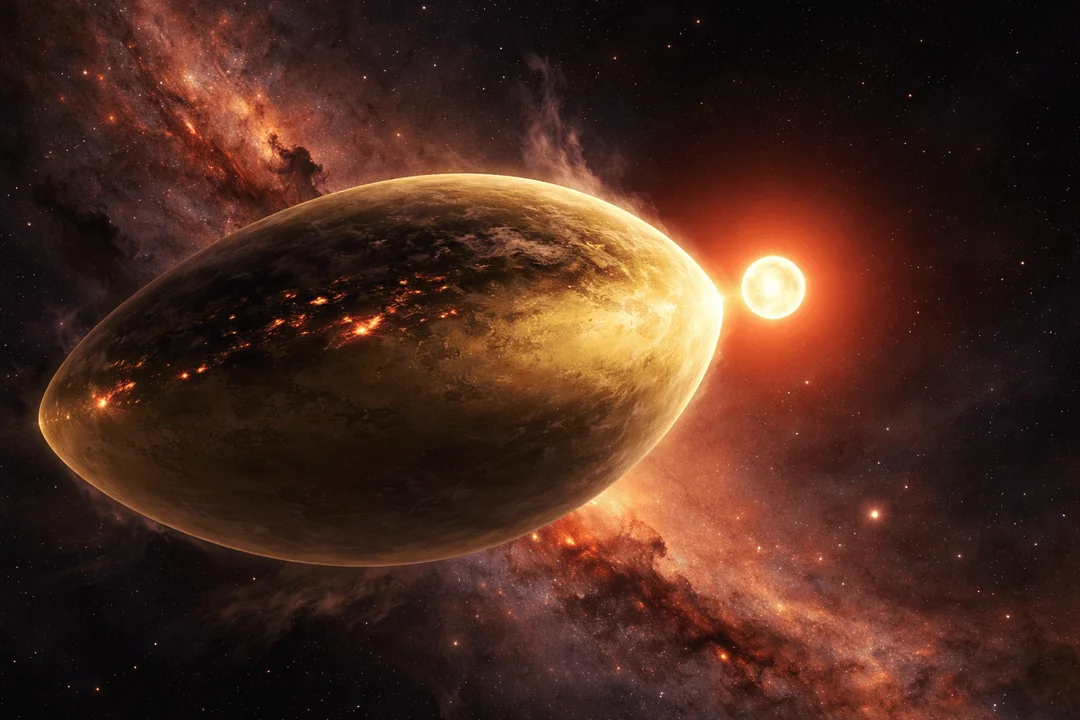
In a revelation that is reshaping fundamental concepts of stellar remnants, NASA announced today the discovery of a bizarre, lemon-shaped celestial object approximately 2,000 light-years away in the constellation Serpens. Designated PSR J1913+1107b, this dense, city-sized object is not a planet, but an ultra-massive, highly deformed neutron star, its shape distorted by the immense, frozen strains within its own crystalline crust and a ferociously powerful magnetic field. The finding, made by a team using data from the Neutron star Interior Composition Explorer (NICER) telescope aboard the International Space Station, challenges long-held assumptions about the symmetry and stability of these cosmic corpses. “We are looking at a stellar fossil frozen in a moment of extreme trauma,” stated Dr. Slavko Bogdanov of Columbia University, principal investigator for the NICER mission. “Its shape tells a story of a violent birth and a subsequent life caged by forces so strong they bend the fabric of matter itself. This isn’t a gentle sphere; it’s a cosmic clenched fist, permanently tensed.”
The discovery was not the result of direct imaging, as neutron stars are too small and distant to be resolved by conventional telescopes. Instead, NICER, an X-ray telescope designed precisely to study the exotic physics of neutron stars, detected subtle but unmistakable variations in the X-ray pulse profile emanating from the object. By meticulously analyzing the timing and energy of these X-rays over a 24-month observation period, scientists constructed a detailed model of its surface temperature distribution and geometry. The data revealed two distinct “hot spots” of X-ray emission at vastly different temperatures and latitudes, a configuration impossible on a perfect sphere. The most compelling fit to the data was a three-dimensional model resembling a prolate spheroid—an elongated sphere, akin to a lemon or an American football. Dr. Renee Loewenstein, an astrophysicist at NASA’s Goddard Space Flight Center, explained the significance: “The X-ray patterns were the key. On a perfectly spherical neutron star with a typical magnetic field, hot spots are relatively symmetrical. Here, the data forced us to consider extreme oblateness. One polar region is significantly hotter and brighter, while the opposing ‘pole’ is cooler and offset, consistent with a magnetic axis that is not only tilted but warped by the object’s distorted shape.”
Neutron stars are the collapsed, ultra-dense cores of massive stars that have exploded as supernovae. Typically packing more than the Sun’s mass into a sphere only about 12 miles across, they are laboratories of extreme physics, with densities where a sugar-cube-sized amount of material would weigh a billion tons on Earth. Most are thought to be nearly perfect spheres due to the overpowering force of gravity. The lemon shape of PSR J1913+1107b, therefore, presents a profound puzzle. Theorists posit that its form is a relic of its cataclysmic birth. The prevailing hypothesis is that the parent supernova explosion was profoundly asymmetric, imparting a tremendous “kick” and spin that left the newborn neutron star rotating rapidly and deformed. As it aged over hundreds of thousands of years, its rotation slowed, but the incredible internal pressure—with a crust potentially 10 billion times stronger than steel—”froze” the deformation in place, preventing gravity from smoothing it into a sphere.
Furthermore, the star’s internal magnetic field, trillions of times stronger than Earth’s, is suspected to be entangled and confined in a way that reinforces the oblong shape. “Imagine a rubber band wrapped tightly around the middle of a soft ball,” analogized Dr. Kenneth Ng, a theorist at the California Institute of Technology. “The internal magnetic stresses act like that constricting band, fighting against gravity’s desire to make everything round. In this case, the magnetic ‘rubber band’ won, locking in the deformation for eons.” This “magnetic confinement” model is now undergoing intense scrutiny, as it suggests a new class of neutron stars that have transitioned from active pulsars into rigid, magnetically-shaped fossils.
The implications of this discovery are far-reaching. First, it provides direct observational evidence for asymmetrical supernova mechanisms, a key factor in understanding how neutron stars receive their high velocities, often being hurled across the galaxy like cosmic cannonballs. Second, it offers a unique window into the quantum chromodynamic behavior of matter at supranuclear densities. The stiffness and shear strength of the neutron star’s crystalline crust—a lattice of atomic nuclei swimming in a sea of free neutrons—are being tested in a way no Earth-based experiment ever could. “This object is a natural crucible,” said Dr. Maria Perez, a nuclear matter specialist at MIT. “Its shape is a direct readout of the stress-strain relationship of matter under conditions we can only dream of replicating. It tells us how rigid, how ‘solid,’ neutron star crusts can truly be.”
Third, and perhaps most consequentially for gravitational wave astronomy, PSR J1913+1107b may be a potent source of continuous gravitational waves. While merging black holes and neutron stars produce transient “chirps,” a permanently deformed, rotating neutron star should emit a steady, faint hum of gravitational radiation. The Laser Interferometer Gravitational-Wave Observatory (LIGO) and future space-based detectors like LISA could, in theory, tune into this specific frequency. Its lemon shape makes it a far more efficient emitter than a symmetrical sphere. Dr. Carl Henderson of the LIGO collaboration remarked, *”If this deformation is as significant as NICER data suggests, PSR J1913+1107b could be a prime target for the next generation of gravitational wave observatories. Detecting its hum would not only confirm the model but open a new channel for probing neutron star interiors directly.”*
The discovery, published today in the journal Nature Astronomy, marks a new chapter in compact object astrophysics. It underscores the value of missions like NICER, which specialize in detailed, long-term observation of X-ray timing. Looking ahead, NASA has already approved extended observation time for the lemon-shaped world, and the upcoming Imaging X-ray Polarimetry Explorer (IXPE) mission may be tasked with measuring its X-ray polarization, which could map the magnetic field geometry in unprecedented detail. As Dr. Bogdanov concluded, *”For decades, we treated neutron stars as points of perfect symmetry in our equations. PSR J1913+1107b is a vibrant reminder that the universe delights in complexity and deformity. It forces us to write new equations. This lemon in the sky isn’t just a curiosity; it’s a new fundamental standard for how matter behaves under the most extreme punishment the cosmos can dish out.”* On this day, December 23, 2025, our map of the stellar graveyard gained a strange, twisted, and utterly fascinating new landmark.