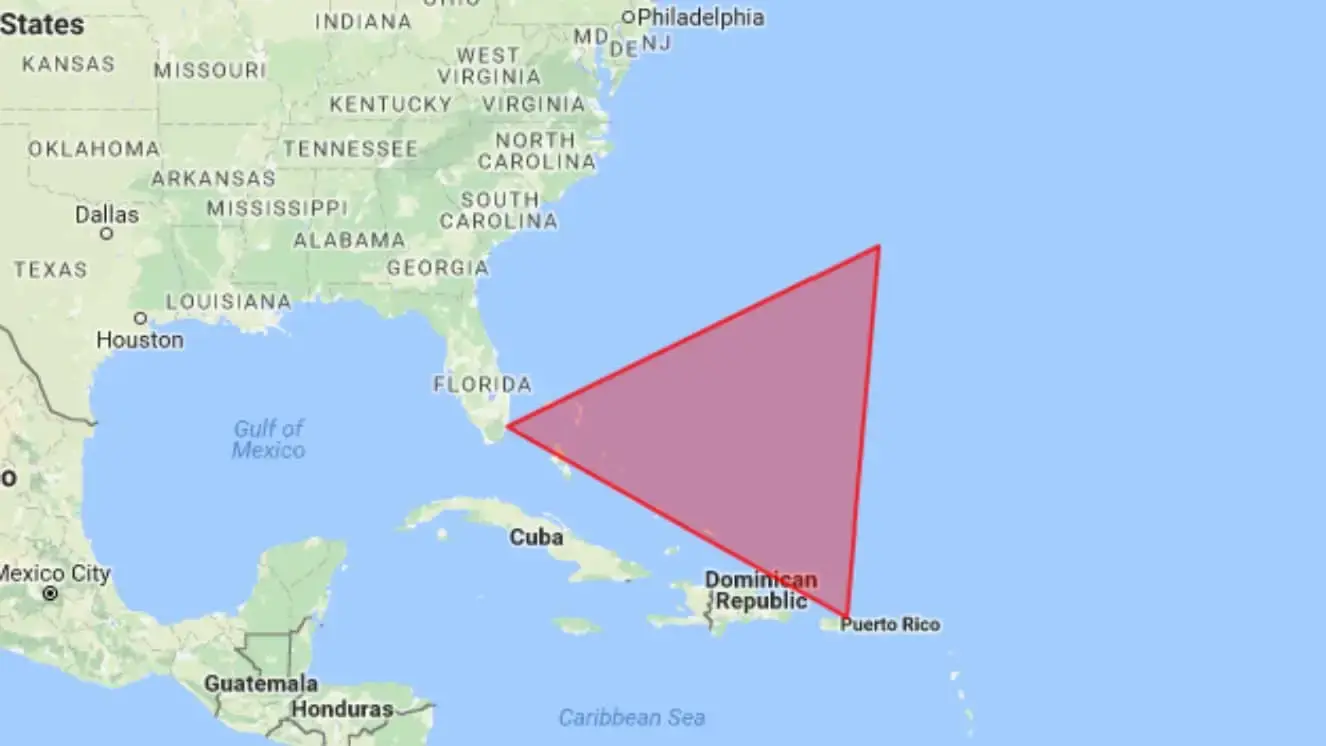
For decades, the very name of the Bermuda Triangle has conjured images of otherworldly abductions, lost cities, and portals to another dimension. The mysterious disappearances of ships and planes in the sprawling 500,000-square-mile swath of the Atlantic Ocean, roughly bounded by Miami, Bermuda, and Puerto Rico , have fueled a multi-billion dollar mythology of aliens and the ghostly powers of Atlantis. However, a comprehensive review of recent scientific data and historical analysis presents a radically different story—one that is far more grounded in geology and physics, yet perhaps more fascinating for its plausibility. The new consensus? The “terror” of the Triangle was likely a natural, temporary phenomenon, and it may now be gone.
For centuries, the region has been a canvas for the paranormal. Christopher Columbus himself fueled the fire in 1492, reporting strange lights on the horizon and erratic compass readings . This legacy of mystery peaked in the 20th century with incidents like the vanishing of five US Navy bombers—Flight 19—on December 5, 1945, an event that cemented the Triangle’s reputation for the inexplicable . But scientists now argue that the true culprit was not little green men, but rather invisible forces lurking beneath the waves. The leading theory points to massive, sudden eruptions of methane gas from the ocean floor.
According to researcher Ronald Knapper of What If Science, the key to the mystery lies in geology, not ufology. “Not aliens or portals—but rare combinations of environmental forces,” Knapper explains. “Methane gas releases from the ocean floor, for example, have been proposed as a hazard capable of disrupting buoyancy and engines” . The science behind this is dramatic: when vast reserves of frozen methane hydrate under the seabed become unstable, they can erupt, turning the water into a churning, gas-infused froth. This suddenly reduces the density of the water, meaning a ship caught in the bubble loses its buoyancy and can sink within moments—often with no time to send a distress signal .
The danger may not have been limited to surface vessels. Aircraft flying low over the ocean, like the ill-fated training planes of Flight 19, could have encountered a plume of flammable methane gas rising into the atmosphere. In such an event, engines could stall, or worse, ignite. This theory, once speculative, has gained significant traction as the most plausible natural explanation for how so many vessels could vanish “without a trace” .
Perhaps the most startling revelation from the latest research is that this period of danger may have been temporary. Scientists propose that the Bermuda Triangle may have once sat atop a highly active “methane field” that has since gone dormant. “If an active field once existed beneath the Triangle and later quieted,” Knapper suggests, “it could explain a rise and fall in incidents” . This would explain why the frequency of mysterious disappearances plummeted dramatically after the 1970s, coinciding with a possible natural depletion of the gas reserves or a shift in the geological fault lines .
Adding to the argument for dormancy is the advancement of modern technology. The era when the Triangle’s legend flourished was, as Knapper points out, “an era without instant verification” . With the advent of satellite tracking, GPS navigation, and instant communication in the 1980s, the “mystery has less room to breathe.” Incidents that might have been blamed on supernatural forces are now quickly identified as mechanical failures, sudden storms, or navigational errors. “Skeptics argue this proves the mystery never existed,” Knapper notes. “Better reporting, they say, exposed exaggerations and coincidences” .
Despite the compelling nature of the methane theory, the scientific community remains divided on whether the mystery was ever truly “active.” A robust counter-argument, championed by Australian scientist Karl Kruszelnicki and official bodies like the National Oceanic and Atmospheric Administration (NOAA) , posits that the Triangle was never statistically dangerous at all. They argue that the number of disappearances is not disproportionate to any other heavily trafficked patch of ocean, given the region’s volatile weather patterns, the existence of the fast-moving Gulf Stream, and the simple reality of human error .
NOAA’s official stance is unequivocal: “The U.S. Navy and U.S. Coast Guard contend that there are no supernatural explanations for disasters at sea. Their experience suggests that the combined forces of nature and human fallibility outdo even the most incredulous science fiction” . Insurance giant Lloyds of London agrees, stating that it does not charge higher premiums for vessels traversing the Bermuda Triangle, as it poses no unique calculable risk .
So, why does the myth persist? Author and skeptic Nigel Watson suggests the answer lies in human psychology. “We have to consider a cluster of possibilities,” Watson says. “We must take into consideration that many of the events in the Bermuda Triangle have been over-hyped and manipulated to make them sound more mysterious” . The allure of aliens and Atlantis provides a more exciting narrative than a ship running aground on a poorly charted sandbar or capsizing in a sudden, violent squall.
In the end, the story emerging in 2026 is one of a mystery dissolving in the light of science. Whether the danger was a natural force that has since “gone to sleep” or a statistical anomaly amplified by a pre-digital media frenzy, the conclusion is the same: the age of blaming the Bermuda Triangle on extraterrestrials or lost civilizations is over. The real forces at play—methane, weather, and human fallibility—are far more complex and, in their own way, just as awe-inspiring as the legends they replace. The “terror” of the Triangle has been demystified, not by finding monsters, but by understanding the planet we live on.