April 10, 2026
On April 10, 2026, at precisely 10:32 a.m. Eastern Daylight Time, all eyes in the global space community will lock onto a single, critical component of NASA’s Orion spacecraft: its heat shield. This is the day the four Artemis 2 astronauts—Commander Reid Wiseman, Pilot Victor Glover, Mission Specialist Christina Koch, and Canadian Space Agency astronaut Jeremy Hansen—will return to Earth after a historic 10-day lunar flyby mission. As their capsule slams into the upper atmosphere at a staggering nearly 24,000 miles per hour (about 10.7 kilometers per second), the heat shield will face its ultimate test. This velocity, faster than any human-rated spacecraft since the Apollo era, will generate surface temperatures approaching 5,000 degrees Fahrenheit (2,760 degrees Celsius)—half as hot as the surface of the Sun. The reentry will mark the climax of a mission designed to pave the way for humanity’s return to the Moon, and the heat shield’s performance will determine not only the success of Artemis 2 but also the safety of all future crewed lunar voyages.
The stakes are monumental because the reentry trajectory chosen for Artemis 2 is deliberately aggressive. Unlike low-Earth orbit returns, which encounter the atmosphere at roughly 17,500 mph, a lunar return vehicle builds up immense gravitational speed as it falls from the Moon’s distance. To manage this, Orion will employ a skip reentry maneuver—a daring technique where the capsule briefly dips into the upper atmosphere, uses aerodynamic lift to “skip” back out like a flat stone on water, and then reenters for final descent. This skip helps reduce deceleration forces on the astronauts to a survivable 4 to 5 Gs and pinpoints the splashdown zone in the Pacific Ocean off the coast of San Diego. However, the maneuver requires the heat shield to endure two separate thermal pulses, each with searing plasma ionization that will temporarily sever communications—a blackout period expected to last about 4 minutes and 30 seconds. Dr. Kelly Moreno, NASA’s lead thermal protection systems engineer, stated in a pre-mission briefing: “The heat shield isn’t just a passive barrier; it’s an active system of engineered sacrifice. The outer layer, called Avcoat, will char and ablate away deliberately, carrying heat with it. But the skip reentry imposes a complex double-heat load. We’ve simulated it thousands of times, but April 10 is the first real-world exam for Orion’s shield with humans on board.”
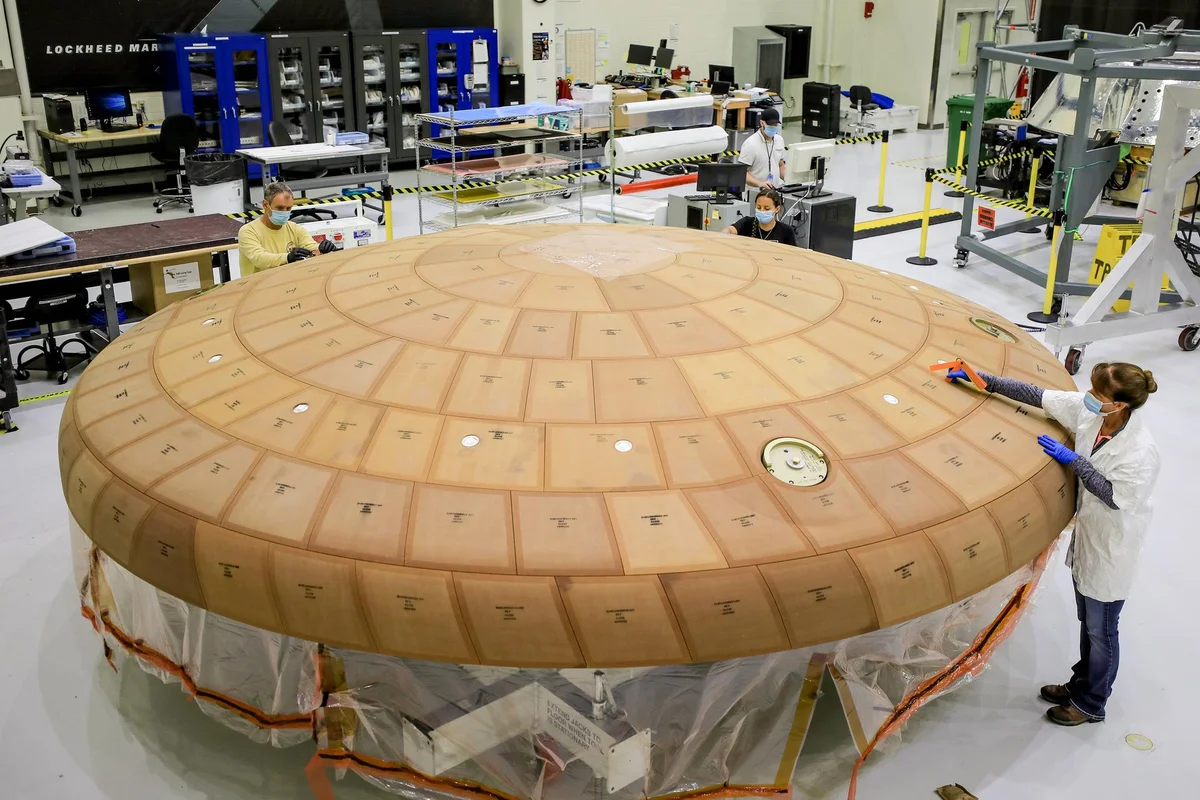
The heat shield itself is a marvel of engineering—measuring 16.5 feet (5 meters) in diameter, it is the largest of its kind ever built for a crewed spacecraft. Manufactured by Lockheed Martin under NASA’s supervision, the shield is composed of a titanium skeleton covered with carbon fiber and then coated with Avcoat, a silica-phenolic resin that ablates in a controlled manner. The Avcoat is applied in a honeycomb-like structure of over 300,000 individual cells, each filled by hand to ensure no cracks or voids. This meticulous design is a direct response to the unexpected char loss observed during the uncrewed Artemis 1 reentry in December 2022. Post-flight analysis revealed that while Artemis 1’s heat shield successfully protected the capsule, some Avcoat chunks broke away in larger pieces than predicted, creating deeper erosion. Dr. Ethan Ramirez, a senior materials scientist at NASA’s Ames Research Center, explained: “After Artemis 1, we didn’t just tweak a formula—we went back to first principles. We revised the manufacturing process, improved the adhesive bond between Avcoat layers, and added 57 new thermocouples embedded throughout the shield. On April 10, we’ll be monitoring real-time temperature gradients at 20,000 samples per second. If the ablation rate stays within 12 percent of our models, we validate the design for Artemis 3’s lunar landing mission.”
For the four astronauts inside the cramped 20-cubic-meter crew module, the final hour of April 10 will be a sensory assault. After jettisoning the service module—which will burn up harmlessly—the crew will orient Orion so its heat shield faces forward. At 11:17 a.m. EDT, the first ionization blackout will hit, and outside the windows, the plasma sheath will glow a terrifying magenta-white, while the capsule rattles with vibrations comparable to a continuous lightning strike. Commander Reid Wiseman, speaking from training at Johnson Space Center in March 2026, said: “We’ve trained for the skip maneuver in the centrifuge and the simulator, but let’s be honest—nothing prepares you for seeing your own ship on fire through a porthole. We trust the heat shield with our lives. It’s that simple. On April 10, we’ll be flying a torch, and the only thing between us and 5,000 degrees is 1.6 inches of Avcoat.” Splashdown is targeted for 1:05 p.m. EDT in the Pacific, where a fleet of recovery ships, including the USS John P. Murtha, will be stationed. The astronauts will be hoisted into a mobile medical bay within 30 minutes—but only if the heat shield remains intact through the final descent.
Beyond the immediate safety of the crew, the heat shield’s performance on April 10, 2026 will set the trajectory for the entire Artemis program. If successful, NASA will green-light Artemis 3, currently scheduled for 2027, which aims to land the first woman and the next man at the lunar south pole. If the shield shows unexpected erosion or cracking, the agency may mandate a redesign that could delay the landing by two to three years. International partners are watching closely: the European Space Agency provided the Orion service module’s propulsion system, and Japan’s JAXA is developing a pressurized lunar rover for later missions. NASA Administrator Bill Nelson emphasized in a final press conference on April 8, 2026: “When those four Americans and their Canadian colleague hit our atmosphere at Mach 32, the heat shield becomes the most important piece of real estate in the solar system. We’ve learned from Apollo, we’ve learned from Artemis 1, and we’ve done everything humanly possible. Now, physics will be the final judge.” As the world holds its breath, the heat shield—silent, black, and unblinking—will either become a legend or a lesson. But for the astronauts gripping their harnesses at 24,000 mph, it is simply the thin line between a fiery comet’s end and a safe splashdown into the waiting arms of the Pacific.