April 17, 2026
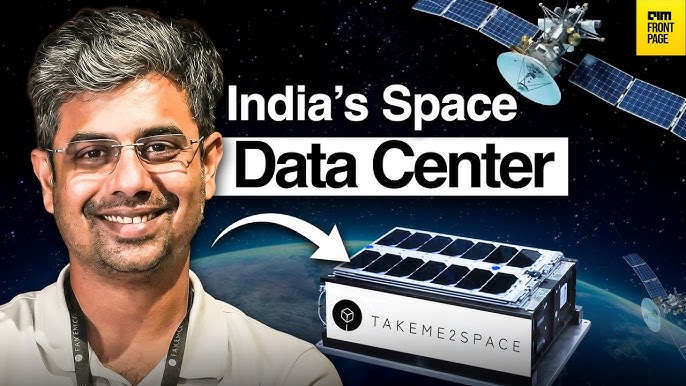
The Indian space-tech startup TakeMe2Space has officially announced its ambitious roadmap to establish a 50-kilowatt orbital data center, a move that signals a significant shift in how humanity might process and store information beyond the confines of Earth. Following a $5 million seed round announced in January, the company is now seeking to raise an additional $55 million to fund this next-generation infrastructure. The vision, articulated by founder Ronak Kumar Samantray, is not merely to place servers in space but to create the foundational building blocks for a future “gigawatt orbital data center.” Speaking at the 2026 Space Symposium in Colorado Springs, Samantray outlined a clear rationale for this cosmic leap, emphasizing that the company is positioning itself to “play the orbital data center game globally.” This initiative comes at a time when terrestrial data centers face increasing scrutiny over land use, energy consumption, and, notably, physical vulnerability. The startup’s journey from concept to near-reality has been swift; having been founded in late 2024, TakeMe2Space has already demonstrated its core technology. In December 2024, the company launched its first satellite, the My Orbital Infrastructure-Tech Demonstration (MOI-TD) , aboard India’s Polar Satellite Launch Vehicle (PSLV). This 1-unit cubesat successfully validated the startup’s onboard computer, edge processor, and attitude control systems while still attached to the rocket’s fourth stage. “Three customers uploaded their AI model, did inferencing and got the results,” Samantray stated, confirming the viability of their in-orbit processing capabilities .
The technical roadmap for TakeMe2Space is structured in distinct phases, with the next critical milestone scheduled for October 2026. On that date, the company will launch a 6-unit cubesat aboard a SpaceX Falcon 9 rideshare mission. This satellite will be equipped with an Nvidia Jetson module, a powerful edge AI platform that will allow customers to upload and run artificial intelligence models directly on the hardware. Currently, potential clients are testing these AI models on a physical twin of the satellite on Earth, preparing for a seamless transition to orbital operations . Looking further ahead to 2027, the company plans to deploy a constellation of four satellites, each with a mass of roughly 100 kilograms. These satellites will be interconnected via optical inter-satellite links (laser communication), creating a mesh network in Low Earth Orbit (LEO) capable of sharing data without ground relays. The financial target for this phase is ambitious: $15 million in annual recurring revenue derived from 5 kilowatts of compute power in orbit. This constellation is designed to serve as the commercial proof-of-concept for the much larger 50-kilowatt data center that the new funding round aims to build .
Regarding the specific market applications for space-based computing, Samantray identifies agriculture and insurance firms as the earliest adopters. These industries require rapid “inference” – the process of running live data through trained AI models to generate immediate conclusions. For example, analyzing crop health or assessing disaster damage requires ingesting massive amounts of Earth-observation data. Currently, that data must be downloaded to ground stations, a process hampered by latency and bandwidth constraints. By moving the computation to the satellite, results can be generated in minutes rather than hours. However, one of the most striking drivers for this technology is geopolitical instability. “Of late, there also has been demand for storage in orbit,” Samantray noted. “People want to store mission-critical data on satellites as a backup because data centers, unfortunately, have become military targets.” This realization has led TakeMe2Space to design its satellites to include 100 terabytes of onboard storage capacity, offering a physically isolated backup solution that is immune to terrestrial conflicts, power grid failures, or internet shutdowns . The company maintains a fiercely independent supply chain to keep costs low and iteration fast. “Anything that flies in a satellite, except for solar cells and propulsion, is designed and built by us,” Samantray explained. “That ensures that our cost of manufacturing the satellite is extremely low” .
While the vision is grand, the economic realities of space infrastructure remain challenging. Samantray himself acknowledges that the current launch costs are a limiting factor, projecting that it will not be until 2029 or 2030 that decreasing prices – likely driven by fully reusable rockets like SpaceX’s Starship – will make large-scale orbital data centers truly economical . In the meantime, the strategy is to prove the technology and build demand. The company is betting that “50- to 100-kilowatt compute scale” is the sweet spot where liquidity and market interest currently converge, serving as the logical stepping stone to gigawatt scales. As the date progresses toward the October 2026 launch, the space industry will be watching closely to see if TakeMe2Space can successfully transition from a promising startup with a $5 million seed round to a global infrastructure player with a 50-kilowatt orbital data center, fundamentally rewriting the rules of cloud computing and data sovereignty from 250 miles above the Earth .