
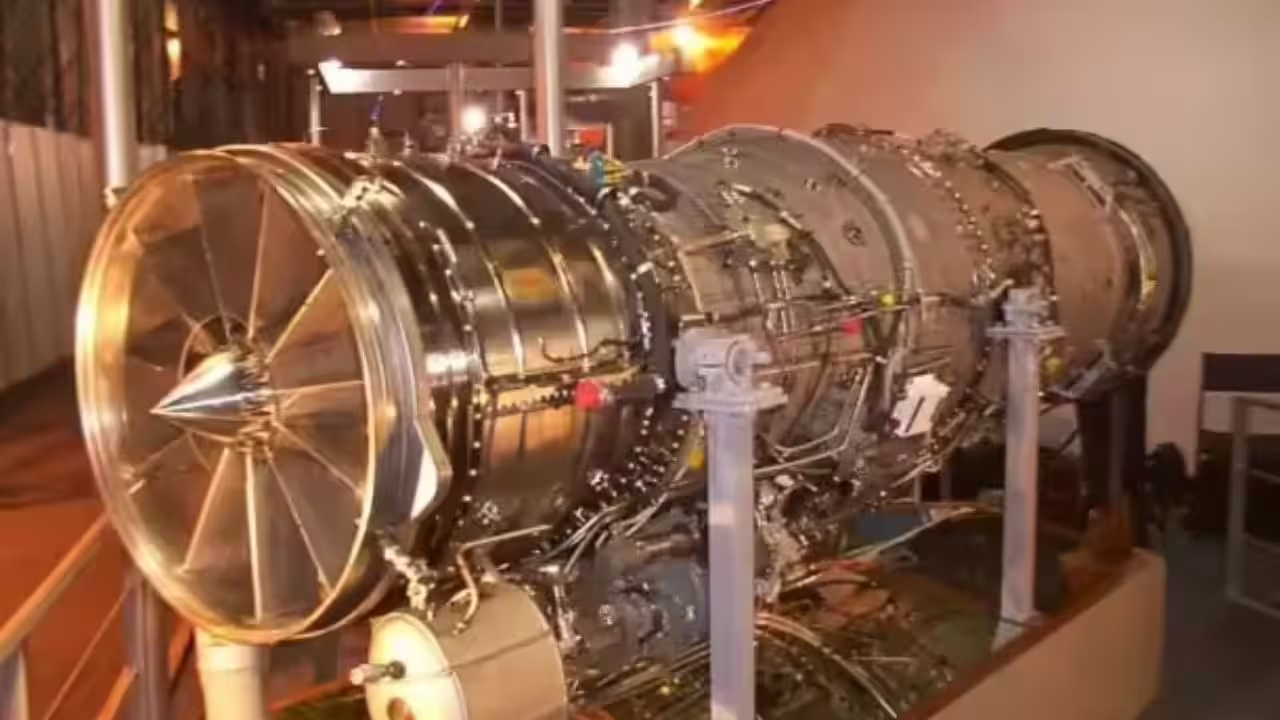
The ongoing delivery crisis surrounding the General Electric (GE) F404 engines for India’s indigenous Tejas Mk1A fighter jets has prompted a significant strategic response from the Defence Research and Development Organisation (DRDO), which is aggressively reviving its indigenous jet engine programme with the new Kaveri 2.0. The supply of these critical powerplants from the US has become a major bottleneck, casting a long shadow over the Indian Air Force’s (IAF) modernization plans and its urgent need to replenish its depleting fighter squadron strength. The situation has been so dire that it has triggered financial penalties and a fundamental re-evaluation of India’s reliance on foreign suppliers for strategic defence components.
The genesis of the current impasse lies in the repeated failures of GE Aerospace to meet its delivery commitments. Under a contract signed in 2021, HAL was to receive a steady stream of GE F404-IN20 engines to power the Tejas Mk1A, a crucial 4.5-generation light combat aircraft . However, deliveries have been painfully slow, with GE having provided only seven engines by July 2026 against a total order of 99, a shortfall that has directly resulted in a production delay of over two years for the Tejas programme . The geopolitical tensions, particularly the ongoing West Asia conflict involving the US, Israel, and Iran, have been cited by GE as a contributing factor to the supply chain disruptions and delayed shipments .
The production delays have severely impacted HAL, which had completed the airframes for several aircraft but was left waiting for engines to integrate them, leading to no Tejas Mk1A being delivered to the IAF despite the original schedule . The situation reached a point where, in a rare and significant move, Hindustan Aeronautics Limited (HAL) began imposing liquidated damages on GE Aerospace, invoking the penalty clause in their contract to compensate for the delays on a per-engine basis .
Adding to the frustration, technical issues also surfaced. While the engines that did arrive were meant to accelerate production, one of the six engines delivered earlier was found to have “some issues” during standard inspection and testing by HAL engineers . This snag, though described as minor and rectified with the help of GE experts, further underscored the fragility and risk associated with sole dependence on a foreign supplier for such a vital and complex system . The shortfall has put immense pressure on HAL, with the defence ministry reviewing the production status and expressing its intent to penalize HAL for the consequential delivery delays, despite HAL’s clarifications that it is ready to deliver aircraft as soon as the engines are integrated . This crisis has had a cascading effect on the IAF, which is already grappling with a fighter squadron strength that has dwindled to approximately 30, far below the sanctioned requirement of 42 squadrons needed to effectively manage a two-front war .
In a decisive response to this crisis, the DRDO has strategically restarted and re-engineered the long-dormant Kaveri engine project, unveiling a more powerful and capable version known as Kaveri 2.0 . The original Kaveri programme, conceived decades ago, had been shelved after it consistently failed to meet the thrust and weight requirements for the Tejas, generating an insufficient 49-52 kN of dry thrust and weighing more than planned . However, Kaveri 2.0 represents a major redesign, incorporating significant technological upgrades. The primary target for the new engine is to produce 55-60 kN of dry thrust and a robust 90-100 kN of thrust with an afterburner, bringing it much closer to the power requirements of the Tejas Mk1A .
This new engine is not merely an iteration but features a completely redesigned core with an advanced high-pressure compressor to improve efficiency. It also utilizes advanced lightweight materials like titanium-alloy blisks—which combine the blade and disc into a single component—to reduce weight, and single-crystal turbine blades that can withstand extremely high operational temperatures, thereby improving the engine’s overall thrust-to-weight ratio and reliability .
The revitalisation of the Kaveri programme carries immense strategic implications for India. If successfully developed and certified, Kaveri 2.0 could serve as a powerful indigenous substitute for the foreign engines, potentially replacing them when the Tejas Mk1A fleet approaches its mid-life engine replacement cycle towards the end of the decade . Its development is being fast-tracked as the engine is reported to be about 70% complete, with preparations underway for critical afterburner tests, and if the current timeline is met, it could power Tejas fighters by 2030 . Beyond the Tejas, the engine has a wider role in India’s future aerospace ambitions.
A dry, non-afterburning version of the Kaveri is already being utilized to power the DRDO’s Ghatak stealth combat unmanned aerial vehicle (UCAV) programme, providing critical real-world experience . Furthermore, the success of Kaveri 2.0 is considered vital for reducing India’s long-term dependence on foreign suppliers, strengthening its strategic autonomy, and potentially powering future platforms like the Advanced Medium Combat Aircraft (AMCA) . While Kaveri 2.0 still needs to undergo rigorous testing to meet the stringent safety and reliability standards required for a frontline fighter, the project provides a compelling domestic alternative and signifies India’s determination to achieve true self-reliance in critical defence technology .