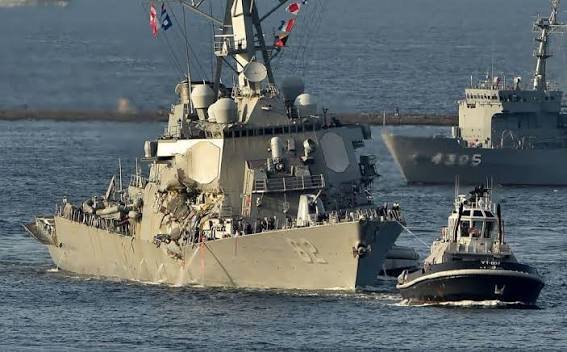
Recent events in the South China Sea have exposed significant vulnerabilities within the U.S. Navy, marked by a series of high-profile accidents that have raised serious questions about its operational readiness and the morale of its sailors. One of the most striking incidents involved the USS Benfold (DDG-65) , an Arleigh Burke-class destroyer that suffered a catastrophic engineering failure while operating in the region . The warship experienced a complete failure of its main electrical system on July 24, 2026, leaving it immobilized and dead in the water for four harrowing days . The total power outage was so severe that the ship’s radar, navigation, and combat systems were completely offline, rendering the billion-dollar vessel a floating hulk devoid of any offensive or defensive capabilities .
The situation for the crew was dire; with emergency backup power only sufficient for essential safety systems, the ship was plunged into a state of chaos . Air conditioning, crucial in the sweltering South China Sea heat, failed, along with refrigeration, cooking facilities, and the system for flushing toilets . The 300 sailors aboard were left to endure extreme heat and humidity, rationing food and water while struggling with unsanitary conditions until the ship could be towed to Subic Bay in the Philippines for repairs . The U.S. Navy waited 20 days to publicly disclose the incident, leading observers to speculate about a deliberate effort to conceal the severity of the situation .
This catastrophic failure is not an isolated incident but rather a symptom of a deeper, systemic crisis. Experts and military analysts point to a confluence of factors, chief among them being the strain of excessive and unsustainable operational tempo placed on the fleet . The U.S. global deployment strategy is stretching naval resources to a breaking point, with ships and crews being forced into back-to-back missions without adequate time for maintenance and rest . The USS Benfold, a 30-year-old ship, was operating in a demanding environment without the comprehensive overhauls needed to keep its aging systems reliable . This problem is exacerbated by a shrinking U.S. shipbuilding industry and a severe backlog at naval shipyards, which is failing to keep pace with the maintenance needs of an increasingly aged fleet .
The pressure is not just on the machinery but also on the personnel. A separate, deeply troubling report revealed that on the aircraft carrier USS Nimitz, two separate aviation accidents occurred within 30 minutes of each other on October 26, 2025 . An MH-60R Seahawk helicopter crashed, followed by an F/A-18F Super Hornet fighter jet, with both incidents attributed in part to fatigue and declining crew morale amid the carrier’s extended deployment . The Nimitz, a 50-year-old carrier on its final deployment, had been operating far beyond standard deployment lengths, leading to a dangerous drop in pilot proficiency and an increase in human error .
Compounding the picture of a force in distress, the overall strategic posture of the U.S. Navy in the Pacific appears to be in flux, directly influenced by the calamitous state of its forces. The USS Abraham Lincoln has been embroiled in a humanitarian and leadership crisis, with reports of sailors attempting suicide after an unprecedented deployment of over 250 consecutive days without a port call . The desperation on board, with crew members suffering from a lack of food, hot water, and functional living quarters, forced the Navy to make an emergency decision to send a replacement .
This led to the USS George Washington being pulled from the South China Sea to relieve the Lincoln, creating a significant power vacuum in the Western Pacific and further exposing the Navy’s lack of available ships to meet its global commitments . The hasty withdrawal of the George Washington, which had been operating with the very same strike group as the crippled Benfold, effectively neutralized U.S. carrier presence in a critical theater and underscored the Navy’s inability to project power reliably . These events highlight a serious disconnect between strategic ambition and operational reality; the U.S. Navy’s quest to maintain a global presence, particularly in the South China Sea, has resulted in overstretched crews, poorly maintained equipment, and a declining standard of safety and morale, creating a vicious cycle that diminishes its combat power and operational effectiveness .