
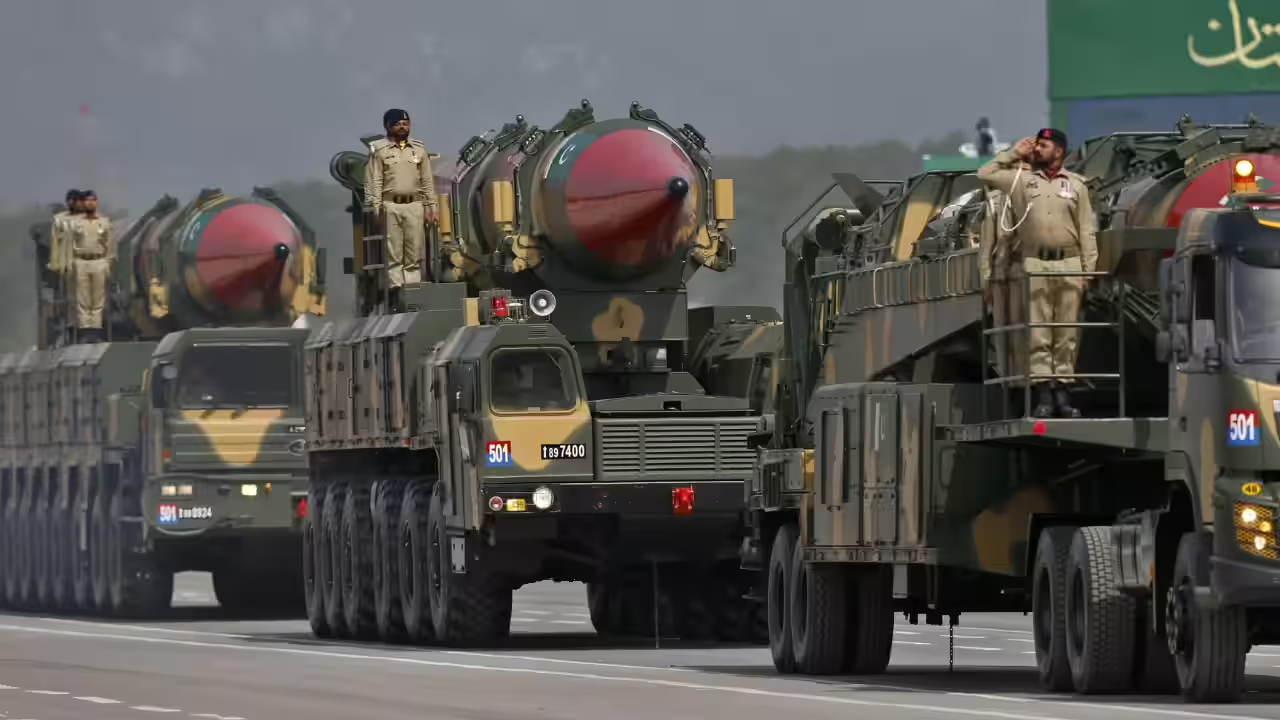
Pakistan has restricted a significant 750-kilometer stretch of its airspace, a development that has led regional defense analysts to widely speculate that the nation is preparing for the imminent test-launch of its advanced Fatah-3 supersonic cruise missile . The airspace restriction, a standard safety protocol for high-profile military tests, covers key areas including Punjab, Sindh, coastal Balochistan, and extends over the Arabian Sea . This precautionary measure aligns with open-source intelligence (OSINT) that has identified a maritime danger zone near the Somiani test range, a known Pakistani military facility frequently used for missile evaluations . The closure of such a vast expanse of airspace is a strong indicator of a significant launch, pointing towards a system with a considerable range and flight profile .
The suspected test subject, the Fatah-3, is a formidable addition to Pakistan’s strategic arsenal and was first publicly showcased in May 2026 . It represents Pakistan’s entry into the exclusive club of nations possessing supersonic cruise missiles, directly challenging India’s long-held monopoly in this domain, which has been spearheaded by the Indo-Russian BrahMos missile . By developing the Fatah-3, Pakistan aims to address the strategic imbalance in conventional precision-strike capabilities, signaling a significant shift in the regional military dynamic .
The Fatah-3’s technical specifications suggest a weapon designed for high speed, survivability, and multi-role functionality . The missile boasts a top speed of Mach 3-4, making it an extremely difficult target for most conventional air defense systems . While its exact range is debated, reports indicate it can strike targets between 290 and 450 kilometers, capable of carrying a payload of 240-400 kilograms . It is designed to engage both land-based targets with precision and naval vessels through a sea-skimming anti-ship mode, which would require sophisticated terminal guidance such as active radar homing . For ground attack, its accuracy is reported to be within 10 meters, achieving a level of precision that is considered “surgical” .
The missile’s design is heavily influenced by advanced aerospace engineering, with multiple reports pointing to its technological lineage . Its design shares striking similarities with the Chinese HD-1A supersonic cruise missile, featuring a distinctive X-shaped air intake and a solid-fuel ramjet engine . This power plant is what allows it to sustain its incredible speed; a solid-fuel rocket booster initially launches the missile, and once it reaches sufficient velocity, the ramjet engine takes over, compressing incoming air for combustion and providing sustained, high-speed thrust . This engine configuration, also likened to the French ASMP-A air-launched nuclear missile, gives the Fatah-3 a high degree of maneuverability, including real-time course correction, further enhancing its ability to penetrate modern missile defenses .
Beyond its raw speed and power, the Fatah-3 is built for battlefield survivability, a critical factor in modern warfare . It is deployed via a road-mobile, twin-round canister launcher, a feature that allows it to be rapidly moved, fired, and quickly relocated before enemy counter-battery fire can be effectively targeted . This “shoot-and-scoot” capability is crucial for preserving the platform and the crew in a high-intensity conflict scenario, ensuring that the weapon can be used repeatedly without being easily destroyed on the ground . The current airspace closure, while unconfirmed by the Pakistani military’s Inter-Services Public Relations (ISPR) as of the latest reports, strongly suggests that the development of this system is now moving from public display to active and validated combat readiness .