
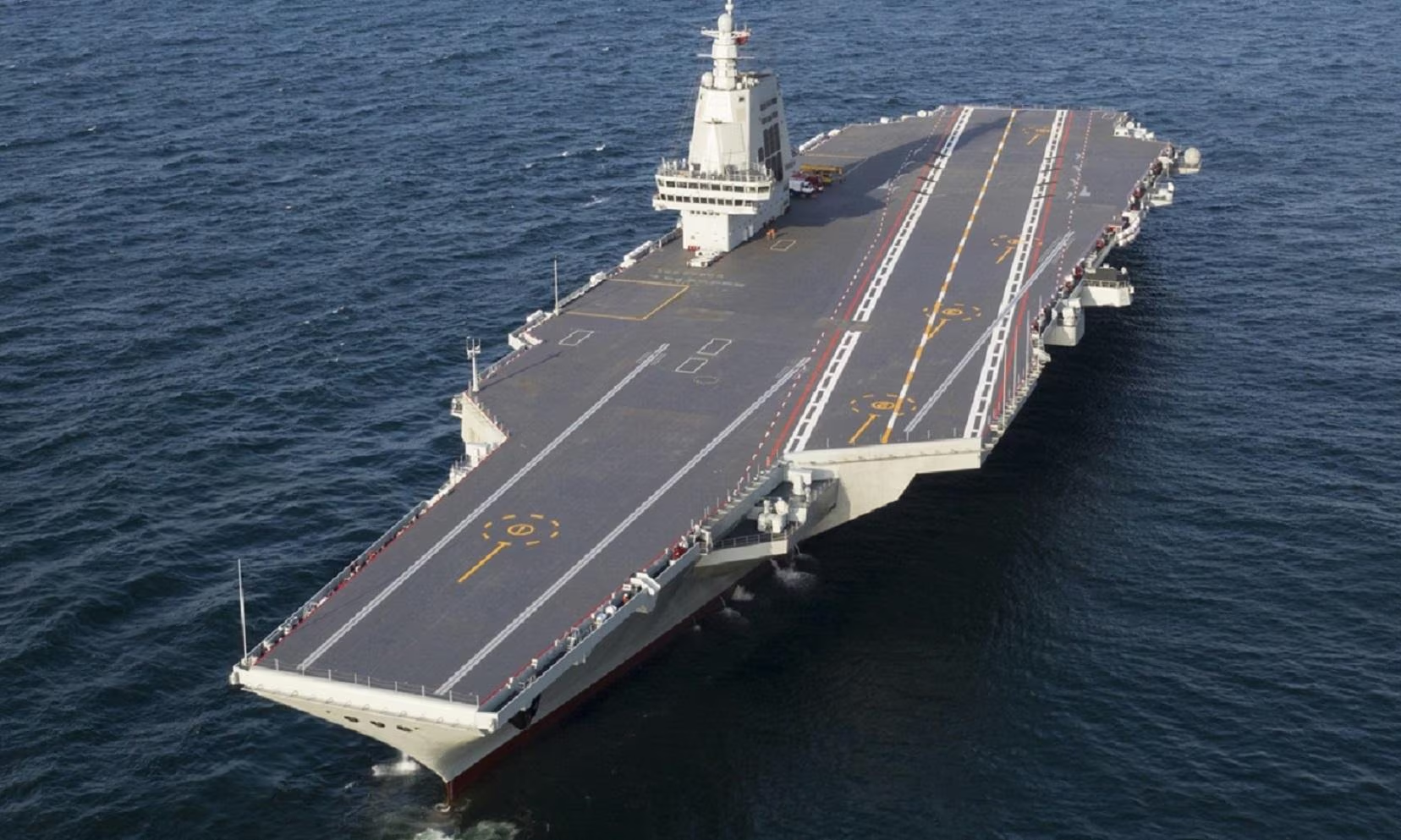
China’s ambitious aircraft carrier programme is entering a critical new phase. With theongoing sea trials of the Fujian, the country’s first domestically designed catapult-equipped carrier, and the expansion of its carrier fleet to three, the strategic focus is shifting from the vessels themselves to thehuman element that gives them teeth. The central question is no longer just about shipbuilding capacity but whether China can train enough elite pilots and crew to operate a growing and increasingly complex carrier fleet. Evidence strongly suggests that while a significant challenge exists due to the extreme difficulty of the task, the Chinese military is implementing a comprehensive andunprecedented nationwide strategy to recruit and train personnel, achieving record-breaking recruitment numbers and systemic overhauls in pilot development to meet its future needs.
The sheer scale of the demand is staggering anddrives this urgent recruitment drive. The Liaoning and Shandong each operate roughly 24 to 30 fighter jets, requiring approximately 120 fixed-wing pilots per vessel to maintain a “one ship, two air wings” rotation principle, meaning these two carriers alone demand a pool of around 240 pilots. The Fujian, an 80,000-ton supercarrier, nearly doubles this capacity with 48 fighter jets, adding another 120 pilot requirement for its air wing. When factoring in helicopter pilots for the carriers and therapidly expanding fleet of amphibious assault ships—including four Type 075 vessels and the forthcoming Type 076—the total pilot demand is estimated to approach 500 or more. To further compound this need, expert analysis suggests that to maintain a continuous presence in the South China Sea, East China Sea, and Indian Ocean under a “one on patrol, one in training, one in maintenance” cycle, the People’s Liberation Army Navy (PLA Navy) may ultimately require six carriers, a long-term goal that makes current pilot recruitment efforts a foundational necessity.
This enormous need is being met by arecord-breaking and strategically diversified recruitment drive. In 2025, the PLA Navy’s pilot recruitment achieved historic highs, with the number of applicants exceeding tens of thousands for the first time. The selection process has been broadened to draw from high school graduates, naval aviation schools, and military and civilian university graduates, creating a larger and more diverse pool of talent. Recognizing that a broad net is needed, the Navy has also loosened medical criteria for the first time, allowing candidates who have undergone vision correction surgery to apply, thereby not wasting talent that might have been previously disqualified due to eyesight. This drive for expansion has also extended to inclusivity, with the first group of female carrier-based pilot trainees recently passing their daytime individual landing assessments—a historic step in the force’s development.
However, numbers alone are insufficient, as theinherent difficulty of developing a carrier-qualified pilot is immense. Carrier-based aviation is often referred to as “dancing on a knife’s edge,” requiring pilots to land a high-speed jet on a runway that is not only short—just 36 meters of effective landing area—but also pitching and rolling on the ocean. The journey from a novice to a fully qualified pilot is grueling, with a high attrition rate of 45% to 50% and a typical training cycle of 5-8 years. To overcome this bottleneck, the PLA Navy has evolved its training paradigm from the initial goal of “being able to fly and land on a carrier” to a more sophisticated new phase: “being able to fight and conduct joint operations“. This represents a fundamental shift away from solely producing individual pilots to developing “crew members, pilots, and commanders” who are system-level thinkers capable of coordinating complex, multi-domain operations.
This new training ethos is being put into practice. Recent carrier group exercises in the Bohai Sea have prominently featured integrated training involving J-15T fighters, J-35 stealth fighters, and KJ-600 airborne early warning aircraft, operating not as individual platforms but as a single, unified combat network. The training is designed to forge five distinct categories of personnel: carrier-based fighter pilots, helicopter pilots, special aircraft pilots, airborne warfare officers, and UAV operators. This focus on “system of systems” capability also responds to the complexity of new technology; the Fujian’s electromagnetic catapult system, unlike the ski-jump ramps on its predecessors, presents entirely new operational challenges for pilots, requiring them to adapt to new launch dynamics and integrate with new aircraft like the stealthy J-35.
To meet these modern requirements, the PLA Navy is also overhauling its pilot development pathways. It is now using a “dual-track” talent cultivation system. An “alteration model” quickly converts experienced pilots from the Air Force or shore-based naval aviation to carrier operations, providing an immediate injection of skilled manpower. More importantly, a “growth model” is training cadets directly from high school, who undergo a systematic course of study at the Naval Aviation University, a process that not only standardizes training but ultimately produces pilots with a longer potential service life. The success of this model is becoming clear, as the PLA Navy reported that for the first time this year, the proportion of candidates meeting the standards for carrier-based fighter pilots reached record levels, signaling a maturing and effective training apparatus.
In conclusion, while the question of whether China has “enough people” is a pressing one, it is clear that the country is confronting the challenge on an enormous scale and with strategic depth. Through a combination of massive recruitment drives, a fundamental redesign of its training curriculum, and the exploitation of new talent pools, China is systematically building the human foundation required for its growing navy. The challenge of producing “the ace of aces” remains one of the most difficult in modern warfare, but by recruiting from a population of over 1.4 billion and implementing a multi-faceted, high-intensity training pipeline, the PLA Navy is making a determined, multi-generational effort to ensure its carrier fleet is crewed by a force capable of both operating the ships and winning the complex battles of the future.