
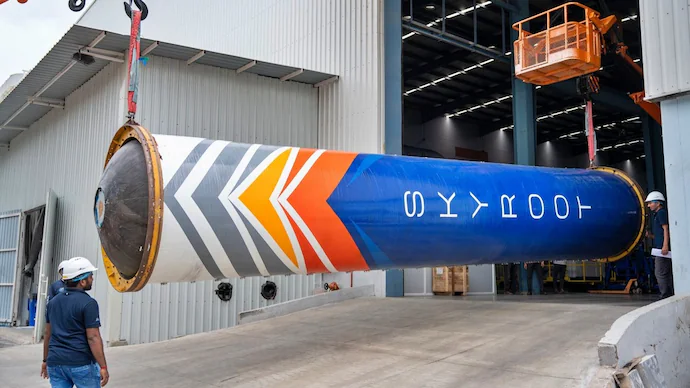
Just over a month after its historic maiden voyage, Indian private space company Skyroot Aerospace is already preparing for the second launch of its Vikram-1 rocket, having dispatched the vehicle’s first stage to the Satish Dhawan Space Centre in Sriharikota . This rapid movement of hardware marks the beginning of launch preparations for the company’s second mission and signals a strong push towards establishing a more frequent and reliable launch cadence .
The first stage’s arrival at the spaceport initiates a process of further integration, comprehensive testing, and final launch preparations, a crucial step as Skyroot aims to transition from a successful debut to a sustained operational launch program . The quick turnaround is particularly significant for a young company, as space firms typically need to demonstrate repeatability and reliability to secure customer confidence and move toward regular commercial operations . This urgency is underscored by Skyroot’s ambitious long-term vision, which includes its Hyderabad manufacturing facilities eventually producing one orbital rocket every month .
The second Vikram-1 mission is being planned following the resounding success of its maiden flight, named “Mission Aagaman,” on July 18, 2026 . On that day, Vikram-1 became the first privately developed Indian orbital rocket to successfully reach orbit from Indian soil, a feat achieved on its very first attempt . The 24-metre, all-carbon-composite rocket successfully injected its payloads, including the SCOPE and Grahaa satellites, into a Low Earth Orbit, making India only the third country in the world with private orbital launch capability . This monumental success was widely hailed as a defining moment for India’s space journey by Prime Minister Narendra Modi and demonstrated the rapid growth of the country’s private space ecosystem following reforms initiated in 2020 . The mission also showcased Skyroot’s advanced engineering, featuring 3D-printed liquid engines and multiple solid-fuel stages, developed by a team with an average age of just 28 years .
With the successful first flight demonstrating the rocket’s capability, the focus now shifts to the upcoming mission, which is expected to be a crucial test of the vehicle’s reliability . Skyroot founder and CEO Pawan Kumar Chandana has indicated that a second successful launch is vital for building customer confidence, and the next mission is expected to be a mix of commercial satellites and technology demonstration payloads . This dual-purpose approach would allow the company to gradually transition Vikram-1 into regular commercial service while continuing to validate its performance.
The company’s current target is to conduct the second launch by the end of 2026, although the final timeline will depend on the outcome of the post-flight analysis from the first mission and any subsequent modifications required . As the first stage of its second rocket now resides at Sriharikota, Skyroot is not only preparing for another journey to orbit but is also taking a definitive step toward proving that its historic “Aagaman” was not an isolated incident, but the beginning of a new, reliable commercial launch service for India .