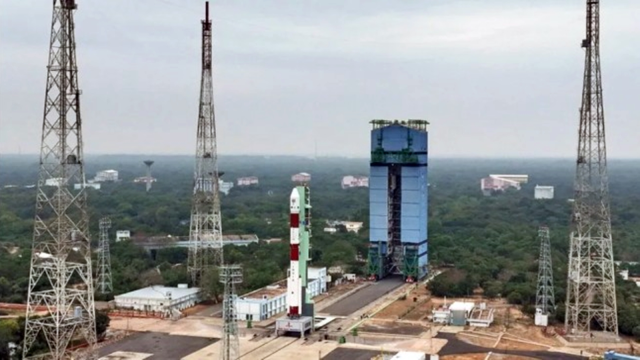
The Indian Space Research Organisation (ISRO) is making final preparations for the much-anticipated launch of its advanced GISAT-1A (EOS-05) Earth observation satellite, marking a significant return to the launchpad after a previous setback. The mission is scheduled to lift off from the Satish Dhawan Space Centre in Sriharikota, with the Geosynchronous Satellite Launch Vehicle GSLV-F17 serving as the designated rocket for this critical deployment. According to multiple space tracking websites and internal ISRO schedules, the launch window is expected to open on September 4, 2026, aligning with the completion of satellite integration and final testing protocols. This mission is not merely a routine deployment; it is a high-stakes comeback for ISRO, aimed at placing a powerful “sky-eye” in geostationary orbit to enhance India’s real-time monitoring capabilities, following the failure of its predecessor, GISAT-1 (EOS-03), in August 2021 due to a technical anomaly in the cryogenic upper stage of the GSLV rocket.
GISAT-1A is a next-generation Earth observation satellite weighing approximately 2.2 tons, and it represents a paradigm shift in how India monitors its landmass and surrounding waters. Unlike traditional remote-sensing satellites that orbit in low Earth orbits (LEO) and can only capture images of a specific area when they pass over it, GISAT-1A will be placed in a geostationary orbit (GEO) at about 36,000 kilometers above the equator. This orbital placement is its most defining feature because it allows the satellite to remain continuously fixed over a specific longitude, effectively “staring” at the Indian subcontinent and its neighboring regions without interruption. This geostationary vantage point gives it the unique ability to provide near-real-time, high-frequency imagery, which is a game-changer for applications that require immediate situational awareness. The satellite is equipped with state-of-the-art multi-spectral and hyper-spectral sensors capable of delivering high-resolution images, with spatial resolutions ranging from 50 meters to 1.5 kilometers, depending on the spectral band used. Its technological core lies in its rapid revisiting capability; it is estimated that GISAT-1A can send back an image of the entire Indian landmass every 30 minutes, and even more frequently for smaller targeted areas, provided that weather conditions like cloud cover are favorable.
The potential applications of GISAT-1A are extraordinarily diverse, making it a force multiplier for national development, environmental management, and strategic security. In the realm of disaster management, this satellite’s near-real-time imaging capability will be a transformative tool, enabling authorities to monitor and track cyclones, thunderstorms, floods, landslides, and other natural calamities with unprecedented speed and accuracy. This continuous watchfulness is invaluable for issuing early warnings, coordinating timely evacuations, directing rescue operations, and assessing damage for relief efforts, thereby potentially saving countless lives and reducing economic losses.
In agriculture, which forms the backbone of India’s economy, the high-spectral data from GISAT-1A will be instrumental in monitoring crop health, estimating yields, detecting pest infestations, and planning irrigation strategies, thereby contributing significantly to food security and sustainable farming practices. Beyond these, the satellite will also play a crucial role in forestry, tracking changes in forest cover; in snow and glacier monitoring for water resource assessment; in oceanography for studying sea-surface temperatures and phytoplankton; and in water body analysis for hydrological studies. On the strategic front, the satellite’s ability to continuously monitor India’s land and maritime borders has profound national security implications, providing real-time intelligence on troop movements, infrastructure development, and any unusual activities along sensitive frontiers, thus aiding border security forces and defense planners in their operations.
This launch mission carries a weight far beyond its technical specifications, as it symbolizes ISRO’s resilience and its commitment to learning from past failures. The GISAT-1A mission is a critical “bounce-back” attempt for ISRO, coming after the disheartening failure of its predecessor, GISAT-1 (EOS-03), which was lost when the GSLV-F10 rocket’s cryogenic upper stage failed to ignite properly during its flight. That failure was a major setback for the space agency, especially because GISAT-1 was originally slated to become India’s first Earth observation satellite in a geostationary orbit, and its launch had already been postponed multiple times since 2017 due to various technical and logistical challenges. The loss was not just a hardware failure but a blow to ISRO’s ambitious timeline for advanced space-based surveillance. Now, with GISAT-1A, ISRO has demonstrated its rigorous review culture and technological maturity.
The GSLV-F17 rocket, which is the core of this mission, has undergone exhaustive checks, component replacements, and system-level improvements to ensure its reliability, particularly in the cryogenic stage that previously failed. The satellite itself has been optimized with enhanced redundancy and fault-tolerance mechanisms, reflecting the lessons learned from the 2021 mission. The combination of a proven, re-verified rocket and a performance-enhanced satellite makes this launch more than just a demonstration—it is a major declaration of ISRO’s engineering prowess and mission robustness. The Indian space community and the general public are keenly watching this event, as it is viewed as a crucial confidence-building step for ISRO’s future ambitious projects, including the Gaganyaan human spaceflight mission and interplanetary explorations. Before the satellite was transported to the launch pad for final integration with the rocket, it successfully cleared all critical pre-launch tests, including vibration, acoustic, and thermal vacuum tests, indicating that the ground preparations are progressing smoothly.