
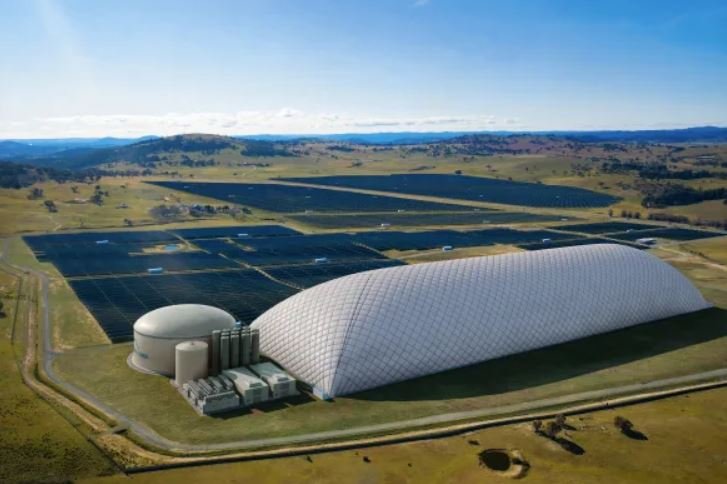
Can carbon dioxide power our homes? The short answer is yes — but not by burning it, and not yet at the scale of a national grid. Instead, scientists and engineers are developing ways to use CO₂ as a working fluid, a chemical feedstock, and a storage medium for energy. If these technologies mature, the same gas that is overheating the planet could help run our lights, heating, and appliances.
The most advanced idea is the CO₂ battery, a form of long-duration energy storage. The best-known example is Energy Dome, an Italian company whose pilot plant in Sardinia began operating in 2022. The system works like this: surplus electricity from solar or wind powers a compressor that squeezes carbon dioxide gas into a liquid. That process also generates heat, which is captured and stored. When electricity is needed, the liquid CO₂ is warmed, it turns back into a gas and expands rapidly, and that expansion spins a turbine to produce power. The CO₂ is not consumed; it is sealed in a closed loop and reused again and again. Because CO₂ becomes liquid at relatively moderate pressure — around 70 bar — the tanks and equipment can be far cheaper and smaller than those needed for compressed-air storage. Energy Dome claims its system can store power for 8 to 24 hours at roughly half the cost of lithium-ion batteries, making it a candidate for keeping the lights on when the sun does not shine and the wind does not blow.
A second route is carbon capture and utilization for synthetic fuels. Rather than powering homes directly, CO₂ can be combined with hydrogen — made from renewable electricity — to produce e-methane, e-methanol, or synthetic gasoline. These “electrofuels” can be burned in existing boilers, furnaces, or power plants. The appeal is that the carbon is recycled rather than newly extracted from underground. The catch is efficiency: making hydrogen and then attaching it to CO₂ consumes a lot of electricity, and burning the resulting fuel releases the CO₂ again. Unless the original CO₂ came from the air or from a waste stream, the climate benefit disappears. Most experts therefore see electrofuels as best suited for aviation, shipping, and heavy industry — not for heating homes, where electric heat pumps are far more efficient.
A third and more speculative approach is the CO₂-based heat pump. Heat pumps already move heat rather than create it, and CO₂ has long been used as a refrigerant in industrial and commercial systems because it is non-flammable, non-toxic, and has very low global-warming potential compared with conventional refrigerants. In Europe and Japan, CO₂ heat pumps are used for domestic hot water, sometimes reaching temperatures above 60°C. This is not “powering” a home with CO₂ in the sense of generating electricity, but it does use the gas to deliver heat efficiently, cutting the amount of electricity a home needs. Researchers are also exploring supercritical CO₂ power cycles for grid-scale electricity generation. Because supercritical CO₂ is denser than steam, turbines can be much smaller and more efficient, potentially reaching 50% or higher thermal efficiency. If paired with a nuclear plant or a concentrated solar facility, such a system could feed a neighborhood grid — but the CO₂ would be a medium, not a fuel.
There are also biological routes. Algae and genetically engineered bacteria can convert CO₂ into biofuels, hydrogen, or even electricity in microbial fuel cells. These systems are promising in the laboratory but remain far from powering a typical home. Likewise, direct air capture — pulling CO₂ from the atmosphere — is energy-hungry and currently very expensive, which limits its use as a feedstock for home energy.
So what stands in the way? Cost, scale, and round-trip efficiency. Every time energy is converted from electricity to liquid CO₂ and back, some is lost; typical figures are 60–70% round-trip efficiency, comparable to or slightly better than some other long-duration storage, but well below lithium-ion batteries. Building enough CO₂ batteries would require massive tanks, turbines, and grid connections. Safety and regulation also matter: CO₂ is an asphyxiant in high concentrations, so leaks in enclosed spaces must be prevented. And there is a public perception problem — telling people their home runs on carbon dioxide sounds like a joke or a greenwashing slogan, even when the engineering is sound. Finally, policy and investment are uneven. Governments have poured money into hydrogen and batteries; CO₂ storage and utilization have received far less, though the U.S. Department of Energy and the EU’s Horizon program have funded demonstration projects.
The realistic near-term answer is therefore nuanced. CO₂ will not replace natural gas or electricity in most homes anytime soon. But it can play three supporting roles: as a long-duration storage medium for renewable power, as a working fluid in heat pumps and advanced turbines, and as a recycled carbon source for synthetic fuels in sectors that are hard to electrify. If the technology improves and costs fall, a future neighborhood might store summer solar power as liquid CO₂ and release it on a winter evening — or use a CO₂ heat pump to warm water while a supercritical CO₂ turbine balances the local grid. For now, the most honest summary is this: carbon dioxide can help power our homes, but it works best as a partner to renewables, not as a replacement for them. The gas that caused the problem may become part of the solution — provided we keep it in a closed loop and do not let it escape.