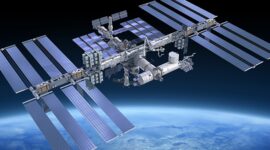
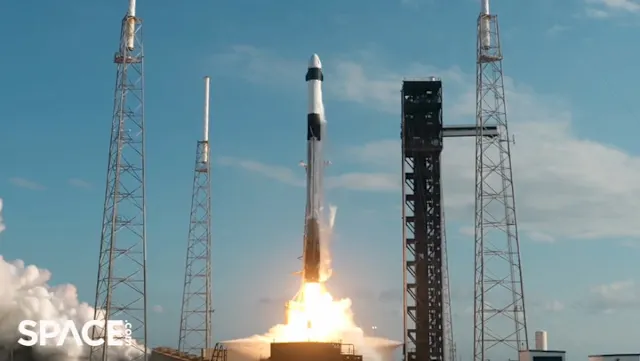
SpaceX is set to launch approximately 6,300 pounds (about 2,858 kilograms) of cargo to the International Space Station (ISS) on October 13, 2026, marking another routine but critically important resupply mission for the orbiting laboratory. The flight, expected to be the 34th commercial resupply services mission (CRS-34) under SpaceX’s contract with NASA, will lift off from Launch Complex 39A at NASA’s Kennedy Space Center in Florida atop a Falcon 9 rocket. While SpaceX has not yet released a precise instantaneous launch window, sources indicate the launch is targeting late morning or early afternoon Eastern Time, with a backup opportunity available approximately 24 hours later in case of weather or technical issues. The mission continues the long-standing partnership between NASA and SpaceX, which has been delivering supplies, scientific experiments, and hardware to the ISS since 2012.
The Dragon spacecraft assigned to this mission is a previously flown Cargo Dragon 2 capsule, refurbished and recertified for another flight. Unlike the crewed Dragon variant, the cargo version lacks seats, life support consoles, and abort thrusters, but it retains the same autonomous docking capability. After launch, the Falcon 9 first stage will attempt a landing on the droneship “A Shortfall of Gravitas” positioned in the Atlantic Ocean, continuing SpaceX’s practice of reusing boosters to reduce costs. The second stage will place Dragon into a preliminary orbit, after which the spacecraft will perform a series of thruster burns to catch up with the ISS. Docking is scheduled for approximately 24 to 36 hours after liftoff, with the station’s Canadarm2 capturing the capsule if needed, though Dragon 2 typically docks autonomously at a forward port of the Harmony module.
The 6,300 pounds of cargo will be divided among several categories, including crew supplies, vehicle hardware, and scientific investigations. NASA has highlighted a number of research payloads that will fly on this mission. One major experiment involves a new generation of bioprinting technology designed to produce human tissue constructs in microgravity, which could advance regenerative medicine on Earth. Another investigation will study the behavior of fire in confined spaces to improve fire safety protocols for future deep-space habitats. Additionally, a set of small satellites, or CubeSats, will be deployed from the station’s Kibō module later in the mission, targeting Earth observation and technology demonstration. Medical research will also be a focus, with experiments examining bone density loss and muscle atrophy in astronauts during long-duration spaceflight. These studies are directly relevant to NASA’s Artemis program, which aims to return humans to the Moon and eventually send crews to Mars.
Among the hardware items, a new carbon dioxide scrubber unit and spare parts for the station’s water recovery system are considered critical. The ISS is currently in a sustained operational phase through at least 2030, and regular resupply missions are essential to keep its life support systems functioning. The cargo also includes food, clothing, and personal items for the Expedition 74 crew, who will be aboard the station at the time of arrival. Fresh fruit and vegetables are often a welcome treat for astronauts, though they must be consumed relatively quickly. The Dragon capsule will remain docked to the ISS for about one month, during which time the crew will unload its contents and then reload it with experiments and trash for return to Earth. Unlike the Russian Progress or Northrop Grumman Cygnus vehicles, Dragon is capable of returning cargo to Earth intact, which is vital for scientists who want to analyze samples and hardware after exposure to microgravity.
Weather conditions for the October 13 launch are expected to be favorable, according to preliminary forecasts from the 45th Weather Squadron. The primary concerns are cumulus clouds and possible thunderstorms, typical for Florida in mid-October. NASA and SpaceX will conduct a launch readiness review a few days before liftoff, and the mission will proceed only if all systems are nominal. The Falcon 9 rocket for this mission is a veteran booster, having flown previously on a Starlink or commercial mission. SpaceX will attempt to recover the first stage on the droneship, and if successful, the booster will be returned to Port Canaveral for refurbishment. The Dragon capsule itself has flown on at least one prior CRS mission, demonstrating SpaceX’s commitment to reusability. NASA pays SpaceX under a fixed-price contract for these resupply services, and the agency has praised the company for its reliability and cost-effectiveness.