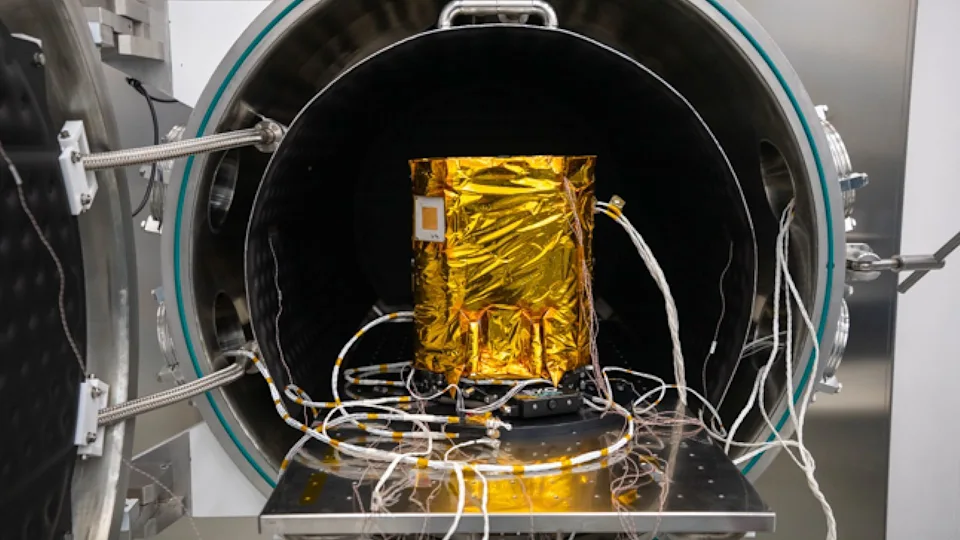
The United Arab Emirates has unveiled an ambitious lander designed to touch down on an asteroid as part of a bold mission that aims to visit seven asteroids and land on one beginning with a launch in 2028. The announcement, made by the UAE Space Agency and the Mohammed Bin Rashid Space Centre (MBRSC) , marks a significant leap in the country’s growing space ambitions and places the UAE among a small group of nations pursuing deep-space asteroid exploration. The mission, known as the Emirates Mission to the Asteroid Belt (EMA) , is designed to study the formation and evolution of asteroids, unlock secrets about the early solar system, and test advanced technologies that could support future resource utilization in space. The unveiling of the lander is a critical milestone because it transforms the mission from a flyby and orbiter concept into a sample-return and surface-exploration endeavor, dramatically increasing the scientific return and technical complexity of the undertaking.
The EMA spacecraft is expected to travel more than 5 billion kilometers over a planned seven-year journey, making it one of the longest and most complex deep-space missions ever attempted by a nation. After launching in 2028, the probe will first conduct a series of gravity-assist maneuvers , including flybys of Earth, Venus, and possibly Mars, to build up the speed needed to reach the main asteroid belt between Mars and Jupiter. The mission’s target list includes seven asteroids of varying compositions and sizes, with the primary goal of landing on a specific asteroid — designated (269) Justitia — which is of particular scientific interest because it appears to have a reddish spectral signature that may indicate the presence of organic molecules and water-ice-bearing minerals. Some scientists believe Justitia may have originated in the outer solar system before migrating inward, making it a potential relic of the primordial material that formed the planets.
The lander itself is a compact, sophisticated vehicle equipped with a suite of scientific instruments, including cameras, spectrometers, a radar sounder, and a sample-collection mechanism. Once the main spacecraft reaches Justitia, it will release the lander, which will descend autonomously to the surface, avoiding boulders and other hazards using real-time terrain-relative navigation and hazard-avoidance algorithms. The lander is designed to operate for a limited duration on the asteroid’s surface, conducting in-situ analysis and, crucially, collecting a sample of asteroid material. The sample will then be loaded into a return capsule that will launch from the asteroid’s surface and eventually make its way back to Earth, landing in the UAE or a designated recovery zone. If successful, the UAE would become only the second country after Japan and the United States to return samples from an asteroid, and the first Arab nation to do so.
The scientific objectives of the EMA mission are wide-ranging. First, the mission aims to characterize the geology and composition of multiple asteroids , providing a comparative view of bodies that formed in different regions of the early solar system. Second, by landing on Justitia and returning a sample, scientists will be able to study organic compounds and hydrated minerals in a laboratory on Earth, which could shed light on the origins of water and life on our planet. Third, the mission will test advanced deep-space navigation, communication, and autonomous landing technologies that will be essential for future human and robotic exploration of the solar system. Fourth, the data gathered will help assess the resource potential of asteroids , including water, metals, and other materials that could support a future space economy.
The UAE’s space program has already achieved notable successes, including the Hope probe currently orbiting Mars and the Rashid rover that was sent to the Moon in 2022. The EMA mission builds on that momentum and reflects the country’s strategy to diversify its economy and inspire a new generation of scientists and engineers. The UAE Space Agency has partnered with international collaborators , including Japanese and American institutions , for certain subsystems and scientific instruments, but the overall mission architecture and management are led by the UAE. The 2028 launch window is tight, and the mission will require precise orbital mechanics and robust spacecraft design to succeed. Engineers are currently testing the lander’s propulsion, guidance, and sample-handling systems in preparation for integration with the main spacecraft.
The announcement also highlights the economic and strategic dimensions of the mission. The UAE hopes to catalyze a domestic space industry by involving local universities, startups, and manufacturers in the supply chain. The mission is expected to cost several hundred million dollars , a fraction of the cost of comparable NASA or ESA missions, thanks to streamlined management and strategic partnerships. The UAE has emphasized that the EMA mission is peaceful and scientific in nature, consistent with international space treaties. The lander unveiling included a full-scale model and detailed animations showing the spacecraft’s journey, the separation of the lander, and the sample-return sequence.