
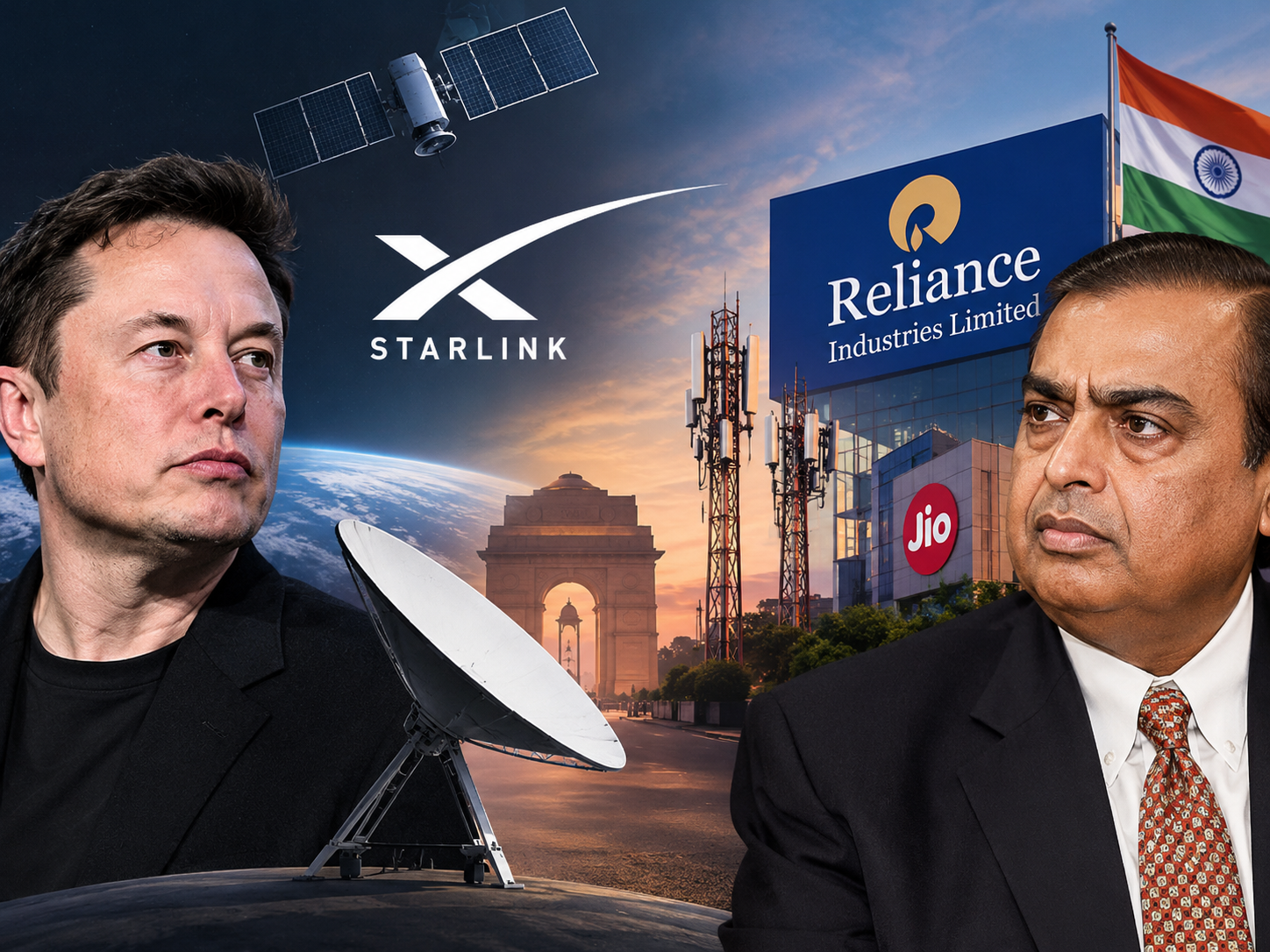
The standoff between Elon Musk’s Starlink and Mukesh Ambani’s Reliance Jio has become one of the most closely watched corporate confrontations in India’s telecom and digital landscape. At its core, the dispute is about how satellite broadband services should be licensed and priced in India, and whether foreign players like Starlink should be allowed to enter the market on terms that Reliance argues would give them an unfair advantage. The clash pits the world’s richest person against India’s most powerful conglomerate, and the outcome could shape the future of internet connectivity for millions of Indians in underserved rural areas.
Starlink, the satellite internet division of SpaceX, has been seeking to launch commercial broadband services in India for several years. The company had initially planned to roll out services in 2021 but was forced to pause after the Indian government ordered it to stop accepting pre-orders and obtain the necessary licenses. Starlink has since been lobbying regulators to grant it a global mobile personal communication by satellite (GMPCS) license and to allocate spectrum for satellite services. The company has argued that satellite broadband can bridge India’s digital divide by connecting remote and rural regions where laying fiber optic cables is economically unviable.
Reliance Jio, India’s largest telecom operator, has strongly opposed Starlink’s entry on the terms the company is seeking. Reliance has argued that satellite spectrum should be allocated through auctions rather than administrative assignment, and that foreign satellite operators should not be allowed to bypass the same licensing and regulatory requirements that domestic telecom companies must follow. Reliance has also raised concerns about security and data sovereignty, warning that allowing foreign satellite companies to operate freely could compromise India’s national security. The company has invested heavily in its own satellite broadband venture, JioSpaceFiber, and views Starlink as a direct competitor.
The dispute intensified after reports emerged that Starlink had allegedly bypassed Indian regulations by selling devices and accepting payments through informal channels before receiving formal approval. Indian authorities reportedly launched investigations into whether Starlink had violated foreign exchange and telecom licensing rules. Starlink has denied any wrongdoing, stating that it has always sought to comply with Indian law and that it had paused operations pending regulatory approval. The allegations, however, gave Reliance ammunition to argue that Starlink should not be granted preferential treatment.
A key flashpoint in the standoff is the issue of spectrum allocation for satellite services. Reliance has advocated for auctions, arguing that this is the fairest and most transparent method and that it would ensure a level playing field. Starlink and other satellite operators, backed by international bodies, have argued that satellite spectrum is a shared resource that should be allocated administratively, as is the practice in many countries. The Indian government has not yet taken a final decision on the matter, and the ambiguity has kept both sides on edge. The Telecom Regulatory Authority of India (TRAI) has been consulting on the issue, and its recommendations will be crucial in determining how the market opens up.
Reliance’s concerns also extend to pricing and predatory competition. Reliance has suggested that Starlink could engage in aggressive pricing to capture market share, undercutting domestic players and potentially creating a monopoly in the long run. Starlink has countered that its pricing will be transparent and that competition will ultimately benefit consumers. The Indian government has been cautious, balancing its desire to attract foreign investment and cutting-edge technology against the need to protect domestic industry and ensure regulatory compliance.
The standoff has also drawn in political and diplomatic dimensions. Elon Musk has made public statements criticizing India’s regulatory environment, and his comments have sparked debate about whether India is sending mixed signals to foreign investors. The Indian government, meanwhile, has defended its regulatory process, emphasizing that all companies must follow the law. The episode has become a test case for how India handles high-profile foreign tech entrants in sensitive sectors. It has also highlighted the growing importance of satellite broadband in India’s digital strategy, especially as the government pushes initiatives like Digital India and BharatNet to connect rural households.
Reliance’s own satellite broadband plans are advancing. JioSpaceFiber, developed in partnership with SES, aims to provide high-speed internet to remote areas. Reliance has positioned itself as a champion of India’s digital sovereignty and has argued that domestic players should be given a fair chance to compete. The company has also warned that allowing foreign satellite operators to operate without adequate oversight could undermine India’s telecom security architecture.
As the situation stands, no final resolution has been reached. The Indian government continues to deliberate on the licensing and spectrum framework, and both Starlink and Reliance are lobbying hard. Starlink has expressed optimism that it will eventually receive approval, while Reliance has vowed to fight any move that it believes would disadvantage domestic operators. The outcome will depend on TRAI’s recommendations, the government’s policy decisions, and possibly judicial intervention if either side challenges the regulatory process.
In the broader context, the Musk-Reliance standoff reflects a global debate about how to regulate satellite broadband. Countries around the world are grappling with similar questions about spectrum allocation, foreign ownership, and national security. India’s decision will be watched closely by other nations and could set a precedent for how emerging markets open their skies to satellite internet. For Indian consumers, especially those in rural and remote areas, the stakes are high. A well-regulated satellite broadband market could bring affordable high-speed internet to millions, but a poorly managed process could stifle competition or compromise security.
The standoff is far from over. Both sides have deep pockets, strong political connections, and compelling arguments. The Indian government’s next moves will be critical in determining whether Starlink and Reliance compete on a level playing field or whether one side gains a decisive advantage. What is clear is that the outcome will shape India’s digital future for years to come, and the world is watching.