
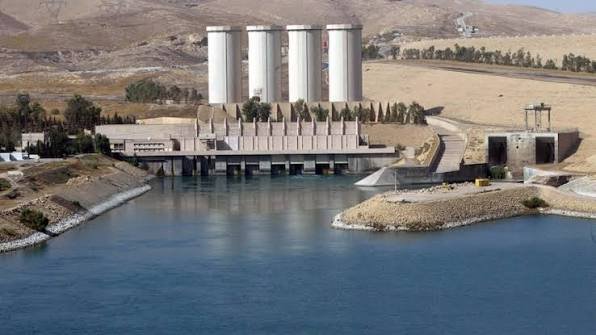
Iraq’s Mosul Dam, widely designated by engineers and international observers as the most dangerous dam in the world, has been locked in a relentless, four-decade battle against geological collapse since its completion in 1986. Rising roughly 113 meters (370 feet) high and stretching 3.4 kilometers (2.1 miles) across the Tigris River in northern Iraq, this massive earth-fill embankment structure impounds up to 11.1 billion cubic meters of water in Lake Dahuk, supplying vital hydroelectricity and irrigation water to the region. Despite its immense strategic and economic importance, the dam suffers from a fatal, unfixable design flaw: it was constructed directly atop a foundation of water-soluble gypsum, anhydrite, and karstified limestone. From the very moment the reservoir began filling in the mid-1980s, pressurized river water started seeping beneath the embankment, dissolving the soft bedrock like sugar and carving out subterranean caverns, sinkholes, and channels that constantly threaten to swallow the structure from below.
The origins of this engineering nightmare trace back to the late 1970s and early 1980s, when Saddam Hussein’s regime pushed forward with the monumental project (originally named the Saddam Dam) as a symbol of national prestige and resource independence. International geological surveys conducted prior to construction warned explicitly that the chosen site, roughly 45 miles north of the city of Mosul, was geologically unsuitable for a mega-dam due to deeply fractured, soluble bedrock extending roughly 100 meters beneath the riverbed. However, political ambition overrode geological caution. Swiss and Yugoslavian consultants, along with German and Italian contractors, were tasked with building the dam anyway, attempting to compensate for the unstable ground by designing a deep underground grout curtain—a barrier created by drilling boreholes into the rock and injecting pressurized cement slurry to seal off water pathways. Even before the reservoir reached full operational capacity, massive subterranean springs and downstream sinkholes appeared, proving that water was actively eroding the dam’s foundation faster than initial seals could contain it.
Because the underlying gypsum dissolves continuously whenever water flows through it, construction and stabilization work at Mosul Dam have never actually stopped. For forty years, teams of engineers and laborers have operated around the clock in a grueling, endless cycle known as continuous maintenance grouting. Workers drill deep into the earth through specialized underground galleries beneath the dam and pump thousands of tons of liquid cement, bentonite, and chemical additives into newly formed voids to temporarily shore up the eroding rock. Over the decades, more than 100,000 tons of solid grout material have been injected into the foundation, yet water relentlessly finds new paths around the hardened plugs, dissolving adjacent gypsum layers and creating fresh cavities. As former chief engineers and international inspectors have repeatedly noted, grouting is merely a temporary palliative rather than a permanent cure—akin to plugging holes in a melting block of ice.
The human and geopolitical stakes of a potential breach are almost unimaginable, placing millions of people living downstream in the Tigris River valley directly in the path of a catastrophic flash flood. Following the 2003 invasion of Iraq, the U.S. Army Corps of Engineers conducted extensive structural assessments and famously declared Mosul Dam the most dangerous dam on Earth, warning that a sudden collapse could happen without warning. Hydraulic models indicate that if the dam were to fail at high water levels, a wall of water over 20 meters (65 feet) high would obliterate the city of Mosul within two to four hours. The deluge would then surge southward down the Tigris floodplain, inundating major population centers including Tikrit, Samarra, and eventually reaching Baghdad—home to over seven million residents—within roughly 45 hours, submerging vast swaths of the capital under several meters of water. Estimates suggest that between 500,000 and 1.5 million people could perish in the initial wave and its aftermath, while critical infrastructure, power grids, agricultural land, and priceless ancient Mesopotamian archaeological sites such as Nineveh and Nimrud would be wiped off the map.
Compounding the geological peril is decades of regional warfare, economic sanctions, and political instability that have repeatedly interrupted vital maintenance. In the late 1980s, recognizing the extreme danger of a breach, the Iraqi government began building the Badush Dam downstream, specifically designed as a massive catch-basin to absorb and safely release a catastrophic flood wave from Mosul Dam. However, construction on Badush Dam was abandoned in 1991 due to international sanctions following the Gulf War, leaving the downstream population completely unprotected. The crisis reached its most acute breaking point in August 2014, when Islamic State (ISIS) militants captured the Mosul Dam for nearly two weeks. During the occupation, workers fled, critical grouting machinery was looted or destroyed, and the continuous grouting operations ground to a complete halt, allowing water to eat away unchecked at the foundation. Although Kurdish Peshmerga and Iraqi forces, backed by U.S. airstrikes, swiftly retook the facility, the disruption left the dam critically weakened and spurred global alarm over an imminent collapse.
In response to the post-2014 emergency, the Iraqi government partnered with international specialists, awarding a major contract in 2016 to the Italian engineering firm Trevi—supported by the U.S. Army Corps of Engineers—to execute an intensive rehabilitation campaign. Between 2016 and 2019, crews modernized the grouting galleries, repaired jammed spillway gates that had previously prevented operators from relieving reservoir pressure, and drilled a deeper, higher-density grout curtain. Simultaneously, an international board of experts enforced strict operational limits on the reservoir’s water level, keeping it well below its maximum capacity of 330 meters above sea level to reduce the hydrostatic pressure forcing water through the bedrock. While these heroic interventions successfully stabilized the structure and averted immediate disaster, the fundamental geological reality remains unchanged. Today, Mosul Dam survives solely on permanent life support, requiring perpetual funding, vigilance, and daily injections of cement to hold back billions of tons of water from crashing down on millions of unsuspecting lives.