
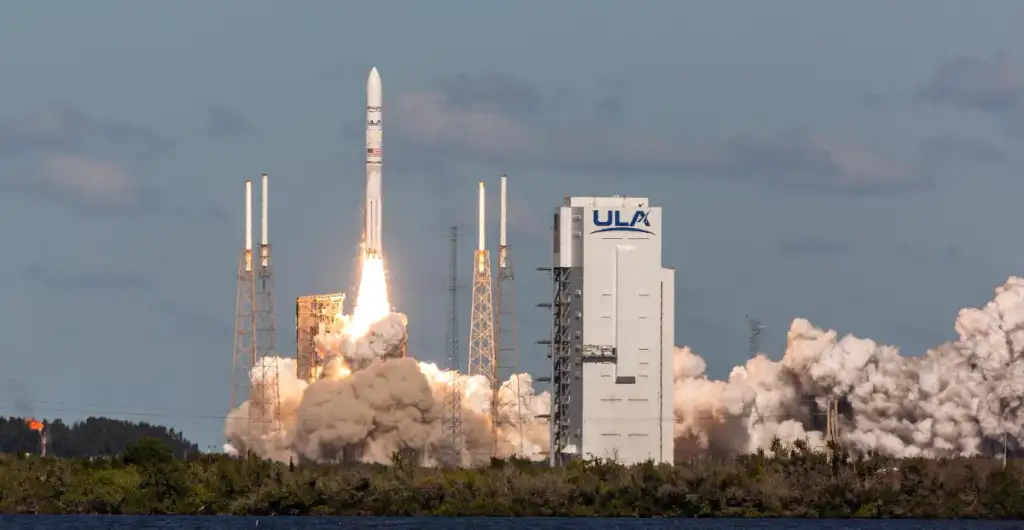
In a major setback for commercial spaceflight, Amazon lost 40 broadband internet satellites on Sunday, November 15, 2026, after a Vulcan Centaur rocket operated by United Launch Alliance (ULA) suffered a catastrophic mid-flight failure. The mission, designated LV-01, lifted off at 12:40 p.m. local time (1740 GMT) from Space Launch Complex 41 at Cape Canaveral Space Force Station in Florida. Intended to deploy the largest single batch of spacecraft yet for Amazon’s low-Earth orbit (LEO) constellation, the rocket experienced a critical in-flight anomaly approximately 10 minutes after liftoff, failing to deliver its payload into orbit and resulting in the total destruction of the 40 satellites.
The catastrophic failure shattered a legendary streak for United Launch Alliance, marking the first mission failure in the company’s 20-year history. Formed in 2006 as a joint venture between aerospace giants Boeing and Lockheed Martin—merging Boeing’s Delta rocket program with Lockheed Martin’s Atlas program—ULA had built an industry-leading reputation on a 100% mission success record across dozens of launches. Sunday’s launch was meant to be a triumphant return-to-flight mission for the Vulcan Centaur, ULA’s next-generation heavy-lift vehicle designed to replace the aging Atlas V. Instead, the loss of the Amazon payload immediately ended two decades of unbroken operational reliability and cast fresh scrutiny over the company’s flagship launch vehicle.
Technical details released immediately following the incident indicate that the rocket initially cleared the launchpad and navigated its earliest ascent phases without visible trouble. Sunday’s flight was the fifth overall mission for the Vulcan rocket since its January 2024 debut, and notably the first configuration to fly with six solid rocket boosters (SRBs). Prior to this mission, Vulcan had been grounded for nine months following technical investigations into SRB nozzle failures experienced during its second flight in October 2024 and a fourth national security mission in February 2026. Although the redesigned SRBs and the first-stage Blue Origin BE-4 engines—which had also undergone oxygen-valve retrofits—appeared to complete their initial burns and stage separation, the fatal anomaly occurred roughly 10 minutes into the flight during the upper-stage phase. ULA confirmed via its Launch Director that the Centaur upper stage failed to reach orbital velocity, though officials noted that telemetry analysis had only just begun and the exact root cause remained under investigation.
For Amazon, the destruction of the 40 spacecraft represents a costly and frustrating delay in its ambitious effort to build Amazon Leo, the broadband satellite network formerly known as Project Kuiper. Designed to deliver high-speed, low-latency internet globally and compete directly with Elon Musk’s SpaceX Starlink, the first-generation Amazon Leo constellation requires 3,232 operational satellites. Prior to Sunday’s accident, Amazon had successfully deployed 398 satellites across 14 launches since April 2025, representing roughly 12% of its target network, and had never previously suffered a payload loss. Because commercial launch service agreements typically place the financial risk of payload loss on the satellite operator or its insurers rather than the launch provider, Amazon bears the direct loss of the 40 destroyed satellites. In a measured public statement, Amazon acknowledged the inherent dangers of spaceflight, noting that risk is especially acute on inaugural rocket configurations like LV-01.
The timing of the failure poses significant strategic and regulatory challenges for Amazon’s deployment timeline. Under Federal Communications Commission (FCC) licensing rules, Amazon faces strict deployment milestones, including a critical regulatory deadline to deploy and operate its full 3,232-satellite constellation by July 30, 2029, in order to retain priority access to key radio-frequency spectrum bands. Furthermore, the tech giant had hoped to initiate its first commercial internet service rollouts before the end of 2026. Having paused launches since July while awaiting Vulcan’s return to service, Amazon was counting on ULA as its primary launch partner; the company has purchased 38 Vulcan launches, which are contracted to carry nearly half of the entire first-generation constellation into orbit. With Vulcan now facing a lengthy technical investigation and regulatory grounding expected to last several months, Amazon will have to lean more heavily on its alternative launch providers—including Arianespace’s Ariane 6, which is scheduled to carry 36 Leo satellites as early as November 23, as well as SpaceX and Blue Origin—to keep its deployment schedule on track.
Beyond Amazon’s commercial ambitions, the Vulcan failure carries profound implications for ULA and the broader U.S. national security space sector. The incident occurred during a period of major transition for ULA, following the departure of longtime CEO Tory Bruno to Blue Origin in late 2025 and the appointment of Vulcan development lead Mark Peller as CEO in August 2026. Because the U.S. Space Force had already paused national security launches on Vulcan following the February booster nozzle issue, Sunday’s total mission loss will severely complicate ULA’s efforts to recertify the rocket for sensitive Pentagon payloads. Until engineers dissect the flight data, isolate the cause of the 10-minute anomaly, and implement corrective hardware or software fixes, both ULA’s commercial manifest and U.S. national security launch schedules remain in limbo, underscoring the unforgiving technical hurdles of bringing a new orbital launch system to full operational maturity.