April 2, 2026
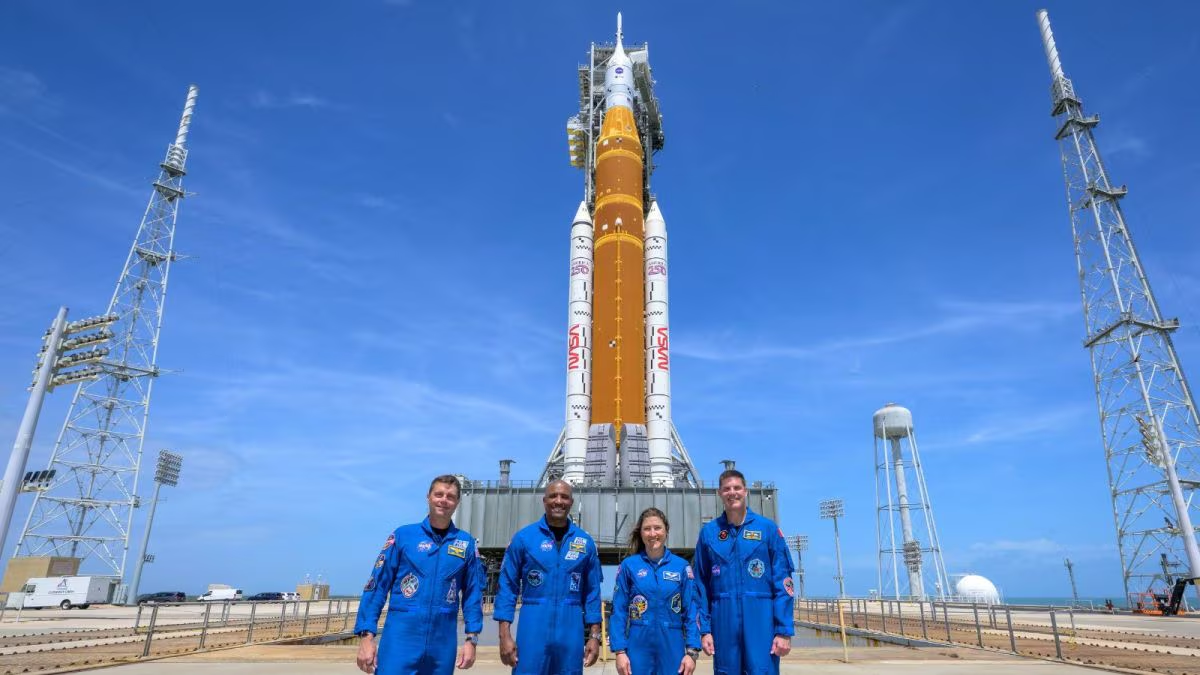
Just over fifteen hours after a historic nighttime liftoff from the Kennedy Space Center, the four astronauts of NASA’s Artemis II mission are safely ensconced in a high, looping orbit around Earth, diligently preparing their Orion spacecraft for the critical engine burn that will hurl them toward the Moon. Following a picture-perfect launch at 6:35 p.m. EDT on April 1 from Launch Complex 39B in Florida, Commander Reid Wiseman, Pilot Victor Glover, and Mission Specialists Christina Koch and Jeremy Hansen of the Canadian Space Agency have begun the intricate work of validating the spacecraft’s systems, marking the first time humans have traveled beyond low-Earth orbit on a lunar trajectory since the Apollo era ended in 1972 .
The initial hours of the flight have been a whirlwind of activity and minor technical troubleshooting, a scenario anticipated by mission planners for a test flight designed to push the boundaries of human spaceflight. After successfully separating from the Space Launch System rocket’s upper stage, the Orion crew capsule entered a highly elliptical orbit around Earth, where it will remain for approximately 24 hours . This phase is not merely a holding pattern but a rigorous testing ground. The crew has been working on a timeline that is both exhausting and exhilarating, having already donned and doffed their orange launch suits, configured their living space in the capsule, and initiated a series of critical systems checkouts . One of the most significant events of this initial orbital shakedown was a proximity operations demonstration, where the astronauts manually piloted Orion to practice rendezvous and docking maneuvers using the discarded upper stage as a target—a crucial skill for future missions that will dock with lunar landers and the Gateway space station .
In a moment that underscored the real-world, hands-on nature of space exploration, the crew successfully troubleshot a minor but attention-grabbing issue with Orion’s onboard toilet. Early on April 2, the astronauts reported a blinking fault light associated with the spacecraft’s waste and hygiene compartment. Working in close coordination with mission control in Houston, the crew was able to diagnose and resolve the issue, restoring the system to normal operation. NASA spokesperson Sandra Jones confirmed in a morning briefing, “The team on the ground and the crew in orbit worked seamlessly to assess the data and resolve the fault. It was a textbook example of real-time problem-solving, proving the resilience of both the spacecraft and the humans flying it.” Following this successful troubleshooting, the crew was directed to take a well-deserved four-hour nap at 3:00 AM EDT, a critical rest period to ensure they are fully alert for the mission’s next major milestone .
Awakening at 7:00 AM EDT on this crisp April morning, the astronauts have now turned their full attention to the next pivotal maneuver: the perigee raise burn. This engine firing, scheduled for later today, is designed to lift the lowest point of Orion’s Earth orbit, further refining their path and setting the stage for their departure from our planet’s gravitational embrace . The day’s agenda is packed with methodical preparation. The crew will test the flywheel exercise device, a critical piece of equipment not just for physical fitness but as a stress test for the life-support systems in a deep-space environment . They will also conduct another series of burns and verify the deep-space communication networks that will be their only link to Earth as they venture farther than any humans in history. “We are methodically checking every box,” said NASA Associate Administrator Amit Kshatriya during a press conference from the Johnson Space Center. “Artemis II is a test flight, and the test has just begun. The crew is putting Orion through its paces so the crews who follow them can go to the Moon’s surface with confidence.”
Assuming all systems continue to perform nominally, the crew is on track for the mission’s defining moment: the Trans-Lunar Injection (TLI) burn, scheduled for the evening of April 2. This powerful, approximately three-minute firing of Orion’s European-built Service Module engine will accelerate the capsule from its orbital speed of about 17,500 mph to over 24,000 mph, providing the energy needed to break free of Earth’s orbit and slingshot toward the Moon . The TLI will place Orion on a “free-return” trajectory—a brilliant piece of orbital mechanics that acts as an emergency safety net. This specific path uses the Moon’s gravity to naturally swing the spacecraft back toward Earth without requiring any additional engine burns, ensuring a safe return home even in the event of a major propulsion failure . Once this burn is complete, the crew will truly be on their way, marking the moment humanity once again commits to leaving its home planet for another world.
Over the next several days, the astronauts will settle into the rhythm of deep-space transit. They are expected to enter the lunar sphere of influence—the point where the Moon’s gravity becomes stronger than Earth’s—by April 5 . Their closest approach to the lunar surface, a flyby that will take them within approximately 4,100 miles, is scheduled for April 6 . During this flyby, the crew will pass behind the far side of the Moon, experiencing a 30-to-50-minute communications blackout as Earth disappears behind the rocky horizon. While they lose contact with mission control, they will gain an unparalleled perspective, becoming the first human eyes to witness the full expanse of the lunar far side up close in the 21st century. “When they get on the backside of the Moon, there will be a perspective that no human eye has ever seen before,” Lakiesha Hawkins, acting deputy associate administrator for NASA’s Exploration Systems Development Mission Directorate, said in a pre-launch interview .
This 10-day mission is not merely a victory lap; it is a high-stakes proving ground for the systems that will one day return humans to the lunar surface on Artemis III and establish a long-term presence with Artemis IV. The crew is testing everything from the emergency radiation shelter to the orange Orion Crew Survival System suits designed to protect them for up to six days in a depressurization event . Each successful test, each burned calorie, and each captured image of the receding Earth is a brick in the foundation of humanity’s new lunar program. As the astronauts stole a moment to look back at the blue marble they had left behind, Commander Reid Wiseman radioed down to a rapt Earth, his voice carrying the weight of the moment: “It is good to be back in this high frontier. Orion is a sleek ship, and the team is ready. We go for the Moon together.” With the perigee burn complete and the TLI on the horizon, the Artemis II crew is poised to answer the call, transforming a decade of dreams and engineering into a new reality for human spaceflight.