April 7, 2026
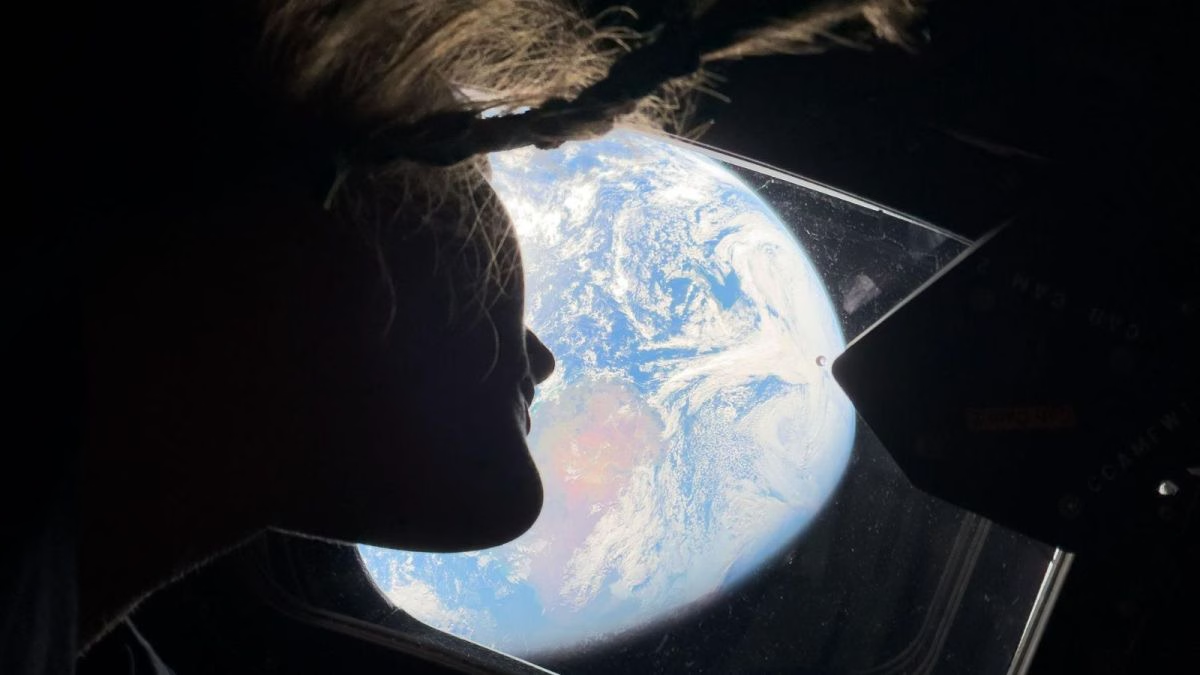
NASA’s Artemis II mission has marked a historic milestone on its fifth day in space, as the four-member crew successfully executed the first crewed lunar flyby in over five decades. At 03:15 UTC, the Orion spacecraft fired its main engine for 2 minutes and 47 seconds, performing a precise lunar gravity assist that swung the capsule within 87 nautical miles (100 km) of the lunar surface. Moments after the burn, mission control at Johnson Space Center, Houston, confirmed that Orion had broken the record for the farthest distance from Earth ever traveled by a human-rated spacecraft. The new record – 268,563 miles (432,244 km) from Earth – surpasses the previous mark set by Apollo 13 in 1970. “We are now farther from home than any humans in history,” radioed Commander Reid Wiseman, his voice crackling with static as the capsule’s high-gain antenna locked onto Earth across the void. “The Moon is absolutely breathtaking on our starboard side. It’s surreal to be here.” The crew – Wiseman, pilot Victor Glover, mission specialist Christina Koch, and Canadian astronaut Jeremy Hansen – had been awake since 04:00 UTC, preparing for the flyby. Live video downlinked at 06:00 UTC showed the stark, cratered lunar surface sliding past Orion’s windows, with the distant Earth appearing as a pale blue marble less than half the size of a fingernail at arm’s length.
The record-setting distance was achieved as Orion continued its trajectory into the distant retrograde orbit (DRO) insertion phase, which will carry the spacecraft to a maximum of 280,000 miles (450,000 km) from Earth later on day six. However, the flyby itself was the mission’s most dangerous moment so far. “We designed this trajectory to test the heat shield and navigation systems at lunar re-entry speeds, but the psychological impact of being so far from home is something we studied for years,” explained NASA Flight Director Holly Ridings during a press conference at 13:00 UTC. “Seeing the Moon fill the windows while Earth shrinks to a dot – that’s a moment that changes you.” The crew conducted a series of science experiments during the closest approach, including deploying a pair of CubeSats designed to map lunar polar ice deposits. One of the small satellites, Lunar Trailblazer, immediately began transmitting data on water signatures near Shackleton Crater. “The signal is stronger than any ground simulation predicted,” said Dr. Bethany Ehlmann, principal investigator for the mission at Caltech. “We are witnessing direct evidence of surface water ice in the permanently shadowed regions. This is a game-changer for sustained lunar habitation.”
Health monitoring systems aboard Orion reported excellent vitals for all four astronauts, though Koch noted that the deep-space radiation environment had triggered several alerts on her personal dosimeter. “We’re seeing about eight times the radiation dose of low Earth orbit, but it’s still within safe limits for this short transit,” she reported during a live broadcast at 08:45 UTC. “The Orion shielding is performing flawlessly. We’re eating, sleeping, and working in shifts – but honestly, none of us wants to sleep tonight. The view is too incredible.” The crew also took time to deploy a small memorial patch dedicated to the Apollo 1, Challenger, and Columbia crews, releasing it through an airlock at 11:00 UTC into lunar orbit – a symbolic gesture marking the legacy of exploration and sacrifice.
Back on Earth, global celebrations erupted as live coverage of the lunar flyby reached an estimated 1.2 billion viewers across 190 countries. NASA Administrator Bill Nelson, speaking from the agency’s headquarters in Washington at 15:30 UTC, called the moment “a giant leap for a new generation.” He added, “When Commander Wiseman and his crew looked out that window, they saw not just the Moon, but the beginning of a permanent human presence beyond Earth. Artemis II is proving that we are ready to go back – and this time, we’re staying.” The European Space Agency and JAXA both issued congratulatory statements, while the Canadian Space Agency celebrated Hansen as the first non-American to fly beyond low Earth orbit. “Jeremy’s voice from lunar distance is now part of history,” said CSA President Lisa Campbell. “The partnership is working perfectly.”
The next major event for Artemis II will occur on April 8, 2026, when Orion fires its engines again to enter the DRO – a stable orbit that will carry the capsule to its maximum distance of 280,000 miles (450,000 km) on April 10. That distance will set yet another record, one that is expected to stand until Artemis III attempts a lunar landing in late 2027. Meanwhile, the crew has been tasked with testing the new docking system for the Lunar Gateway station, which remains under construction. At 19:00 UTC on day five, the astronauts successfully simulated a docking with a virtual Gateway module, using Orion’s onboard AI-assisted navigation software. “The system locked on in under four minutes – faster than any simulation we ran on the ground,” said Glover. “We’re ready for whatever comes next.”
As the crew prepared for their scheduled sleep period at 22:00 UTC, Commander Wiseman offered one final thought: “The Moon is behind us now for a bit, but Earth is still out there – tiny, fragile, and beautiful. We’re carrying everyone’s hopes with us. And from half a million kilometers away, that feels like a privilege beyond words.” The Artemis II mission continues to exceed all performance metrics, with flight controllers reporting 100% system functionality across Orion’s power, propulsion, and life support. Day six will begin with a live educational downlink to schools across North America, as the crew prepares to break their own distance record – and push humanity farther into the solar system than ever before.