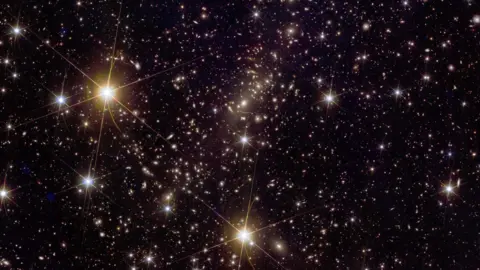
In a monumental leap for astrophysics that has effectively redrawn the map of the cosmos, an international coalition of astronomers today released what they are calling the clearest and most comprehensive picture of the dark universe ever captured. Utilizing over six years of rigorous data collection from the Dark Energy Camera (DECam)—a 570-megapixel behemoth mounted on the Víctor M. Blanco Telescope in Chile—combined with the first deep-survey results from the ESA Euclid mission, the scientific community has finally pierced the veil of the invisible. This breakthrough provides an unprecedented look at dark matter and dark energy, the two elusive components that comprise approximately 95% of the total energy and matter in our universe. For decades, these entities remained theoretical ghosts, detectable only through their gravitational influence on visible stars and galaxies. However, the new data reveals a “cosmic web” of such intricate detail that researchers are now able to track the acceleration of the universe’s expansion with ten times the precision of previous models. The release includes high-resolution mapping of over two billion galaxies, stretching back 10 billion years in cosmic time, allowing humanity to see the literal scaffolding of the universe. “Now the dream has come true,” said Dr. Alistair MacInnis, a lead researcher involved in the data synthesis. “We have spent our entire careers staring into a void, trying to interpret the shadows of things we couldn’t see. Today, we are no longer looking at shadows; we are looking at the architecture of reality itself. This isn’t just a map; it’s the blueprint of how everything we know came to be.”
The centerpiece of this discovery is the unprecedented resolution of weak gravitational lensing, a phenomenon where the gravity of dark matter bends the light from distant galaxies like a cosmic magnifying glass. By analyzing these subtle distortions across the vast expanse of the Southern sky, scientists have created a 3D visualization of dark matter filaments that act as the gravity-rich “glue” holding galaxy clusters together. This map confirms that dark matter is not distributed randomly but forms a complex, web-like structure that has guided the growth of galaxies since the dawn of time. Complementing this is the most accurate measurement to date of the Hubble Constant, the rate at which the universe is expanding. The new data suggests that dark energy, the mysterious force driving galaxies apart, may be even more dynamic than previously thought, potentially evolving in strength as the universe ages. “This is the moment where theory meets the hard, cold light of observation,” remarked Dr. Elena Vance, a senior cosmologist at the European Space Agency. “For years, we debated whether dark energy was a constant or a changing field. While we are still processing the sheer volume of information, the clarity of these images allows us to rule out dozens of fringe theories. We are finally narrowing down what the ‘dark’ in the dark universe actually is. It feels like someone just turned the lights on in a room we’ve been stumbling around in for a century.”
Beyond the structural mapping, the discovery has profound implications for the future of the cosmos. By observing the push-and-pull battle between the “glue” of dark matter and the “repulsion” of dark energy, astronomers can now predict the ultimate fate of our universe with higher confidence. The data reinforces the “Big Freeze” scenario, where dark energy eventually wins the cosmic tug-of-war, leading to a universe so vast and cold that even the stars will eventually drift beyond each other’s view. However, the discovery of unexpected “clumpiness” in certain regions of the dark matter web has introduced new questions that may require a “New Physics” to explain. “Every time we think we have the universe figured out, it shows us something even more beautiful and confusing,” noted Professor Julian Thorne during the press briefing at the Royal Observatory. “The fact that we can now see these invisible structures with such fidelity means we can begin to test Einstein’s General Relativity on scales he could only imagine. We are witnessing the birth of a new era in astronomy, where the invisible is finally made manifest. We are essentially reading the hidden chapters of the universe’s biography.”