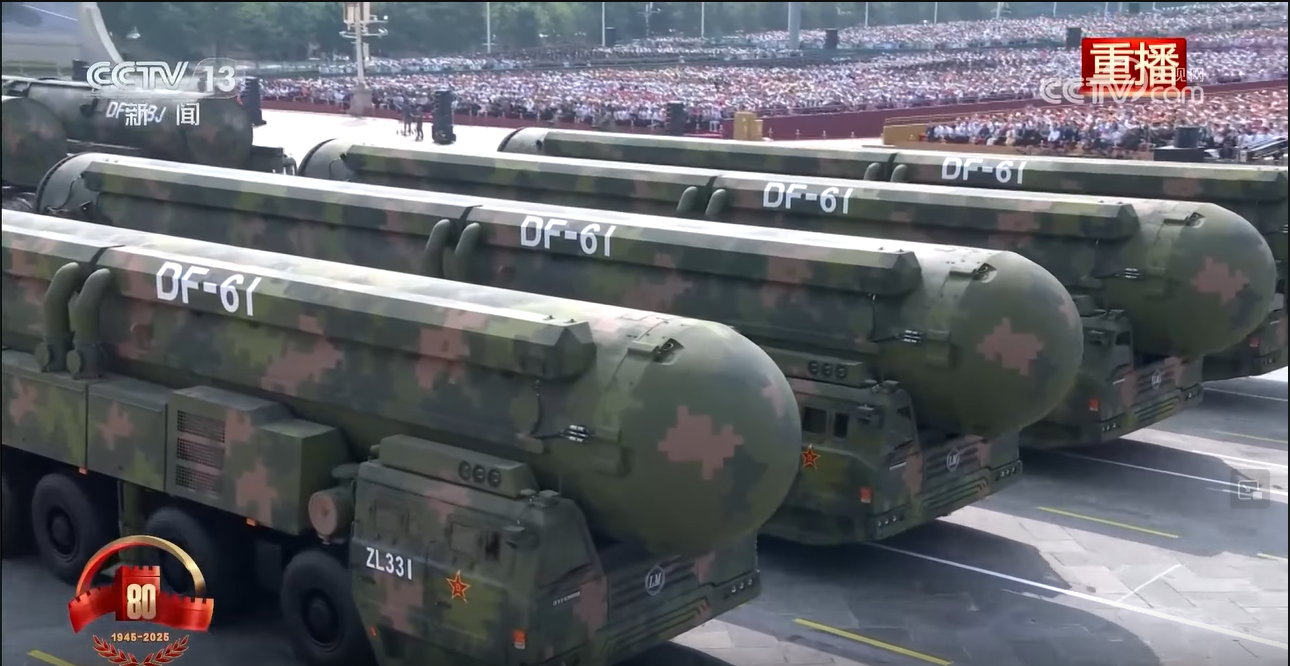
The unveiling of the Dongfeng-61 (DF-61) intercontinental ballistic missile at the September 3, 2025, Victory Day Parade in Beijing marked a watershed moment in the evolution of China’s strategic nuclear forces . As the first public appearance of this previously classified weapon system, the DF-61 immediately captured the attention of defense analysts, strategic planners, and global security experts who recognized it as far more than an incremental upgrade to existing systems . This essay examines the DF-61’s technical specifications, its role within China’s rapidly modernizing nuclear triad, the strategic implications of its deployment, and the broader policy framework that governs its employment, ultimately arguing that the DF-61 represents a fundamental transformation in China’s nuclear posture from a minimal deterrent to a comprehensive strategic capability designed to ensure global reach and second-strike survivability.
Technical Specifications and Design Philosophy
The DF-61, whose designation translates to “East Wind-61,” represents the most advanced land-based intercontinental ballistic missile system yet developed by the People’s Liberation Army Rocket Force . Manufactured by the China Academy of Launch Vehicle Technology (CALT), the missile employs a three-stage solid-fuel propulsion system that represents a significant evolution from its predecessors in the Dongfeng family . Western analysts who observed the missile’s debut noted that its transporter erector launcher (TEL) appeared nearly identical to that of the DF-41 displayed in 2019, mounted on a 16-wheel HTF5980 road-mobile platform capable of operating from China’s extensive highway network and providing substantial operational flexibility .
The DF-61’s estimated operational range of 12,000 to 15,000 kilometers (approximately 7,500 to 9,300 miles) gives it the capacity to strike targets across the continental United States, with some analyses suggesting that from launch sites in central or western China, the missile can reach Washington, D.C., and other strategic targets throughout North America . This range capability represents a critical threshold in China’s strategic calculus, as it enables the credible targeting of all potential adversaries regardless of geographic distance, effectively eliminating any sanctuary concept that might otherwise encourage hostile action against Chinese interests.
Perhaps the most technically significant aspect of the DF-61 lies in its advanced warhead configuration and delivery mechanisms. According to technical analyses derived from Chinese academic publications and defense journals, the missile employs a hypersonic glide vehicle (HGV) as its primary payload, rather than conventional reentry vehicles . These lift-body, waverider-configuration vehicles separate from the booster stage after ascent and enter near-space altitudes, where they execute highly maneuverable, unpowered flight at speeds approaching Mach 25 . This trajectory profile fundamentally differs from traditional ballistic flight paths, complicating detection and interception by existing missile defense systems.
The payload capacity of the DF-61 remains a subject of informed speculation, with estimates ranging from three to eighteen individual warheads depending on configuration . When configured for maximum yield, the missile can reportedly deliver thermonuclear warheads with individual yields of 300 kilotons to 1.2 megatons, producing total destructive potential of up to 21.6 megatons across its payload complement . The circular error probable (CEP) of less than 100 meters achieved through a combination of inertial guidance, stellar navigation, and BeiDou satellite updates ensures that the DF-61 can reliably engage hardened targets such as command bunkers and siloed missile fields .
The Nuclear Triad and Strategic Modernization
The DF-61’s introduction must be understood within the broader context of China’s comprehensive nuclear triad modernization, which was simultaneously showcased at the 2025 Victory Day Parade . Alongside the DF-61, China publicly displayed the JL-3 submarine-launched ballistic missile (SLBM), the DF-31BJ road-mobile ICBM, and the JL-1 air-launched ballistic missile, marking the first time China has demonstrated all three legs of its nuclear triad in a single public forum . This coordinated presentation signaled to international observers that China’s nuclear forces have matured from a land-based dominant posture to a genuinely triadic structure with redundant delivery systems designed to ensure second-strike capability under all circumstances.
The JL-3 SLBM, deployed aboard China’s Type 094 and future Type 096 nuclear-powered ballistic missile submarines, provides the sea-based component of this triad with an estimated range exceeding 10,000 kilometers and the capacity to carry multiple independently targetable reentry vehicles (MIRVs) . This sea-based leg is particularly significant because it represents the most survivable element of any nuclear force, with submarines on patrol able to remain undetected for extended periods while maintaining continuous launch readiness . The JL-1 air-launched system, carried by H-6 bomber aircraft, adds further diversification to China’s delivery platforms, providing flexible response options that complement the faster but less survivable land-based systems .
The DF-61 occupies a unique position within this triad as the most modern and capable land-based system. Its road-mobile configuration provides inherent survivability advantages over silo-based missiles, as the launchers can disperse during periods of tension and operate from prepared positions throughout China’s vast territory . The Federation of American Scientists noted that the DF-61 was “the only entirely new nuclear missile system” presented at the 2025 parade, distinguishing it from upgraded variants of existing systems and underscoring its significance as a next-generation weapon rather than an incremental improvement .
Strategic Implications and Deterrence Philosophy
The deployment of the DF-61 carries profound implications for global strategic stability and the evolving nuclear balance between major powers. Defense experts in Taiwan have described the system as an instrument of “political denial” —a capability designed to deter foreign intervention in regional contingencies, particularly in the event of a cross-Strait conflict . This characterization reflects a broader understanding that China’s nuclear modernization is oriented toward countering potential U.S. intervention by creating unacceptable risks for any adversary contemplating military action against Chinese core interests.
U.S. Department of Defense assessments have tracked China’s nuclear expansion with growing concern, projecting that China will surpass 1,000 operational warheads by 2030 and continue expanding its arsenal through at least 2035 . Satellite imagery has documented the construction of hundreds of new ICBM silos, while the DF-61’s road-mobile deployment adds a layer of uncertainty to these counts . The Pentagon has characterized China’s nuclear modernization as the fastest expansion of any nuclear-armed state, with China adding approximately 100 warheads annually since 2023 to reach an estimated 600 by early 2026 .
Analysts have noted that China’s pursuit of a “lean and effective” nuclear force has evolved considerably from its historical posture of minimal deterrence . The 2025 Chinese government white paper on arms control reaffirmed the country’s no-first-use (NFU) policy while simultaneously stating that China is improving “strategic early warning, command and control, missile penetration, and rapid response, as well as its survivability” . This combination of NFU commitment with operational enhancements suggests that China seeks to maintain strategic ambiguity regarding the precise circumstances under which its nuclear forces might be employed.
Command, Control, and Advanced Technologies
The DF-61 incorporates several revolutionary technologies that distinguish it from previous generations of Chinese ballistic missiles. According to Chinese sources, the system employs quantum entanglement communication technology for command and control links, providing interference resistance reportedly 1,000 times greater than conventional radio systems . While independent verification of these claims remains unavailable, the development of quantum communication infrastructure in China has been well-documented, and such systems would offer substantial advantages in maintaining connectivity during nuclear operations when electromagnetic interference would be severe.
The hypersonic glide vehicle technology integrated into the DF-61 represents another significant technical achievement. These vehicles execute unpredictable, non-ballistic trajectories that complicate interception by existing missile defense systems, including the U.S. Ground-Based Midcourse Defense (GMD) system . The “fractional orbital bombardment system” (FOBS) characteristics of this trajectory profile allow the DF-61 to approach targets from unexpected directions, potentially over the South Pole rather than the more predictable northern approach, reducing warning times and bypassing early warning radars oriented toward traditional threat axes .
The composite materials and lightweight casing technologies employed in the DF-61’s construction represent advances in Chinese materials science that enable greater range and payload capacity without proportional increases in launch weight . These materials also contribute to the missile’s reduced radar signature, enhancing its survivability during the boost phase when it would be most vulnerable to interception . The combination of mobility, stealth characteristics, and advanced penetration aids makes the DF-61 substantially more capable of surviving a first strike and delivering its payload than any previous Chinese ICBM.
Policy Context and Strategic Stability
China’s nuclear modernization, including the DF-61, occurs within a policy framework that emphasizes defensive nuclear strategy and minimum deterrence while acknowledging the need for credible capabilities . The November 2025 white paper titled “China’s Arms Control, Disarmament, and Nonproliferation in the New Era” reaffirmed that China “never has and never will engage” in a nuclear arms race with other nations in terms of expenditure, quantity, or scale of nuclear weapons . However, the document also explicitly stated that China is “promoting the modernization of its nuclear forces to safeguard China’s own strategic security and overall global strategic stability” .
Tong Zhao, a senior fellow at the Carnegie Endowment for International Peace, has observed that China’s approach to nuclear transparency is “mostly oriented toward delivering deterrence signals rather than providing strategic reassurance” . This assessment helps explain the contrast between China’s public statements emphasizing restraint and its concurrent deployment of advanced systems like the DF-61. The Chinese government appears to calculate that maintaining ambiguity about its nuclear capabilities serves deterrence objectives more effectively than detailed transparency would, particularly given the asymmetric nature of U.S.-China nuclear relations.
The DF-61’s deployment has implications for arms control and strategic stability dialogues between the United States and China. The expiration of the New START treaty between the United States and Russia, scheduled for February 5, 2026, creates an uncertain arms control environment at the very moment when China’s nuclear capabilities are expanding rapidly . Chinese officials have consistently maintained that the countries possessing the largest nuclear arsenals bear “special and primary responsibility” for nuclear disarmament, a position that China uses to justify its own more modest modernization efforts while declining to join bilateral arms control negotiations with the United States .
Strategic significance of DF-61
The DF-61 represents a historical inflection point in the development of China’s nuclear forces, marking the transition from a minimal deterrent designed to dissuade nuclear attack to a comprehensive strategic capability capable of holding all potential adversaries at risk under all circumstances. Its combination of intercontinental range, road-mobile deployment, advanced penetration aids, and hypersonic glide vehicle payloads places it among the most capable strategic weapons systems in existence, comparable in many respects to the most advanced U.S. and Russian systems while incorporating technologies that in some cases surpass those fielded by other nuclear powers.
The strategic significance of the DF-61 extends beyond its technical specifications to encompass the broader evolution of Chinese nuclear policy and force structure. As the centerpiece of China’s modernized nuclear triad, the DF-61 ensures that the People’s Liberation Army Rocket Force possesses credible second-strike capability with sufficient diversity of delivery platforms and operational concepts to complicate any adversary’s targeting calculations. The system’s ability to hold global targets at risk while maintaining high survivability through mobility and advanced technologies provides China with strategic options it previously lacked.
For global strategic stability, the DF-61’s deployment presents both challenges and opportunities. The erosion of the U.S.-China nuclear imbalance that has characterized the bilateral strategic relationship since China’s first nuclear test in 1964 creates new dynamics in great power competition . Whether this transition proceeds peacefully or contributes to renewed arms competition will depend on the interactions between Chinese force development, U.S. strategic responses, and the evolution of the arms control framework that has historically managed nuclear rivalry among the major powers. The DF-61, as the most visible symbol of China’s emergence as a peer nuclear competitor, will likely remain at the center of these strategic calculations for decades to come.