
The history of human innovation is often viewed as a linear progression, culminating in the scientific and technological breakthroughs of the modern era. However, scattered across millennia, from the deserts of Egypt to the submerged ruins of the Aegean Sea, lie artifacts and structures that present a profound challenge to this conventional narrative. These are the “unexplained” ancient inventions—technological marvels that showcase a level of sophistication, precision, and engineering knowledge that scientists and historians struggle to reconcile with the supposed capabilities of their creators. Far from being simple curiosities, these inventions force us to question not only what ancient civilizations achieved, but how they did it, and perhaps most importantly, why that critical knowledge was subsequently lost to time.
The mystery surrounding these five inventions—the Antikythera Mechanism, Roman Concrete, Damascus Steel, the Baghdad Battery, and the Great Pyramid’s Precision—stems from two primary factors. First, the incredible material science or mechanical complexity they embody (e.g., the nanoscale structures in Damascus steel or the planetary gear train in the Mechanism). Second, the glaring technological gap they represent; for example, the self-healing capability of Roman concrete wasn’t intentionally replicated until the 21st century, and the astronomical computing power of the Antikythera Mechanism vanished for over 1,000 years. These artifacts are not simply old; they are anomalies that suggest either a hidden lineage of brilliant, unrecorded engineers or the deliberate application of empirical knowledge that bordered on modern science. By examining these enduring enigmas, we begin to appreciate the true depth of ancient ingenuity and acknowledge the compelling fact that the past still holds secrets that modern science cannot fully explain.
The Antikythera Mechanism
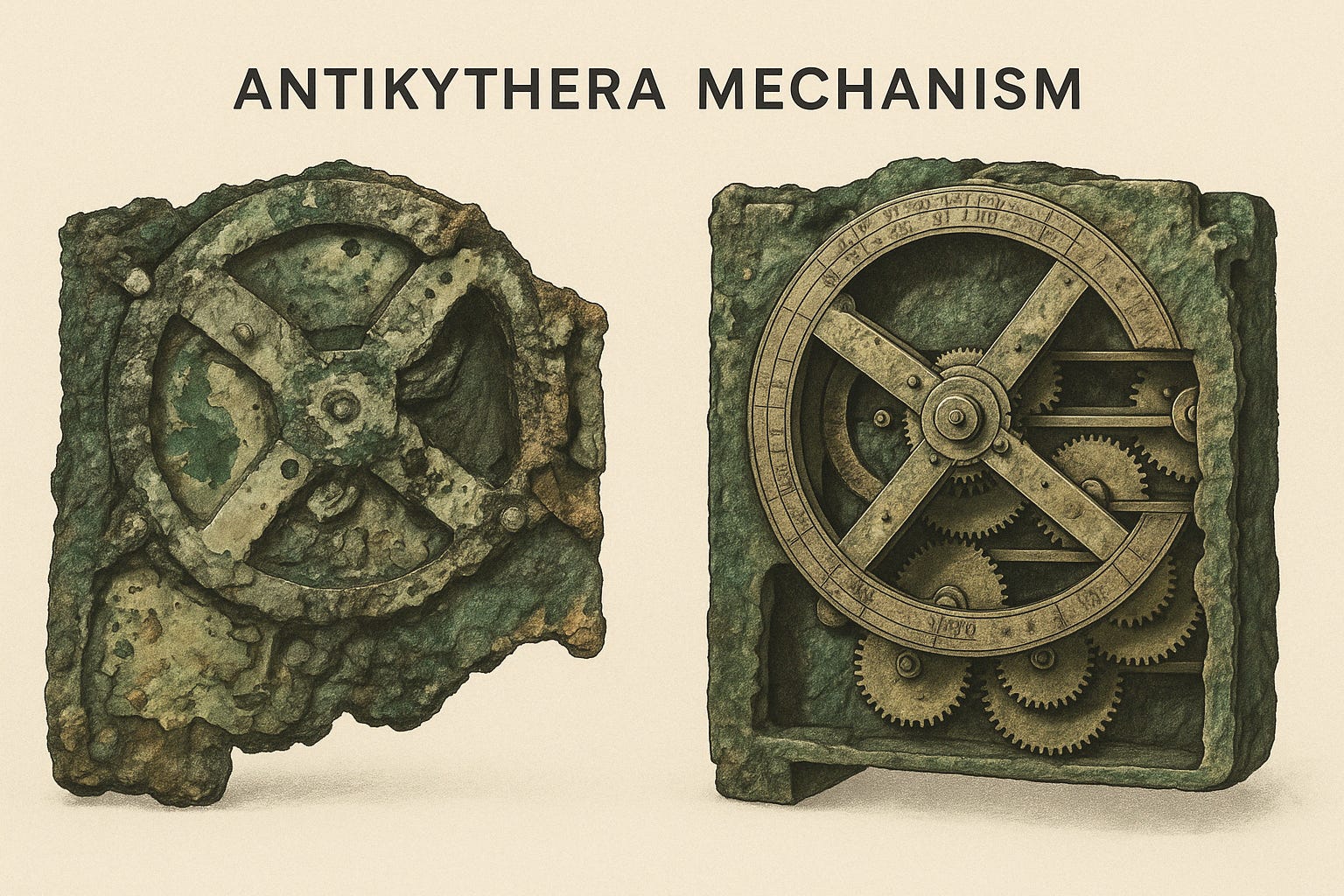
The Antikythera Mechanism, discovered in a Greek shipwreck in 1901, is often described as the world’s first analog computer, dating back to around 150-100 BCE. Its extraordinary complexity remains a profound mystery, as no other comparable device from the Greco-Roman world has ever been found; its mechanical sophistication was not matched until the great astronomical clocks of 14th-century Europe, over a millennium later. Composed of over 30 meticulously crafted bronze gears, the device was housed in a wooden box with inscribed dials. Modern X-ray tomography and modeling have revealed it was an astonishingly intricate cosmological calculator, designed to predict lunar and solar eclipses, track the movements of the Moon and the five known planets, and even manage a four-year calendar cycle, including the scheduling of ancient athletic games. The engineering feat alone—the precision with which the gear trains were cut and assembled to model complex, irregular celestial motions, such as the Moon’s elliptical orbit (an anomaly not fully accepted in astronomy until centuries later)—baffles historians. The mystery is not what it did, but how they made it, who invented it, and why the technology vanished so completely for over a thousand years, suggesting a hidden tradition of mechanical genius far exceeding the established historical timeline for technological advancement.
Roman Concrete (Opus Caementicium)
The durability of Roman concrete is an architectural and material science paradox that modern engineering has yet to fully replicate, especially for long-term underwater applications. Used to construct monumental and enduring structures like the Pantheon and marine piers, this ancient building material has survived for over 2,000 years, often outperforming its modern counterpart, which typically degrades within decades, especially when exposed to seawater. Modern research has identified key ingredients, including lime, volcanic ash (known as pozzolana), and seawater, but the exact mechanism for its incredible longevity has been a long-standing mystery. One key discovery is that the Roman builders did not use a simple mixture; instead, a complex chemical reaction occurs over centuries. Specifically, exposure to seawater triggers the growth of a rare, non-toxic mineral called tobermorite and a related aluminum tobermorite, which fills micro-cracks and effectively makes the concrete self-healing and stronger over time. The precise ancient recipe, including the specific temperatures and processes used to create the optimal reactive lime components, and the lost knowledge of how to masterfully proportion these materials for such colossal longevity, remains a fiercely debated subject in material science.

Damascus Steel
Damascus steel, renowned throughout the Middle Ages for crafting swords of legendary sharpness, resilience, and a distinctive watery or “watered” pattern on the blade, represents a metallurgy technology that was completely lost to history around the 18th century. The mystery surrounding this metal lies in the fact that its unique properties are not merely the result of superior craftsmanship but are due to an ancient, highly advanced chemical and thermal process involving an ultra-high-carbon steel called wootz steel, which was imported from India. Modern scanning electron microscopes have revealed that genuine Damascus steel contains microscopic structures: carbon nanotubes and cementite nanowires—structures that today are associated with modern nanotechnology. The combination of specific trace elements in the original wootz ore and a complex, low-temperature forging process is believed to have facilitated the formation of these ultra-hard, microscopic structures that gave the blades their incredible edge retention and flexibility. The exact temperature and forging cycles that produced this ‘nanotechnology’ of the ancient world, allowing for such advanced microstructure control without a modern lab, remain the subject of intense, ongoing research and experimentation, as no successful, large-scale commercial replication has ever truly matched the quality of the original blades.

The Baghdad Battery (Parthian Battery)
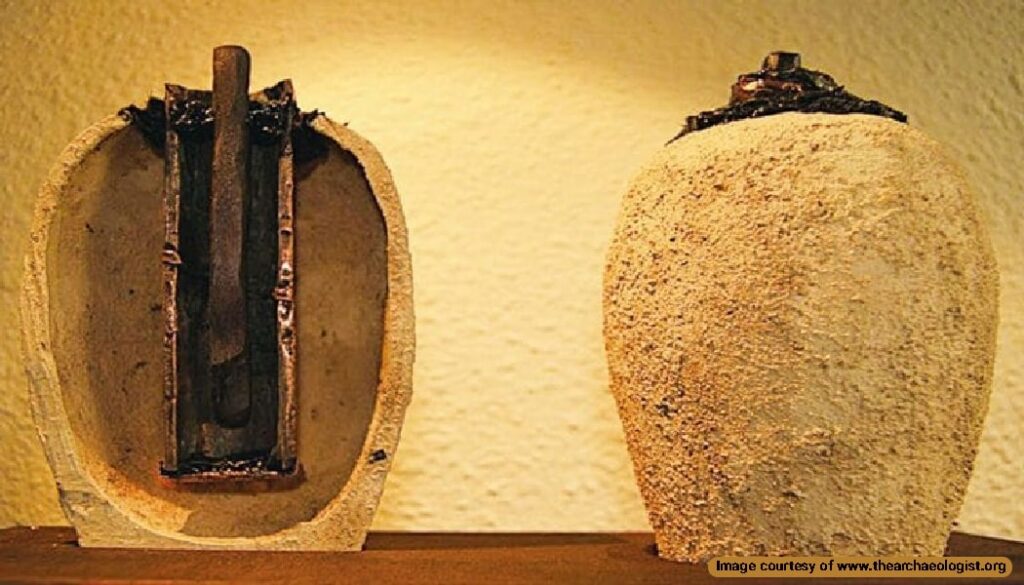
The Baghdad Battery is a collection of three artifacts—a ceramic jar, a copper cylinder, and an iron rod—discovered near Baghdad in 1936, dating from the Parthian or Sasanian period, possibly as early as 250 BCE. While its true purpose is unproven, the artifacts’ structure has led to the highly controversial theory that it functioned as a primitive electric cell. The copper cylinder would have been separated from the iron rod by the clay jar, creating two distinct electrodes. If filled with an electrolyte like grape juice, vinegar, or brine, as suggested by experiments, it could theoretically have generated a low voltage (about 0.8 to 2.0 volts). The enigma is twofold: first, if it was indeed a battery, it predates the accepted discovery of electricity by Alessandro Volta by nearly two millennia, forcing a drastic revision of ancient technological history. Second, what was its purpose? The resulting electrical current is too low to be useful for power or lighting. Theories range from its use in electroplating (gilding objects with a thin layer of gold or silver, though no definitively electroplated artifacts have been found from that era), to medical pain relief (proto-acupuncture), or use in religious rituals to produce a mild shock and thus an “awe-inspiring” effect. Without ancient texts or multiple corroborating artifacts, the “Baghdad Battery” remains an enigmatic piece of ‘out-of-place’ technology whose intended function is a persistent challenge to archaeological interpretation.
The Great Pyramid of Giza’s Precision
The Great Pyramid of Giza, constructed around 4,500 years ago, is an unparalleled feat of engineering that continues to defy complete scientific explanation regarding the sheer scale and precision of its construction. The mystery centers less on the existence of the pyramids and more on the logistical impossibility of moving, hoisting, and precisely aligning its two million-plus stone blocks—some weighing over 70 tons—using only the documented tools and manpower of the Bronze Age. Furthermore, the structural and astronomical precision is baffling: the base is level to within an inch, and its four sides are aligned with the cardinal directions (North, South, East, West) with near-perfect accuracy, a feat that would be challenging even with modern surveying equipment. The theory that the blocks were moved on wooden sledges over lubricated surfaces has been explored, but the methods for lifting the multi-ton blocks hundreds of feet high, or for achieving the final, extremely tight mortarless fit of the outer casing stones (which would have required almost perfect planar geometry), remain unproven. This ancient construction represents a lost knowledge of large-scale logistics, advanced quarrying, and astronomical-grade surveying that suggests a level of organizational and intellectual prowess far beyond what is conventionally attributed to early Egyptian civilization.