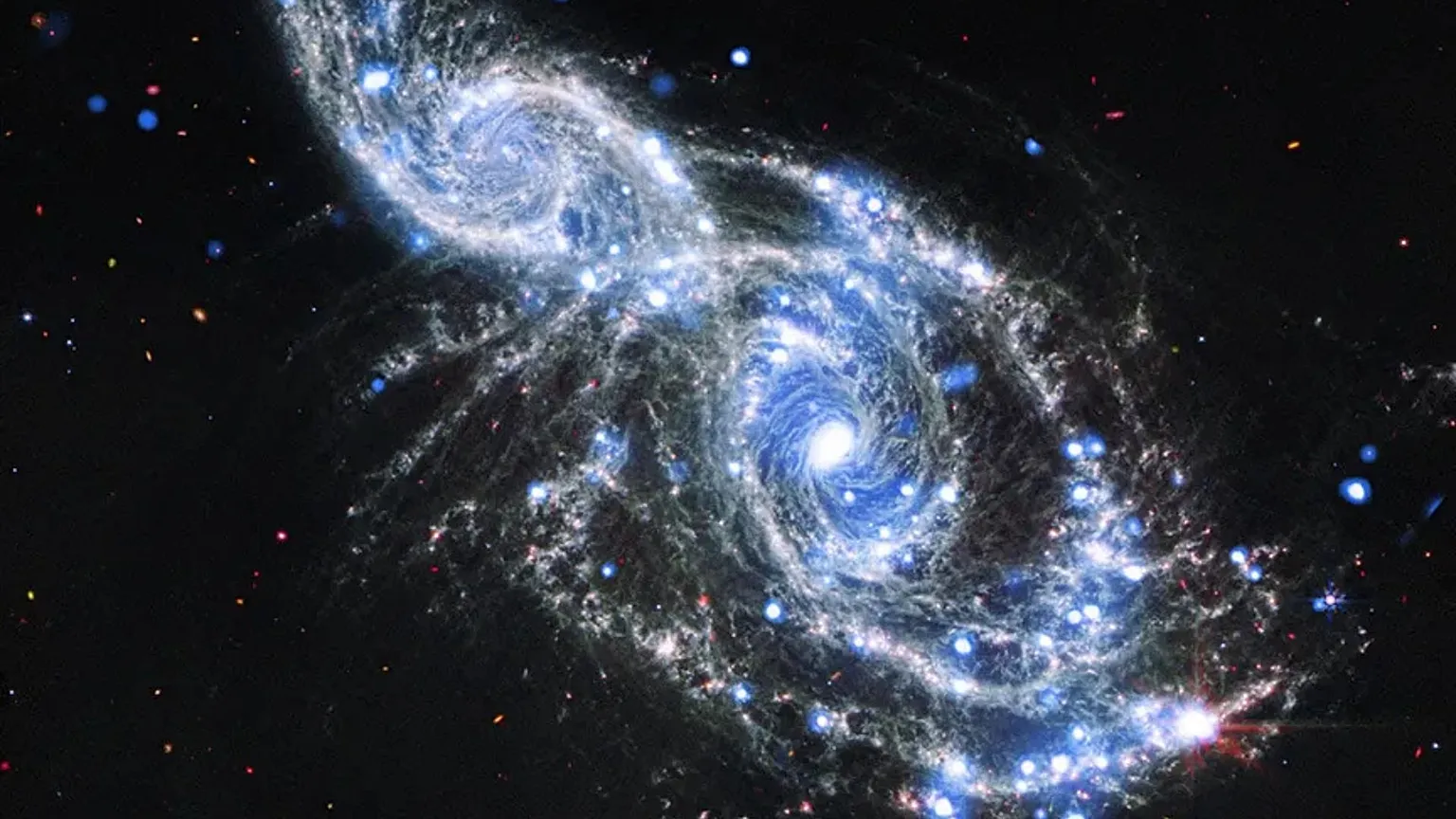
Today the scientific world is celebrating a monumental achievement as NASA and the European Space Agency (ESA) have released a breathtaking new image from the James Webb Space Telescope (JWST). This visual masterpiece provides an unprecedented look at the chaotic and transformative process that occurs when two massive galaxies collide, a cosmic event that reshapes the very fabric of the universe. The image, captured with Webb’s Near-Infrared Camera (NIRCam) and Mid-Infrared Instrument (MIRI), reveals a “bridge” of stars and gas stretching across the void, marking the slow-motion destruction and simultaneous rebirth of these galactic giants.
The Anatomy of a Cosmic Smash-up
The galaxies in question, part of a system located millions of light-years away, are currently locked in a gravitational embrace that began hundreds of millions of years ago. As they draw closer, the immense gravity of each galaxy pulls on the other, distorting their once-perfect spiral arms into long, wispy “tidal tails.” These tails are composed of billions of stars and massive clouds of gas that have been stripped away from their original homes.
One of the most striking features of the new image is the luminous bridge of gas connecting the two nuclei. Unlike previous observations from the Hubble Space Telescope, Webb’s infrared eyes can pierce through the thick veils of cosmic dust that usually shroud these regions. This has allowed scientists to see individual star clusters forming within the bridge itself. The collision has compressed the cold hydrogen gas, triggering a “starburst”—a period of frenzied star formation where new suns are born at a rate twenty times faster than in our own Milky Way.
Scientific Revelations: A Runaway Mystery
Perhaps the most shocking discovery tied to this observation is the confirmation of a runaway supermassive black hole. Astronomers noticed a bizarre, 200,000 light-year-long streak of light trailing away from the site of the collision. Using Webb’s spectroscopic data, they confirmed that a black hole, weighing 10 million times the mass of the sun, was ejected from the center of the merging galaxies. It is now rocketing through intergalactic space at a staggering 2.2 million miles per hour (1,000 kilometers per second).
This phenomenon occurs when a third galaxy joins the fray, or when the two central black holes of the merging galaxies fail to merge smoothly, creating a gravitational “kick” that flings one of them out. “The forces that are needed to dislodge such a massive black hole from its home are enormous,” noted Robert Lea, a leading researcher on the project. “With the JWST, we discovered the huge displacement of the gas at the tip of the wake… the shock signatures are crystal clear, and there is just no doubt about what is happening here.”
The Future of Our Own Galaxy
This observation serves as a grim yet beautiful preview of the future of our own neighborhood. In about 4 billion years, the Milky Way is destined to collide with the Andromeda Galaxy. While the term “collision” sounds violent, the vast distances between stars mean that individual stars rarely hit one another. Instead, the galaxies will pass through each other, eventually merging into a single, massive elliptical galaxy.
“An encounter with another galaxy would be quite spectacular,” explained astronomer Pieter van Dokkum. “When this shock wave encounters the dense gas of another galaxy, it would compress and shock that gas and likely form a lot of new stars. It would be quite the show!”
Summary of Key Findings
| Feature | Observation Detail |
| Object Name | Interacting Galaxy Pair (Arp System) |
| Star Formation | Triggered “starburst” regions appearing in bright red and gold |
| Black Hole | Confirmed runaway supermassive black hole at 2.2 million mph |
| Structural Change | Formation of a 200,000 light-year-long bridge of stars |
| Distance | Approximately 9 billion light-years (for the runaway black hole system) |