
April 12, 2026
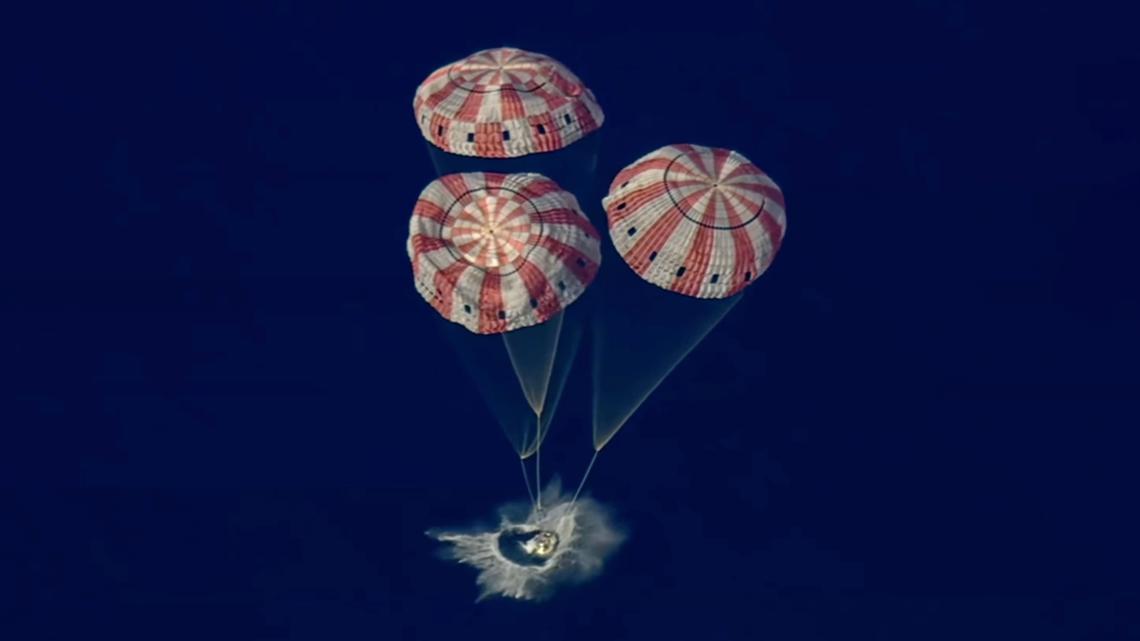
The vast, quiet expanse of the Pacific Ocean became the center of the world today as NASA’s Artemis 2 capsule, Odyssey, plunged through Earth’s atmosphere at nearly 25,000 miles per hour before unfurling a series of orange-and-white parachutes and splashing down gently off the coast of San Diego, California. The successful return of the four astronauts—Commander Reid Wiseman, Pilot Victor Glover, Mission Specialist Christina Hammock Koch, and Canadian Space Agency astronaut Jeremy Hansen—marks the triumphant conclusion of the first crewed lunar mission in over half a century. “Splashdown confirmed. Welcome home, Artemis 2,” came the calm voice of NASA’s Mission Control in Houston as the capsule hit the water at 2:17 PM EDT, precisely on schedule after a ten-day, 600,000-mile journey that took the crew farther from Earth than any humans have ever traveled.
The re-entry and descent were textbook. After separating from the European-built service module hours earlier, the Orion capsule oriented its heat shield—the largest of its kind ever built—to face the blistering plasma inferno generated by atmospheric friction. Temperatures outside the capsule soared to 5,000 degrees Fahrenheit, nearly half the surface temperature of the sun, while inside, the crew remained in stable, cool conditions. As the drogue parachutes deployed at 25,000 feet, followed by the three main canopies at 8,000 feet, the descent slowed to a gentle 17 miles per hour. A fleet of NASA recovery ships, including the brand-new USS Recovery, had been stationed within a four-mile radius for weeks, ready to hoist the capsule aboard within minutes. The moment the hatch opened at 3:05 PM EDT, a team of flight surgeons and technicians rushed forward to conduct initial health checks. All four astronauts emerged smiling, though visibly weakened by ten days of microgravity, waving to a live global audience of millions.
The mission itself, launched on April 2, 2026, from Kennedy Space Center’s Launch Complex 39B, was a masterpiece of modern spaceflight. Unlike the uncrewed Artemis 1, Artemis 2 carried a live crew into a hybrid free-return trajectory around the moon. On April 8, 2026, the crew made history when Odyssey slipped into a lunar distance of just 80 miles above the moon’s surface—closer than any Apollo mission. Commander Wiseman piloted the capsule through a series of maneuvers that tested the upgraded life-support systems, deep-space communications, and the new autonomous docking technology that will be critical for Artemis 3’s planned lunar landing in 2027. The crew spent two full days in lunar orbit, conducting scientific observations and deploying a set of small CubeSats to map permanently shadowed craters at the moon’s south pole—the target zone for future landings.
Perhaps the most poignant moment came during a live broadcast on April 9, 2026, when the astronauts read the names of 12,000 NASA employees and contractors who had worked on the Artemis program, each name stenciled onto a microchip carried inside the capsule. “We are standing on the shoulders of giants, but also beside the most dedicated engineers, welders, and software writers on Earth,” said Dr. Christina Koch, speaking in a calm, measured tone while the gray, cratered lunar horizon rolled past the window behind her. “The moon is not the destination. It is a proving ground. Today, we proved that humanity is ready to stay.” Her words echoed across social media and news networks, instantly becoming the defining quote of the mission.
Scientifically, Artemis 2 has already delivered a treasure trove of data. The astronauts tested a new radiation-vest shielding system that reduced cosmic-ray exposure by 40% compared to Apollo-era measurements. They also harvested 50 pounds of lunar regolith simulant from a storage container that had been exposed to the deep-space environment—a precursor to sample-return techniques for Mars. “The biological samples from the crew’s blood, bone marrow, and gut microbiome, collected both before and after flight, are unprecedented,” explained Dr. Elena Vasquez, NASA’s lead space medicine researcher, in a press conference following the splashdown. “We are seeing, for the first time, exactly how the human body repairs DNA damage from galactic cosmic rays within 72 hours of returning to Earth. This changes everything for a Mars mission.”
The geopolitical importance of this mission cannot be overstated. Unlike the Apollo program, which was a Cold War sprint, Artemis is built for sustained international cooperation. Alongside NASA, the Canadian Space Agency, ESA, and JAXA all have key roles. Jeremy Hansen, the first non-American to fly beyond low Earth orbit, carried a flag of the Artemis Accords, now signed by 48 nations. “This is not one country’s achievement,” Hansen said from the recovery deck, still wrapped in a thermal blanket. “It is a declaration that the moon’s resources—water ice, rare earth metals, and the eternal sunlight at its peaks—belong to all of humanity, to be used peacefully.”