
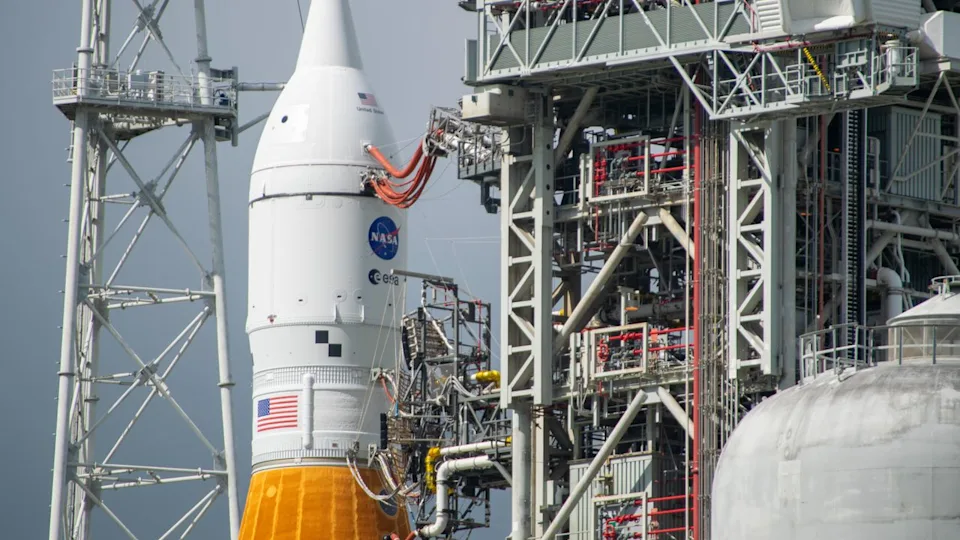
NASA has announced a significant delay in its Artemis program, postponing a critical fueling test of the Space Launch System (SLS) rocket due to unseasonably cold weather at the Kennedy Space Center in Florida. The decision, made out of an abundance of caution, pushes the pivotal “wet dress rehearsal” for the Artemis 2 mission—which will send four astronauts around the Moon—by at least a week. The agency now states the test is targeted for no earlier than Saturday, February 8, with the subsequent crewed launch itself delayed to no earlier than September 2026. This postponement underscores the immense complexity and sensitivity of the world’s most powerful rocket and the unforgiving challenges posed by Earth’s own environment in preparing for deep space exploration.
The wet dress rehearsal is a full-scale practice run of the entire launch countdown, where the 322-foot-tall SLS rocket is rolled to Launch Pad 39B, powered up, and loaded with over 730,000 gallons of super-cooled liquid hydrogen and liquid oxygen propellants. The countdown proceeds to within approximately ten seconds of engine ignition before safely recycling. This test is designed to validate timelines, procedures, and ground systems, and to ensure the rocket and Orion spacecraft perform as expected under cryogenic conditions. The primary concern leading to the delay is the sustained forecast of temperatures dipping below the 40-degree Fahrenheit (4.4-degree Celsius) threshold established for the safe operation of ground support equipment. Prolonged exposure to freezing conditions risks ice formation on crucial umbilical lines and valves, which could damage seals or impede their function. Furthermore, certain components of the mobile launcher, the massive structure that supports the rocket at the pad, have prescribed temperature limits for operation. As NASA’s Artemis 2 Mission Manager, Jeremy Parsons, explained in a press briefing, “The systems on the mobile launcher, particularly the environmental control and pneumatics, have very specific operational envelopes. Pushing them in sustained freezing temperatures introduces an unacceptable risk of failure or damage that could lead to a longer setback than a prudent delay.”
This weather-related delay is a stark reminder that even as NASA aims for the Moon, it remains at the mercy of terrestrial weather. The liquid hydrogen fuel, chilled to -423 degrees Fahrenheit (-253 degrees Celsius), presents an extreme engineering challenge in itself. Adding ambient temperatures near or below freezing creates a complex thermal management puzzle, increasing the potential for unexpected condensation and ice accumulation on systems not designed for such conditions. The decision highlights NASA’s rigid adherence to a “safety-first” philosophy, especially for the first crewed mission of the SLS rocket and Orion spacecraft. The Artemis 2 crew—NASA astronauts Reid Wiseman, Victor Glover, and Christina Koch, and Canadian Space Agency astronaut Jeremy Hansen—are training extensively, and the agency will not greenlight any test that unnecessarily risks the vehicle intended to carry them. In a statement, Artemis 2 Commander Reid Wiseman supported the decision, stating, “Every step of this mission is about learning and ensuring we are ready. The team on the ground is making the right call. We’d rather be on the ground wishing we were flying than in the air wishing we were on the ground.”
The delay has a cascading effect on the overall mission timeline. The wet dress rehearsal is the final major test before the rocket is rolled back to the Vehicle Assembly Building for final integrations and closeouts. A successful test on February 8 would keep the agency on track for a September launch, but any issues discovered during the fueling exercise could necessitate further delays. NASA officials emphasized that the new target date is fluid and dependent on both the weather improving and the test proceeding flawlessly. Catherine Koerner, NASA’s associate administrator for Exploration Systems Development, noted, “The Artemis 2 mission is a critical pathfinder for returning humans to the lunar surface. The data from this wet dress rehearsal is invaluable. While schedule is important, achieving the test objectives thoroughly and safely is paramount.”
This postponement echoes challenges faced during the Artemis 1 wet dress rehearsal campaign in 2022, which encountered multiple technical issues and required several attempts before completion. However, NASA has since implemented upgrades and procedural changes based on those lessons. The current team is confident in the vehicle’s readiness but respectful of the procedural hurdles that remain. Beyond the immediate weather, the agency is also closely monitoring a separate technical concern involving a valve on the Orion spacecraft’s life support system, though engineers have stated this is not a contributor to the current test delay and is expected to be resolved during the final integration phase.
The Artemis 2 mission represents a historic return of humans to lunar vicinity for the first time since Apollo 17 in 1972. The ten-day flight will see the crew travel approximately 6,400 miles beyond the far side of the Moon, testing Orion’s systems with astronauts aboard and validating the life support, communication, and navigation capabilities needed for future long-duration missions. As a foundational step toward establishing a sustained lunar presence and eventually launching crewed missions to Mars, every milestone is scrutinized. The delay, while a temporary setback, is framed by the agency as a necessary and prudent step in the meticulous process of human spaceflight. All eyes will now be on the Florida weather in early February and the performance of the towering SLS rocket as it undergoes its final major test before it is entrusted with the lives of its four pioneering crewmembers.