March 27, 2026
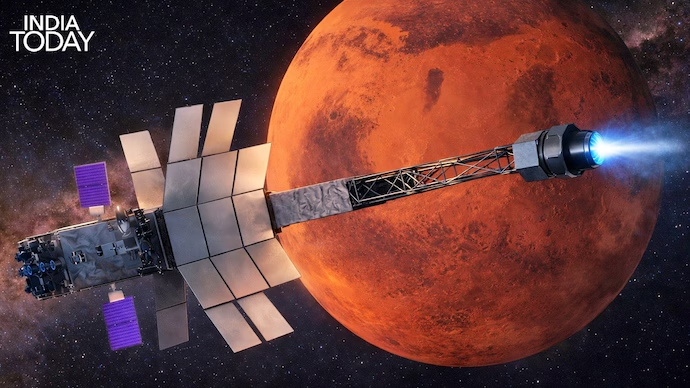
In a landmark announcement that signals a new era for deep-space exploration, NASA has officially confirmed the development of its first nuclear-powered interplanetary spacecraft, the Space Reactor-1 (SR-1) Freedom. Slated for a December 2028 launch, the mission represents a radical departure from traditional solar and chemical propulsion. By leveraging Nuclear Electric Propulsion (NEP), the SR-1 Freedom will transport the ambitious Skyfall payload—a triad of advanced helicopters—to the Red Planet, arriving by late 2029. This mission is designed not just as a technological demonstration, but as a critical scouting operation to pave the way for human boots on Martian soil.
The heart of the SR-1 Freedom is a 20-kilowatt fission reactor fueled by High-Assay Low-Enriched Uranium (HALEU). Unlike the radioisotope thermoelectric generators (RTGs) used in past missions like Voyager or Curiosity, which provide passive electricity through radioactive decay, the SR-1 uses a live fission chain reaction to generate massive amounts of thermal energy. This heat is converted into electricity via an Advanced Closed Brayton Cycle, which then powers high-efficiency ion thrusters. This system allows the spacecraft to move heavy cargo with the reliability of a “space railroad,” independent of the Sun’s distance or the intensity of Martian dust storms.
The Skyfall Fleet: Mars’ New Aerial Scouts
Upon arrival at Mars, the spacecraft will deploy the Skyfall helicopters, a fleet of three rotorcraft that build upon the legacy of the history-making Ingenuity drone. However, while Ingenuity was a proof-of-concept, the Skyfall units are fully equipped scientific workhorses. Their primary objective is to identify subsurface water ice and evaluate potential landing sites for human-scale landers. Each helicopter is outfitted with ground-penetrating radar and high-resolution cameras to map slopes and hazards that traditional rovers cannot access.
“The Skyfall helicopters will carry cameras and ground-penetrating radar to scout a future landing site, to understand the slopes and hazards for human-scale landers,” stated Steve Sinacore, Program Executive for NASA’s Space Reactors Office. He further emphasized the strategic importance of the mission, noting, “SR-1 Freedom will establish flight-heritage nuclear hardware, set regulatory and launch precedent, and activate the industrial base for future fission power systems.”
A Bridge to the Future
The mission’s timing is no coincidence. By launching in 2028, NASA aims to capitalize on the 250th anniversary of the United States, framing the SR-1 Freedom as a symbol of American innovation. The spacecraft itself utilizes repurposed hardware from the Lunar Gateway’s Power and Propulsion Element, demonstrating a pivot toward more cost-effective, modular space architecture. NASA Administrator Jared Isaacman has highlighted that this technology is the “foundation for everything that follows,” suggesting that if successful, NEP could reduce Mars transit times by 25% to 50% in the future.
Critical Mission Milestones
-
June 2026: Completion of the final design and commencement of hardware development.
-
January 2028: Beginning of spacecraft assembly and rigorous environmental testing.
-
December 2028: Target launch window for the SR-1 Freedom from Kennedy Space Center.
-
Late 2029: Arrival at Mars, followed by the “Skyfall” deployment sequence where helicopters exit the entry capsule during atmospheric descent.
The safety protocols for the mission are unprecedented. The reactor will remain dormant during launch and will only be activated once the spacecraft is in a stable trajectory away from Earth, roughly 48 hours after liftoff. This ensures that no radioactive material is active during the high-risk ascent phase. As NASA moves toward a “sustained cadence” of missions, the SR-1 Freedom stands as a pathfinder for a future where nuclear energy makes the outer solar system—from the asteroid belt to the moons of Jupiter—truly accessible.