

January 12, 2025 – Giza Plateau, Egypt.
In a breakthrough that merges cutting-edge 21st-century technology with the enduring mysteries of antiquity, an international team of scientists announced today the discovery of a hidden corridor buried deep within the Great Pyramid of Giza. The revelation came after researchers successfully navigated a flexible, 6-millimeter-thick endoscope through a minuscule gap above the pyramid’s main entrance, capturing the first-ever images of a space untouched for over 4,500 years.
The discovery is the latest and most visually definitive result from the ongoing ScanPyramids project, a multinational mission launched in 2015 that uses non-invasive muon radiography, infrared thermography, and 3D simulations to peer inside the world’s most famous ancient monuments. For years, muon tomography—a technique that uses cosmic-ray particles to detect voids—had indicated the presence of a significant empty space behind the chevron stones on the pyramid’s north face. However, confirming its nature and purpose required direct visual evidence. On Tuesday, engineers from the Technical University of Munich, in collaboration with the French Heritage Innovation and Preservation (HIP) Institute and Egypt’s Supreme Council of Antiquities, performed the delicate endoscopic procedure. A custom-built endoscope, thinner than a pen, was carefully threaded through a tiny joint between the massive limestone blocks, relaying live video footage to a breathless team of archaeologists and physicists.
What the camera revealed was a pristine, unfinished corridor, approximately 9 meters (30 feet) in length and 2.1 meters (7 feet) in width, with a rough-hewn, gabled ceiling characteristic of relieving chambers. The space exhibited no artifacts or markings, but its very existence is a monumental piece of architectural data. The corridor’s design and location, directly behind the descending entrance corridor, strongly suggest it was built to redistribute weight and relieve structural stress from the passageway below, a brilliant engineering solution by the pyramid’s builders to prevent collapse. This theory aligns with the function of other known relieving chambers found above the King’s Chamber. Dr. Christian Grosse, of the Technical University of Munich, who led the measurement campaign, stated, “This corridor, while empty, is a blueprint of the builder’s mind. Its construction technique, the angle of its roof—every detail provides critical data for understanding how the greatest architect of the Old Kingdom, Pharaoh Khufu, achieved this timeless construction.”
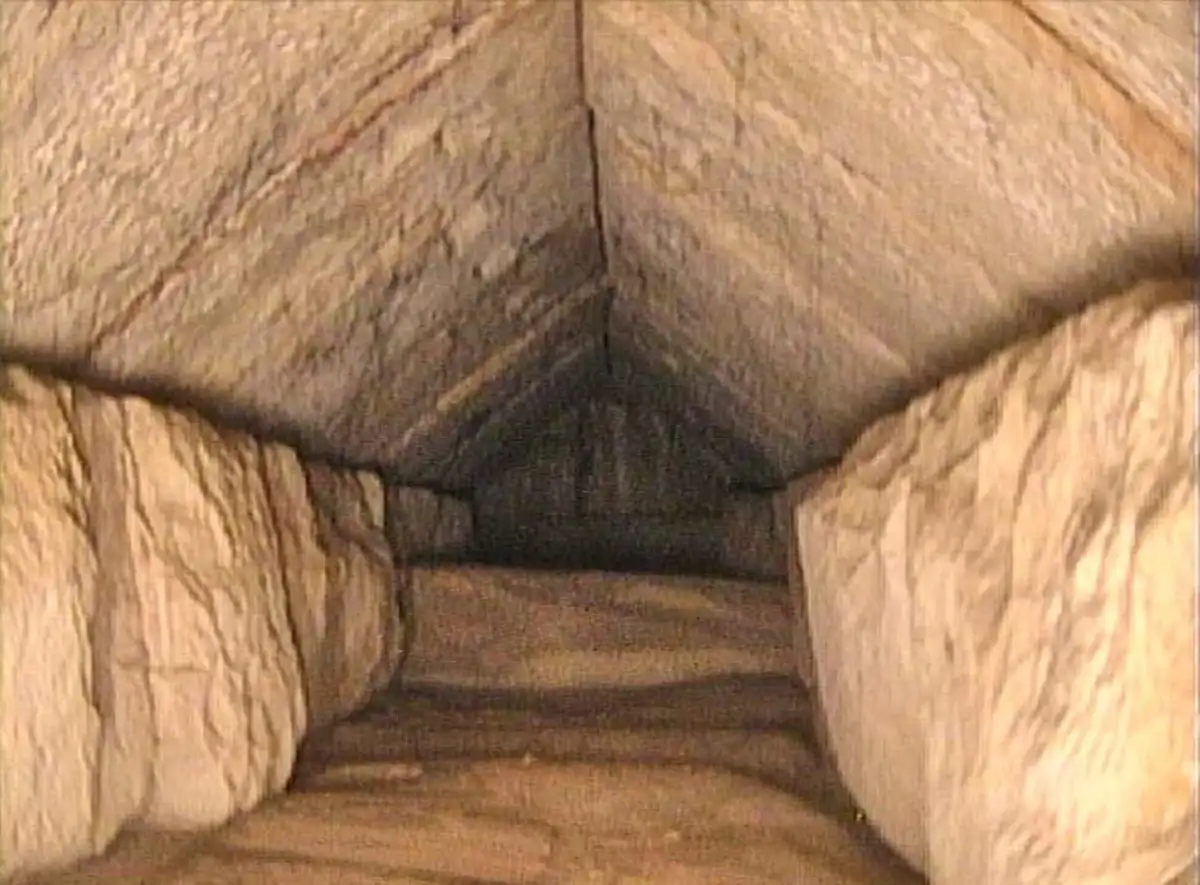
The operation was a feat of modern engineering in its own right. The team had to ensure not a single gram of dust was disturbed, using a blimp-like airship to position the endoscope without touching the ancient stones. Zahi Hawass, the former Egyptian Minister of Antiquities and a key figure on the project, emphasized the historical weight of the moment: *“This is a discovery of the utmost importance. It is the first major inner structure found in the Great Pyramid since the 19th century. It confirms that the pyramid still holds secrets, and that modern technology has finally allowed us to non-invasively peer into the age of the pharaohs.”* The visual confirmation ends years of speculation about the muon scan anomalies, moving the mystery from detection to interpretation.
The discovery immediately reignites fundamental debates about the pyramid’s internal architecture and purpose. While the leading theory remains a structural one, the finding opens new lines of inquiry. Some researchers posit that the corridor could be a previously unknown access route to yet-undiscovered chambers, or part of a more complex system of weight distribution. Dr. Kate Spence, an archaeologist at the University of Cambridge not directly involved in the project, noted, “The precision of the pyramid’s construction is staggering. A void this large isn’t an accident; it’s deliberate. Each new discovery like this helps us move from seeing the pyramid as a monolithic tomb to understanding it as a dynamic, engineered structure where every element has a calculated function.”
Beyond the specific find, the success of the endoscopic probe marks a watershed for archaeological methodology. The non-destructive nature of the technique sets a new global standard for exploring culturally sensitive heritage sites, allowing investigation without drilling or causing damage. This is particularly crucial for the Great Pyramid, where the ethical imperative to preserve the monument is as strong as the drive to understand it. Hany Helal of Cairo University, co-director of the ScanPyramids mission, highlighted this, saying, “We have crossed a threshold. For decades, exploration meant intrusion. Today, we have demonstrated that we can investigate, verify, and document using tools so fine they leave no trace. This is the future of archaeology.”
The announcement, made at a press conference at the Giza Plateau with live footage from the endoscope, sent ripples through the global academic community and captured the world’s imagination. Social media lit up with discussions, blending popular fascination with ancient aliens and lost treasures with genuine admiration for the scientific achievement. Egyptian officials were quick to contextualize the find within both national heritage and tourism, a vital sector for the country’s economy. The corridor is expected to be a focal point for future, more detailed scans and, potentially, the development of robotic explorers that can map its full extent.
As the sun set on the Giza Plateau on January 12, 2025, the Great Pyramid stood unchanged to the naked eye. Yet, internally, a chapter of its story, long sealed in darkness, had been brought to light. The hidden corridor, a masterpiece of ancient engineering, was finally witnessed by human eyes, not through force, but through the deft application of human ingenuity—a fitting tribute to the original builders whose own ingenuity created one of the Seven Wonders of the Ancient World. The find proves that even the most studied monuments on Earth still guard their secrets, waiting for the right key to be found.