
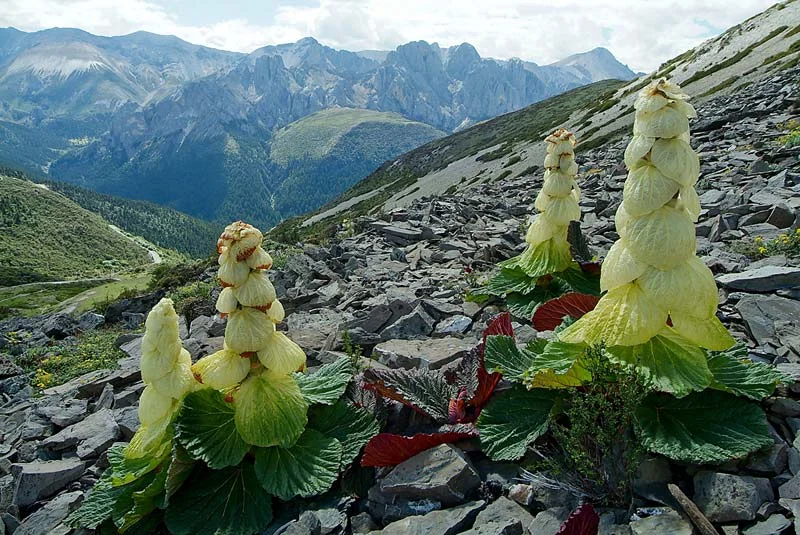
Deep in the windswept, high-altitude reaches of the Eastern Himalayas, where the air grows thin and the landscape turns to a stark palette of rock and snow, lives a botanical marvel known locally as the Sikkim Sundari. Scientifically classified as Rheum nobile (commonly known as the Noble Rhubarb or Sikkim Rhubarb), this plant is far more than a mere high-altitude weed; it is a masterclass in evolutionary patience and architectural brilliance. Rising from the ground like a glowing, ivory-colored pagoda, the Sikkim Sundari is a monocarpic giant—a plant that spends decades quietly storing energy in the harshest conditions on Earth, only to bloom in one magnificent, final act of glory before surrendering its life to the mountains.
The life cycle of the Sikkim Sundari is a testament to the virtue of waiting. For a period spanning anywhere from seven to thirty years, the plant exists as a humble, low-lying rosette of glossy green leaves. During these decades, it remains inconspicuous, hugging the freezing earth at altitudes between 4,000 and 4,800 meters. While other flora might rush to flower annually, the Sundari is a strategic hoarder, channeling every bit of photosynthesis and nutrient absorption into a massive, bright yellow taproot that can grow up to seven feet long and as thick as a human arm. This underground reservoir is its life insurance, a battery of energy being charged for a singular, explosive event.
When the internal biological clock finally signals that enough energy has been stored, the plant undergoes a dramatic transformation. Almost overnight, it shoots upward, reaching heights of up to two meters. It does not produce a traditional “flower” in the aesthetic sense most are accustomed to; instead, it creates a towering conical spike composed of delicate, translucent, straw-colored bracts. These bracts overlap like the scales of a mythical creature, shimmering with a pearlescent light that makes the plant visible across mountain valleys for miles. This structure has earned it the nickname “The Glasshouse Plant,” as these papery leaves act as a natural greenhouse, trapping solar radiation to create a warm microclimate for the tiny, fragile green flowers hidden safely within. This ingenious adaptation protects the reproductive organs from the lethal ultraviolet rays and sub-zero winds of the alpine zone.
The finale of the Sikkim Sundari’s life is as poignant as it is beautiful. Once the bracts have served their purpose and the seeds are successfully dispersed, the once-luminous tower begins to wither. The straw-colored scales turn a coarse reddish-brown, and the towering stalk becomes a dark, skeletal silhouette against the snow. Having exhausted every ounce of its decades-old energy reserve in this one-time reproductive frenzy, the plant dies. It leaves behind thousands of seeds to be scattered by the Himalayan winds, starting the thirty-year countdown anew for the next generation. For travelers and locals alike, witnessing a Sikkim Sundari in full bloom is considered a rare privilege—a fleeting glimpse of a plant that spent a lifetime preparing for its one and only moment in the sun.