March 22, 2026
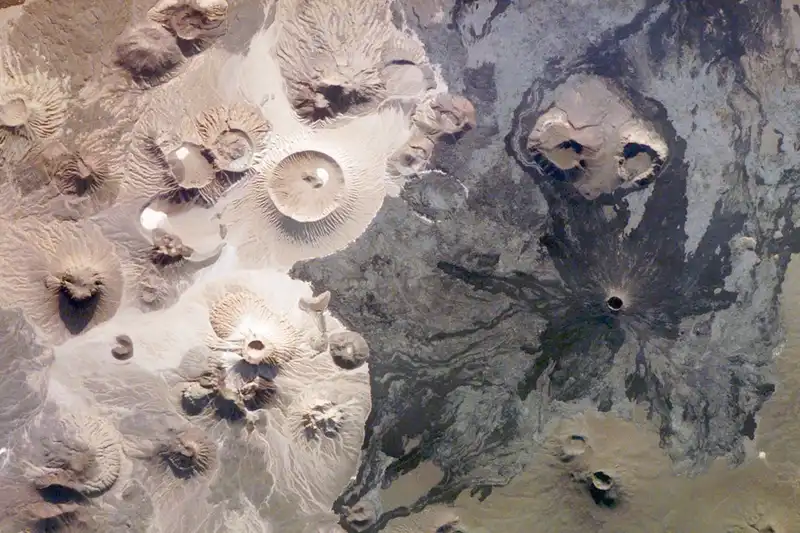
In a discovery that has sent shockwaves through the global archaeological community, a massive complex of nearly 400 stone structures has been identified in the Harrat Khaybar region of northwestern Saudi Arabia. Known colloquially as the “Gates of Hell,” this desolate volcanic field—once considered a geological wasteland—is now being recognized as one of the most significant prehistoric landscapes on Earth. The structures, nicknamed “gates” because of their resemblance to traditional field gates when viewed from above, consist of low stone walls built from local basalt. Despite their immense scale, some stretching over 1,700 feet in length, their original purpose remains a profound mystery, defying traditional classification as homes, burial sites, or animal traps.
The identification of these ruins was made possible through a combination of high-resolution satellite imagery and pioneering fieldwork by the Aerial Archaeology in the Kingdom of Saudi Arabia (AAKSA) project. Experts believe the structures date back to the Neolithic period, roughly 7,000 to 9,000 years ago, a time when the Arabian Peninsula was significantly wetter and greener than the arid desert seen today. These “gates” were often constructed directly on volcanic domes, and in several instances, archaeologists found that subsequent lava flows had partially covered the stone walls, providing a “frozen in time” snapshot of a civilization that thrived amidst a volatile, erupting landscape.
Expert Analysis and Scientific Statements
While the sheer number of structures is staggering, it is their lack of an obvious utility that puzzles researchers most. Unlike the “desert kites”—funnel-shaped walls used for hunting—the gates do not appear to have any tactical or domestic function. “Gates are found almost exclusively in bleak, inhospitable lava fields with scant water or vegetation, places seemingly amongst the most unwelcoming to our species,” stated Professor David Kennedy of the University of Western Australia, who has led the remote sensing efforts in the region. He further emphasized the age and uniqueness of the find, noting that the walls “appear to be the oldest man-made structures in the landscape,” yet admitted that “no obvious explanation of their purpose can be discerned.”
Recent excavations at nearby mustatils (rectangular stone monuments) have offered a potential clue, suggesting a ritualistic or symbolic motivation. Dr. Hugh Thomas, a lead archaeologist on the project, believes these structures reflect a complex social and religious hierarchy. “The reality is that in the Neolithic period these areas were significantly greener, and there would have been really sizeable populations of people and herds of animals moving across these landscapes,” Thomas explained to international news outlets. He suggests that the structures might be linked to a prehistoric cattle cult, where the “gates” served as markers of territorial boundaries or sites for ceremonial pilgrimages. “With the artefacts that are inside, and also the construction techniques that are involved in creating them, there is no practical function for these structures, other than ritual, that would make any sense,” he added.
The Scale of the “Gates of Hell” Discovery
The architectural diversity found within the 14,000-square-kilometer lava field is unparalleled. Beyond the “gates,” researchers have documented “bullseyes,” “wheels,” and “keyhole tombs,” suggesting a long-term human presence that adapted to shifting climates. The “gates” themselves are built from undressed stone, with some featuring a “I” shape and others appearing as long, thin rectangles. The labor required to move these heavy basalt blocks across uneven, jagged lava fields indicates a highly organized social structure capable of coordinated collective labor.
| Feature | Description | Estimated Age |
| Gates | Long, low rectangular stone walls found on volcanic domes. | 9,000 years |
| Mustatils | Ritual rectangular monuments often containing animal offerings. | 7,000 years |
| Desert Kites | Massive funnel structures used for ancient mass-hunting. | 8,000+ years |
| Pendant Tombs | Circular cairns with long “tails” of stones, likely burial sites. | 4,000-5,000 years |
The Mystery of the Purpose
Because the walls are too low to contain livestock and the sites are frequently located in areas with no access to water, the theory of ritual pilgrimage has gained the most traction. The “Gates of Hell” might have acted as a symbolic gateway for the dead or a site for astronomical observation. However, without written records or more extensive internal excavations, the true intent of the builders remains locked in the basalt. The 2025–2026 archaeology season in Saudi Arabia is currently focusing on carbon-14 dating and Lidar surveys to peek beneath the surface of these ruins, hoping to find the hearths or tools of the people who once called this “hellish” landscape home.
As researchers continue to map the millions of stone structures across the peninsula, the story of the “Gates of Hell” serves as a reminder of how much of human history remains hidden in plain sight. For now, these massive stone outlines stand as a silent testament to an ancient people’s ingenuity and their deep, albeit mysterious, connection to the land.