February 23, 2026 GREENBELT, Md.
In a revelation that bridges the gap between theoretical astrophysics and cinematic disaster, NASA has released a comprehensive new explainer detailing the catastrophic chain of events that would unfold if our planet were to stray too close to a black hole. While the scenario remains firmly in the realm of science fiction for the foreseeable future, the space agency’s latest public outreach effort uses the hypothetical to illuminate the bizarre and violent physics governing these cosmic enigmas.
According to the analysis, compiled from decades of observational data and Einstein’s theories of relativity, the scenario would begin not with a bang, but with a subtle, almost imperceptible drift. If Earth were to leave the habitable orbit of the Sun and venture toward one of these gravitational behemoths, the first signs of trouble would be detected by advanced instruments monitoring gravitational anomalies long before any visual confirmation. However, the moment Earth crossed a critical threshold—the point where the black hole’s tidal forces exceed the planet’s own gravity—the end would begin in earnest.
The primary mechanism of destruction, NASA explains, is a process vividly termed “spaghettification.” This occurs due to the extreme tidal forces generated by the black hole’s immense gravity. Because gravity weakens with distance, the pull on the side of Earth facing the black hole would be exponentially stronger than the pull on the far side.
“Imagine taking a ball of pizza dough and stretching it until it becomes a single, long strand,” explained Dr. Elena Vance, an astrophysicist at NASA’s Goddard Space Flight Center, in the report. “The tidal forces are so violent that they overcome the electromagnetic forces holding solids together. Earth’s crust, oceans, and core would be pulled apart into a stream of superheated plasma.”
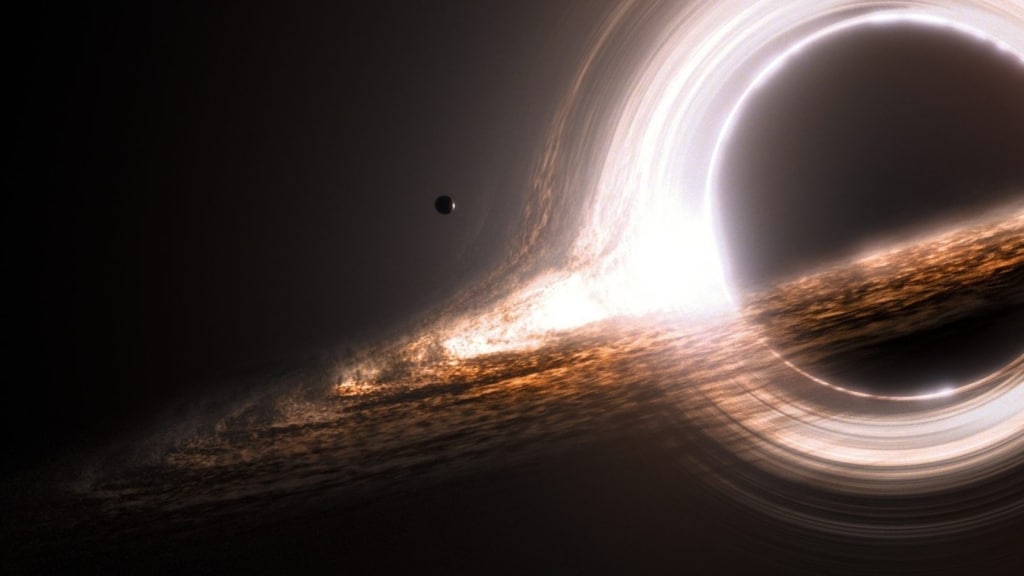
This would not be a clean break. As the planet approached the event horizon—the theoretical boundary from which nothing, not even light, can escape—it would be ripped asunder. The iron core, the rocky mantle, and the vast oceans would be stretched into an incandescent spiral of debris, swirling around the black hole like water circling a drain. This superheated material would collide with itself, generating incredible amounts of X-rays and high-energy radiation, effectively vaporizing any remaining solid matter.
Simultaneously, a bizarre temporal phenomenon would take hold. Due to gravitational time dilation, a cornerstone of Einstein’s general theory of relativity, time itself would warp.
“To a distant observer watching this tragedy with a powerful enough telescope, Earth would appear to slow down,” Dr. Vance elaborated. “As the planet approached the event horizon, its descent would seem to freeze. You would see an image of Earth, stretched and distorted, hanging on the edge of the black hole forever, slowly fading to red as the light struggles to escape the gravity well. From Earth’s perspective, however, the fall would be instantaneous.”
NASA’s report distinguishes between the two main types of black holes to paint a fuller picture. If Earth encountered a stellar-mass black hole, which packs the mass of several suns into an area roughly the size of a city, the spaghettification would occur long before the planet reached the event horizon. The gravitational gradient would be so sharp and intense that Earth would be torn apart from a distance, the debris never even making it to the “surface” of the invisible object.
Conversely, approaching a supermassive black hole—like Sagittarius A* at the center of our Milky Way galaxy, which has the mass of millions of stars—presents a different, though equally fatal, scenario. Because the event horizon of a supermassive black hole is so vast, the tidal forces at that boundary are relatively gentle. In this case, Earth might actually cross the event horizon before being torn apart. For a brief, unknowable moment, our planet would be inside the black hole, having crossed the point of no return, before being crushed into the central singularity.
Despite the dramatic and terrifying nature of these findings, NASA emphasizes that the public has absolutely nothing to fear. The probability of a rogue black hole entering our solar system is astronomically low. The known black holes in our galaxy are either too distant or too small to pose a threat to Earth’s orbit.
“Space is incomprehensibly vast,” Dr. Vance reassured readers. “We can map the trajectories of massive objects for millions of years into the future. There is no incoming object, no gravitational ‘boogeyman,’ on a collision course with our Sun. This exercise is purely educational—a way to use our imagination to test the limits of physics and better understand the universe we live in.”
For now, Earth remains safe in its familiar orbit, drifting through the cosmos at a comfortable 93 million miles from the Sun, far removed from the hungry depths of spacetime.