
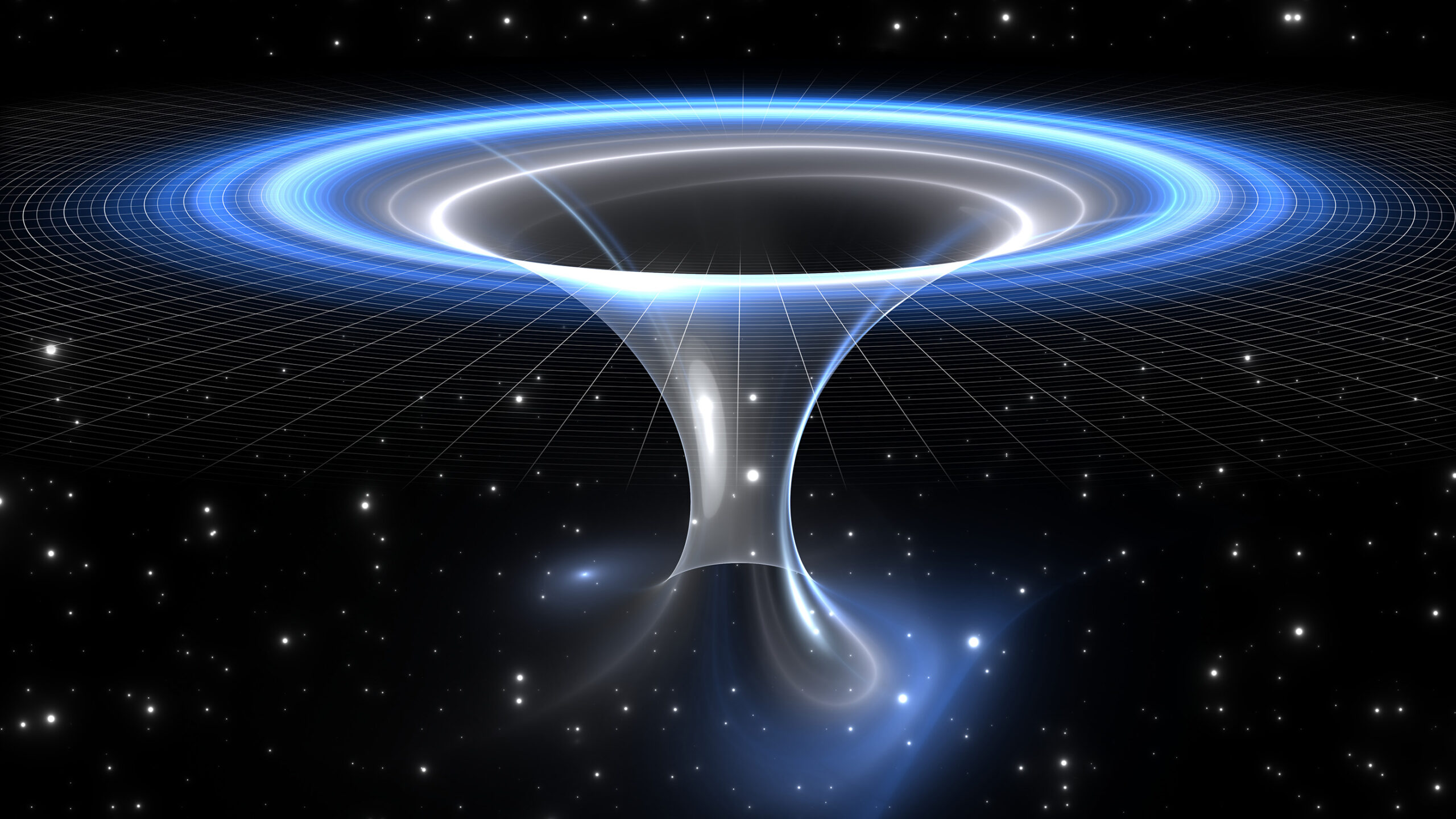
The intellectual journey of the wormhole began not as a portal for space travelers, but as a mathematical curiosity. In 1916, just months after Karl Schwarzschild found the first exact solution to Einstein’s new equations of general relativity (describing a black hole), the physicist Ludwig Flamm noticed another peculiar aspect: it seemed to describe a hidden connection between two separate regions of spacetime . This idea was revisited and formalized in 1935 by Albert Einstein and his colleague Nathan Rosen. They were attempting to unify gravity with electromagnetism and, in the process, described what they called a “bridge.” This bridge was a theoretical connection between two points in spacetime, a feature inherent to the maximally extended Schwarzschild solution, which describes an eternal black hole. In this model, the black hole’s interior connects not to a singularity in the familiar sense, but to a “white hole” in a separate universe, creating a passageway . The term “wormhole” itself was coined later, in 1957, by the American physicist John Archibald Wheeler, who vividly described these topological features as “handles” in the fabric of space .
However, the initial excitement surrounding the Einstein-Rosen bridge was soon tempered by a stark reality check. In 1962, physicists Robert Fuller and John Wheeler demonstrated that this specific type of wormhole is catastrophically unstable. The bridge, they showed, pinches off so quickly that not even a beam of light could travel from one end to the other before it collapses into a singularity. The connection is severed in an instant, making it non-traversable . For decades, this rendered wormholes a mathematical footnote, a fascinating but ultimately dead-end consequence of the equations.
The concept was dramatically revived in the 1980s, largely through the work of theoretical physicist Kip Thorne and his graduate student Mike Morris. Prompted by a question from Carl Sagan for his novel Contact, Thorne began to seriously investigate whether a wormhole could, in principle, be made traversable. The key insight was that to keep the “throat” of the wormhole open, you would need something that defies the gravitational norm. Normal matter, with its positive energy density, pulls things together and would cause the throat to collapse. To prop it open, you would need exotic matter—a hypothetical substance with negative energy density or even negative mass . This exotic material would effectively create gravitational repulsion, counteracting the immense gravitational forces that seek to crush the tunnel. As Thorne and Morris proposed, if such matter could be woven into the fabric of the wormhole’s throat, it could, in theory, be held open for safe passage . This shifted the wormhole problem from one of geometry to one of physics: does exotic matter exist in a form and quantity sufficient to stabilize a macroscopic wormhole?
While negative energy sounds like pure fantasy, quantum physics provides a tantalizing, if limited, loophole. The Casimir effect is a well-documented quantum phenomenon where two uncharged conducting plates placed extremely close together in a vacuum experience a tiny, attractive force. This force is generated because the vacuum itself is not empty but seething with virtual particles, and the plates restrict the quantum field fluctuations between them, resulting in a region of negative energy density . This proves that negative energy is a real, physical effect. However, the amount generated by the Casimir effect is minuscule, confined to microscopic scales, and far from what would be needed to stabilize a human-sized wormhole. Furthermore, quantum field theory imposes constraints, suggesting that significant negative energy cannot persist for long durations or over large volumes . This remains one of the most formidable obstacles to the physical realization of traversable wormholes.
Despite this, theoretical research into wormholes is more vibrant than ever, with scientists exploring ways to circumvent the need for exotic matter or to find it in unexpected places. One major avenue is modified theories of gravity. In Einstein’s general relativity, the energy conditions (which prohibit the negative energy needed for wormholes) are strict. However, if the theory of gravity itself is slightly altered, these conditions can be relaxed. For example, research into f(R) gravity, a family of theories where the gravitational action is a more general function of the curvature, has shown that rotating wormholes could be stabilized with far less exotic matter, or even with normal matter, due to the effective contributions of the modified geometry . Similarly, studies in Einstein-aether theory, a theory that violates Lorentz invariance by introducing a preferred frame, have found wormhole solutions that satisfy all energy conditions at the throat and throughout spacetime, a feat impossible in standard general relativity . These approaches suggest that the problem may not be with wormholes themselves, but with our incomplete understanding of gravity.
Another groundbreaking development is the connection between wormholes and the quantum world of entanglement, known as the ER=EPR conjecture. Proposed by Juan Maldacena and Leonard Susskind, this hypothesis suggests that every pair of entangled particles (the “EPR” part, after the Einstein-Podolsky-Rosen paradox) is connected by a non-traversable, microscopic wormhole (the “ER,” or Einstein-Rosen bridge) . This is a stunning idea: it posits that spacetime geometry itself is built from quantum entanglement. In this view, wormholes are not just giant tunnels but the fundamental “stitches” that hold the fabric of reality together at the Planck scale. The quantum foam hypothesis even suggests that at this incredibly tiny scale, spacetime is not smooth but a seething, frothy mass of constantly appearing and disappearing virtual black holes and microscopic wormholes . This recasts the wormhole from a possible mode of transport to a fundamental building block of the universe.
The holographic principle and the study of wormholes have also provided crucial insights into the infamous black hole information paradox. This paradox, highlighted by Stephen Hawking’s work, questions what happens to information about matter that falls into a black hole if the black hole eventually evaporates away. Recent research using holography, a theory where a universe with gravity can be described by a quantum system without gravity on its boundary, has shown that wormholes play a critical role in the calculation of the entropy of Hawking radiation. They are essential for reproducing the expected behavior (the “Page curve”) of a quantum system that preserves information, suggesting that information is not lost but is encoded in the connections (wormholes) within the quantum gravity structure .
Perhaps most radically, a very recent interpretation of the original Einstein-Rosen bridge by Professor Enrique Gaztanaga and his colleagues suggests we may have misunderstood the 1935 paper all along. They argue that Einstein and Rosen were not describing a spatial tunnel, but a temporal mirror. In this view, the bridge connects two complementary components of a quantum state: one where time flows forward, and its mirror where time flows backward. This provides a natural resolution to the black hole information paradox, as information falling into a black hole in our forward-time universe would simply continue evolving in the opposite, mirror temporal direction . “The bridge is temporal, not spatial—and the Big Bang becomes a gateway, not a beginning,” Gaztanaga explains . This profound reinterpretation connects wormholes not to space travel, but to the deepest mysteries of time, quantum mechanics, and the origin of the universe itself, suggesting that the cosmos may have had a history before the Big Bang, with our universe being the “other side” of a black hole in a parent universe .
In conclusion, while the existence of a stable, traversable wormhole large enough for human travel remains entirely hypothetical and faces seemingly insurmountable obstacles, the concept has proven to be an extraordinarily powerful tool for theoretical physics. From its origins as a mathematical quirk in Einstein’s equations to its modern role in uniting quantum mechanics, entanglement, and the arrow of time, the wormhole forces us to push our theories to their limits. Whether they exist as physical portals or merely as mathematical metaphors for deeper quantum processes, wormholes have tunneled their way into the very heart of our quest to understand the universe.