
November 27, 2025
In a discovery that fundamentally reshapes our understanding of the Red Planet’s history and its potential for past life, an international team of scientists announced today the confirmed identification of a vast, complex network of ancient caves on Mars, unequivocally carved by persistent liquid water. The findings, beamed back from the Mars Reconnaissance Orbiter’s (MRO) HiRISE camera and meticulously analyzed by researchers from the European Space Agency (ESA) and NASA, provide the most compelling evidence to date of not just fleeting water, but a stable, long-lived aqueous environment sheltered beneath the Martian surface. This subterranean world, hidden for eons within the immense canyon system of Valles Marineris, is now poised to become the primary target in the search for fossilized extraterrestrial life.
The breakthrough came not from a new image, but from a novel re-analysis of existing data collected over the past decade. Dr. Alena Kostova, a planetary geologist at ESA and the lead author of the paper published today in Science, explained the moment of revelation. “We were applying a new algorithmic filter to HiRISE data, designed to detect subtle mineralogical signatures. In the rugged walls of Hebes Chasma, a deep trough within Valles Marineris, we noticed a series of peculiar, almost geometric-looking openings that we had previously dismissed as shadow artifacts. The new spectral data, however, revealed a strong and unmistakable hydration signal emanating directly from these openings and the passages visible within. It wasn’t just a few holes in the ground; it was an interconnected system, and the walls were telling a story written in water.” The key evidence lies in the distinct mineral composition of the cave walls and surrounding areas. Spectrometers identified abundant layers of clay minerals, specifically phyllosilicates, and sulfate salts like gypsum. These minerals are known to form only in the presence of stable, neutral-pH liquid water over extended periods. This is a crucial distinction from previous discoveries of ancient lakebeds or flash flood channels; this was a environment of persistent saturation.
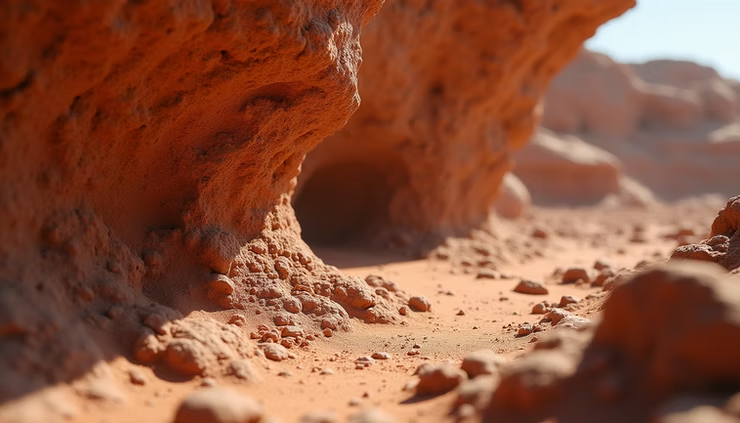
The caves themselves are a marvel of ancient Martian geology. The primary entrance, designated “Hebes Cavus-1” or “HC-1” by the team, is a massive, arched opening over 100 meters wide and 40 meters high. From this main atrium, the HiRISE imagery, enhanced by the orbiter’s ground-penetrating radar (SHARAD), suggests at least three distinct sub-surface levels connected by what appear to be collapsed vertical shafts, forming a skylight-like structure deeper within the system. The internal structure bears a striking resemblance to terrestrial karst systems, like those in Mammoth Cave in Kentucky or the cenotes of the Yucatán, which are formed when slightly acidic water dissolves soluble bedrock like limestone. On Mars, the process is believed to have involved groundwater circulating through layers of soluble volcanic rock, such as carbonate or easily eroded sedimentary layers laid down by an ancient lake, slowly eating away vast chambers and tunnels. Dr. Kenji Tanaka, a geomorphologist from NASA’s Jet Propulsion Laboratory, elaborated on the implications. “This isn’t a lava tube, which are common on Mars but are formed by completely different, dry processes. The morphology is all wrong for that. What we are seeing are textbook dissolution features: scalloped walls, ceiling pockets, sediment fans at the mouths of tunnels where water once flowed out, and even what look like ancient rimstone dams. This was a living, flowing hydrological system, likely active for hundreds of thousands, if not millions, of years. It was a place where water was not just a visitor, but a permanent resident.”
The existence of such a stable, water-rich, and sheltered environment immediately catapults these caves to the top of the list in the search for past life. The subsurface cave network would have offered a triple-layered protection system for any potential microbial organisms: shielding from the intense and sterilizing surface radiation that bombards Mars, buffering against the extreme temperature swings between day and night, and potentially maintaining a stable, relatively mild climate compared to the surface. On a planet that was losing its atmosphere and surface water to space billions of years ago, these subterranean aquifers would have been the last bastions of habitability. Dr. Shreya Patel, an astrobiologist on the team, could barely contain her excitement. “Think of Earth’s most extreme environments—the deep, lightless aquifers, the caves sealed off from the surface for millennia. They are often teeming with chemosynthetic life, organisms that draw energy not from the sun, but from chemical reactions between the rock and the water. The conditions we infer within the Hebes caves are a near-perfect analog. If life ever did arise on Mars, this is precisely the kind of refuge it would have retreated to as the surface became inhospitable. The clay minerals lining those walls are particularly exciting, as they are excellent at adsorbing and preserving organic matter. We could be looking at the best-preserved fossil library in the entire solar system.”
The discovery has sent a seismic wave through the planetary science community, instantly reshaping the roadmap for future Mars exploration. Rovers like Perseverance, which is currently exploring the dried-up river delta of Jezero Crater, are limited to surface and near-surface investigations. The Hebes caves represent a target that is simultaneously a high-reward scientific prize and an immense engineering challenge. Mission architects at both ESA and NASA have confirmed that a mission concept, tentatively named “Proserpina,” is now being fast-tracked from a theoretical study to a pre-project phase. The current vision for Proserpina involves a two-part system: an orbiter module equipped with an even more advanced radar and a laser spectrometer to map the internal geometry and sniff for trace gases like methane venting from the caves, and a dedicated lander. The lander’s centerpiece would not be a rover, but a sophisticated, tethered “Descender” robot, specifically designed for rappelling into the vertical cave entrances and conducting in-situ analysis. Dr. Liam Chen, a robotics engineer involved in the early concepts, outlined the daunting task. *“This is the next great frontier in robotics. The Descender needs to be part mountaineer, part geologist, and part chemist. It must autonomously navigate unstable terrain in low light, lower itself on a cable, and perform a suite of experiments without direct human control due to the communication delay. We are looking at advanced LiDAR for 3D mapping, micro-imagers for texture analysis, and the most sensitive organic chemistry lab ever sent to another world, capable of detecting the molecular fossils of long-dead microbes.”*
While the Proserpina mission is likely at least a decade away from launch, the discovery has already fundamentally altered our perception of Mars. It moves the scientific narrative from a planet that was briefly wet to one that may have harbored long-lasting, habitable oases deep beneath its rusty crust. The confirmed water-crafted caves of Valles Marineris stand as a testament to a Mars that was far more Earth-like in its distant past, a world with a robust hydrological cycle that extended deep into its subsurface. They are silent, dark cathedrals holding secrets that humanity is now, finally, on the cusp of unveiling. As Dr. Kostova poignantly concluded, “For centuries, we have looked up at Mars as a red dot of intrigue. Then, we saw it as a desert world. Now, we must learn to see it as it truly was—a planet with a hidden, watery heart. We have found the door. The next, most difficult step, is to turn the handle and see what remains inside.” The search for our place in the universe has just descended into the profound and promising darkness of another world.