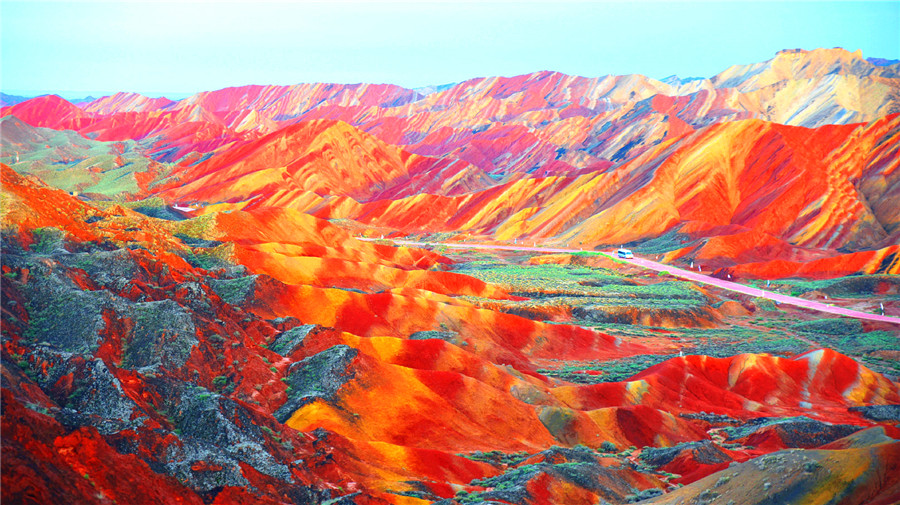
In the arid, rugged heart of Gansu Province, China, lies a landscape that seems conjured from a dream—or perhaps a distant, painterly planet. This is Zhangye Danxia, the “Rainbow Mountains,” a geological masterpiece where the earth itself has been transformed into a vast, undulating canvas of blazing crimson, vibrant ochre, luminous lemon yellow, deep sage green, and startling lavender. More than just a spectacle of color, it is a profound chronicle of time, a 24-million-year-old story written in layers of sandstone and mineral deposits, sculpted by the relentless forces of nature into a surreal wonder that defies ordinary description.
A Geological Epic: The Birth of a Rainbow
The story of Zhangye Danxia begins not with color, but with mundane sedimentation during the Cretaceous period, over 24 million years ago. The area was then a vast inland basin, likely adjacent to ancient seas. Rivers flowing from surrounding mountains carried vast quantities of eroded sandstone, siltstone, mudstone, and trace minerals, depositing them in distinct layers on the basin floor. Like the pages of a book, each layer recorded a different environmental condition—periods of arid oxidation rich in iron, humid reducing environments, variations in mineral content, and changes in sedimentation rate.
The initial palette was monochrome: grays, browns, and dull reds. The transformative magic began with the tectonic uplift of the Tibetan Plateau, a monumental event that started around 50 million years ago and continues today. This colossal geological force pushed the once-horizontal sedimentary strata upward, exposing them to the atmosphere. As the rocks rose, cracks and joints formed, creating the initial framework for future sculpture.
The Alchemy of Color: Painting with Iron and Carbon
The dazzling stripes that define Zhangye Danxia are a direct result of mineral pigmentation within the sedimentary layers. Each hue corresponds to a specific geochemical condition that prevailed during its deposition and subsequent alteration.
-
Reds and Browns: These dominant colors are the signature of iron oxide (hematite, Fe₂O₃). They form in well-oxygenated, arid environments where iron minerals “rust” upon exposure, coating sand grains in a thin, persistent red film.
-
Yellows and Ochres: These warmer tones are also products of iron, but in a different hydrated form: limonite or goethite. They often indicate slightly less intense oxidation or the presence of water during formation.
-
Greens and Grays: These cooler colors are the telltale sign of reducing conditions, where oxygen was scarce (often in waterlogged environments). Here, iron exists in its ferrous state (iron II), forming minerals like chlorite or illite, which impart greenish and grayish tones.
-
Blacks and Purples: Manganese oxide and carbonaceous materials (like ancient organic matter) contribute to darker bands, adding depth and contrast to the vibrant spectrum.
The layers were not uniformly colored from the start. The subtle interplay of groundwater percolation over millions of years further mobilized and redistributed these iron and manganese ions, enhancing the color contrasts and creating the sharp, sinuous boundaries we see today. It is a natural chromatography experiment conducted on a continental scale over epochs.
The Sculptor’s Tools: Wind, Water, and Time
While mineralogy provided the paint, the breathtaking landforms of Zhangye Danxia are the work of erosion, the great subtractive artist. The region’s semi-arid climate, with its scarce but occasionally torrential rainfall, is perfectly suited for this slow-morning artistry. The process is one of differential erosion: the harder, more cemented siltstone layers resist erosion, forming protective caps and sharp ridges, while the softer sandstone and mudstone beneath are worn away more rapidly.
This creates the iconic Danxia topography: towering pillars, steep cliffs, deep ravines, natural arches, and smooth, wave-like walls. Each form reveals the internal anatomy of the strata. The “Rainbow Valley” section showcases smooth, flowing contours like petrified silk, while the “Binggou” area features jagged, fortress-like peaks that glow like embers at sunset. The landscape is in constant, imperceptible flux, with each storm carving new details into the ancient rock.
A Tapestry of Human History
Long before it became a UNESCO World Heritage Site (part of “China Danxia” in 2010) and a global tourist destination, Zhangye Danxia held significance for the people traversing the Hexi Corridor. This area was a vital segment of the ancient Silk Road. For weary merchants traveling between the Taklamakan Desert and the Tibetan foothills, these colored mountains would have been a startling and perhaps spiritual landmark—a natural monument marking their journey. While not heavily settled due to its rugged terrain, the landscape undoubtedly featured in local folklore and was a silent witness to the flow of cultures, goods, and ideas for centuries.
The Immersive Experience: A Walk Through a Living Canvas
To visit Zhangye Danxia Landform Geological Park is to step into a vast, open-air gallery. The experience is carefully managed, with boardwalks and shuttle buses minimizing human impact while guiding visitors to key vistas. The play of light is the final, transformative element. Under the harsh midday sun, the colors are bold and graphic. But it is during the golden hours of sunrise and sunset that the mountains truly ignite. The low-angle light rakes across the stratified contours, intensifying the reds to a fiery glow, deepening the shadows in the ravines, and casting the landscape in dramatic relief. After rain, when the rocks are wet, the colors achieve a surreal, saturated depth, as if the landscape is freshly varnished.
The sensory impact is profound. The sheer scale—over 50 square kilometers of primary scenic area—induces awe. The silence, broken only by the wind, emphasizes the monumental timescale. One is standing before a clock where the seconds are millennia.
Guardianship of a Fragile Masterpiece
The very forces that create Danxia landforms also make them exceptionally fragile. The soft sandstone is vulnerable to foot traffic, carving, and vandalism. Recognizing its irreplaceable value, Chinese authorities and international bodies have implemented strict conservation measures. The established park system, with confined walking paths and shuttle transport, is designed to protect the delicate rock surfaces and surrounding arid ecosystem. The challenge is balancing global fascination with preservation, ensuring that this 24-million-year-old story remains legible for centuries to come. It is a testament to the belief that some wonders are not merely resources, but sacred narratives of the Earth itself.
More Than a Sight, A Revelation
Zhangye Danxia is ultimately more than a picturesque “Instagram moment.” It is a profound geological revelation. It makes the abstract concepts of deep time, plate tectonics, and geochemistry viscerally tangible. In its striped walls, we read chapters of ancient climates; in its eroded peaks, we witness the patient power of erosion. It is a place that recalibrates human perspective, reminding us of the dynamic, creative, and achingly slow processes that shape our world.
It stands as one of nature’s most splendid paradoxes: a landscape of fierce, exuberant color born from the most elemental minerals of the earth, and forms of breathtaking complexity carved by the simplest agents of wind and water. To behold Zhangye Danxia is to understand that the planet’s most astonishing art is not created for an audience, but is the inevitable, magnificent byproduct of its own enduring life. It is, in every sense, a wonder.