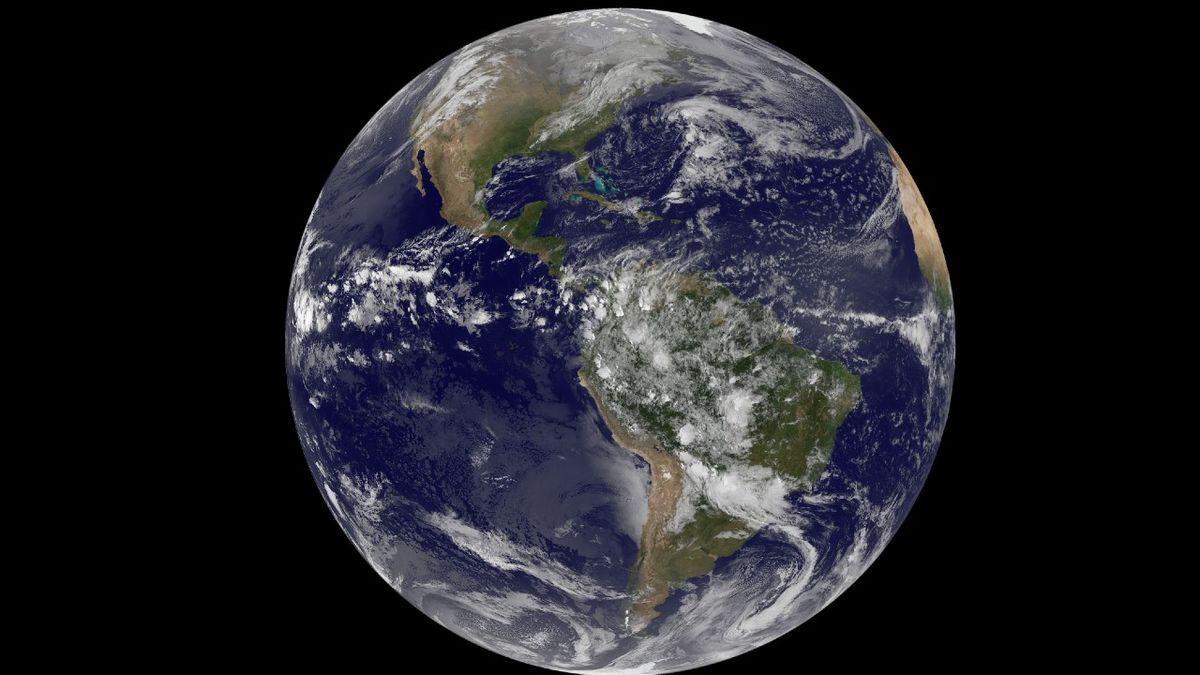
Imagine a world where, for one single tick of a clock, the fundamental clockwork of our planet fails. In this article, we explore the terrifying physics of a hypothetical scenario: What if the Earth stopped spinning for just one second? While the Earth orbits the sun at roughly 107,000 km/h, it is its axial rotation—the spin that gives us day and night—that keeps us pinned to the surface and maintains our global environment. At the equator, this rotation speed is approximately 1,670 km/h. If the solid ground beneath our feet were to come to a dead halt for a mere second while the atmosphere and oceans maintained their momentum, the result would be the most violent event in the history of the Holocene.
The Great Inertial Whiplash
The primary killer in this scenario is inertia. Newton’s First Law of Motion dictates that an object in motion stays in motion unless acted upon by an external force. If the Earth’s crust stops, the air, the water, and everything not anchored to the bedrock would continue moving at supersonic speeds. “It would kill everyone on Earth,” says astrophysicist Neil deGrasse Tyson. “People would be flying out of windows, and that would be just a bad day on Earth.” At the equator, this means humans, cars, and even skyscrapers would be launched eastward at over 460 meters per second. To put that in perspective, the speed of sound is approximately 343 meters per second. We would effectively become projectiles in a global wind tunnel.
Supersonic Winds and Atmospheric Chaos
The atmosphere, which is not physically “bolted” to the Earth, would continue its rotation. For that one second, the planet would experience supersonic winds exceeding the force of the most powerful nuclear blast waves. These winds would not just knock down trees; they would strip the topsoil from the Earth’s crust, erase forests, and pulverize every man-made structure into dust. The friction between the stationary ground and the moving air would generate immense heat, potentially igniting fires across the globe. Even at higher latitudes, where the rotational speed is lower (about 1,180 km/h in London or New York), the winds would still be triple the strength of a Category 5 hurricane.
The Oceanic Surge: A Global Tsunami
The oceans, containing the vast majority of the planet’s kinetic energy, would follow the same law of inertia. The sudden stop would cause the water to slosh violently eastward, creating a wall of water miles high that would sweep across entire continents. These are not typical tsunamis; they are continental-scale inundations. Coastal cities would be erased in seconds, and the water would penetrate deep into the interior of landmasses, carrying the debris of civilizations with it. Furthermore, because the Earth’s spin creates an equatorial bulge—a “spare tire” of water and rock held at the center by centrifugal force—the sudden loss of that force would cause the oceans to migrate toward the poles.
Geological Upheaval and Tectonic Shock
The physical crust of the Earth is not a single solid block but a series of tectonic plates floating on a semi-liquid mantle. A sudden deceleration of the entire planet would send massive shockwaves through the Earth’s interior. This would trigger global mega-earthquakes on a scale never recorded by seismographs. “The sudden redistribution of mass and momentum would induce powerful earthquakes and increased volcanic activity worldwide,” note researchers in recent planetary simulations. Every fault line would rupture simultaneously, and volcanoes—both dormant and active—would likely erupt as the internal pressure of the mantle shifts under the sudden mechanical stress.
The Resumption and Long-term Scars
If the Earth resumed its spin after that one second, the nightmare wouldn’t end. The planet would be a scoured graveyard. The magnetic field, generated by the “dynamo” effect of the rotating liquid outer core, might experience a temporary fluctuation. While the core might keep spinning due to its own inertia, the sudden jolt to the crust could lead to a weakening of our radiation shield, briefly exposing the surface to harmful solar winds. “Flora and fauna rely on Earth’s rotation to regulate circadian rhythms… a stopped Earth would disrupt photosynthesis and migration patterns,” scientists explain regarding the biological fallout.
Conclusion: The Silent Guardian
This thought experiment serves as a humbling reminder of the delicate equilibrium that sustains life. We often think of the ground as “still,” but we are passengers on a massive, spinning engine. The energy required to stop the Earth—even for a second—is equivalent to the energy of billions of atomic bombs. While such an event is physically impossible under the current laws of celestial mechanics, it highlights that our very existence is a product of constant motion.