February 11, 2026
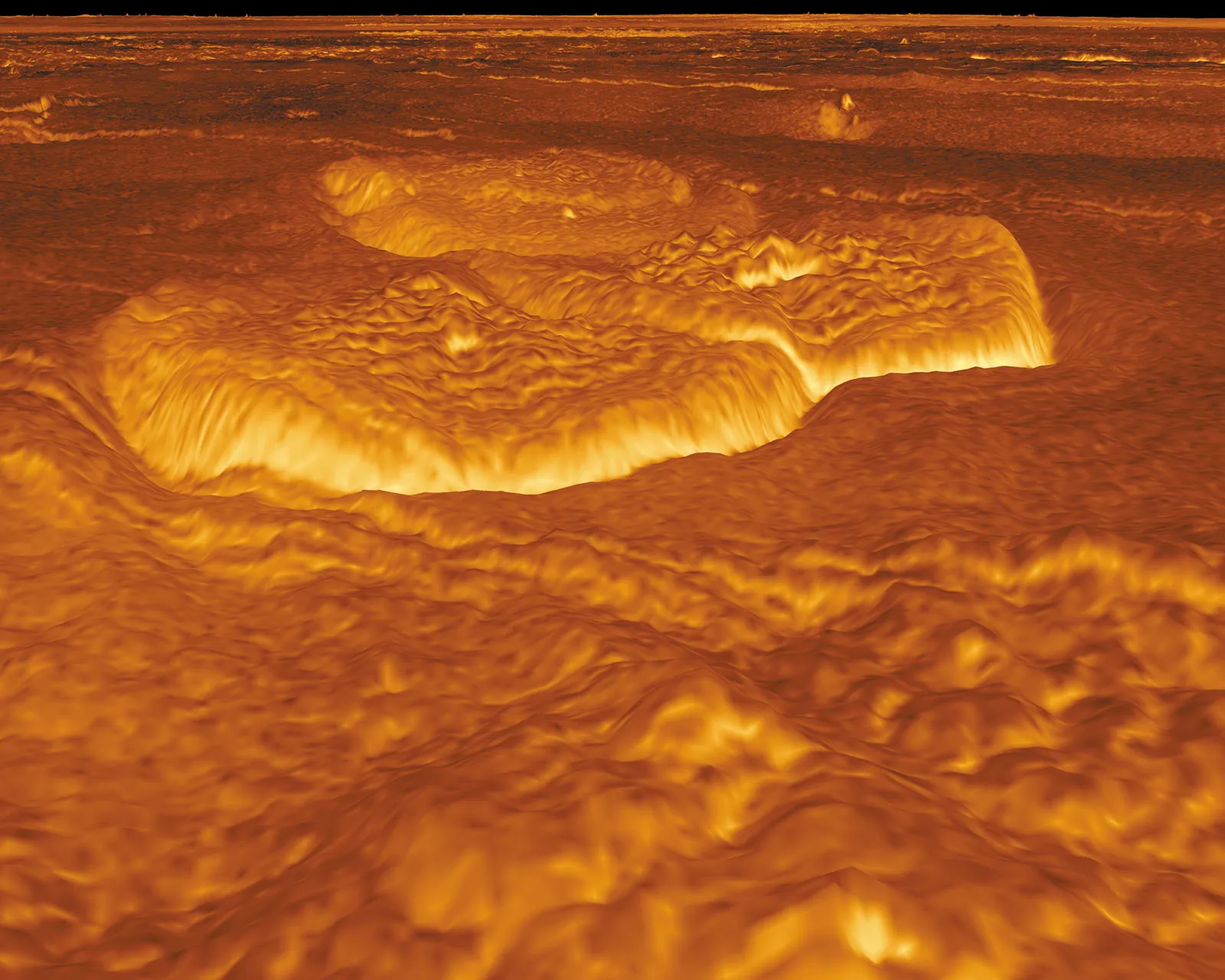
In a revelation that reshapes our understanding of Earth’s enigmatic twin, planetary scientists announced today the discovery of compelling evidence for a massive underground tunnel, or lava tube, on Venus, believed to have been carved by ancient volcanic eruptions. The finding, derived from a fresh analysis of radar data from NASA’s Magellan mission of the early 1990s, provides the strongest indication yet of subsurface structures on Venus and opens a new chapter in the study of its volcanic past and potential habitability. The detected feature, located in the vast Venusian lowland known as Ganiki Planitia, is estimated to stretch for over 45 kilometers (28 miles), with a width exceeding 1 kilometer in places, making it vastly larger than any known lava tube on Earth. This underground conduit would have once served as a river of molten rock, draining lava from volcanic sources and distributing it across the plains, before emptying and leaving behind a hollow, tunnel-like cavity.
The breakthrough was achieved by an international team led by Dr. Alina Petrov of the Moscow Institute of Planetary Science, who applied advanced, terrain-sensitive algorithms to Magellan’s decades-old Synthetic Aperture Radar (SAR) imagery. While the thick, acidic clouds of Venus permanently obscure its surface from visual cameras, radar can penetrate the haze, bouncing signals off the ground to map topography. The new analysis focused on subtle, meandering depressions with distinctive ridges along their lengths—a classic topographic signature of a collapsed or partially collapsed lava tube. What sets this Venusian structure apart is its sheer scale and preservation; the data suggests sections of the tunnel roof remain intact, shielding a dark, subterranean world from the hellish conditions above. As Dr. Petrov stated in a press briefing, “We’ve seen channel-like features on Venus before, but this is the first time we have a clear, geomorphological argument for a surviving subsurface void. The linear continuity, the overhanging ridges, and the context within a known volcanic province leave little doubt. We are essentially looking at a planetary-scale subway tunnel forged by volcanism.”
The environment on the surface of Venus is famously inhospitable, with crushing atmospheric pressures 92 times that of Earth’s and surface temperatures averaging 462°C (864°F), hot enough to melt lead. These conditions make the search for past or present life there a profound challenge. This discovery of a potential underground refuge is pivotal because it posits the existence of a radically different environment below the surface. Lava tubes, whether on Earth, Mars, or now possibly Venus, offer natural shielding from radiation, extreme temperature fluctuations, and hostile atmospheres. Dr. Sarah Jennings, an astrobiologist at the European Space Agency and a co-author of the study, elaborated, “While the surface of Venus is a veritable pressure cooker, the interior of a lava tube could be far more stable. If such a tube sealed after its volcanic activity ceased, it could have trapped a pocket of a different, potentially more temperate ancient atmosphere. It becomes a buried time capsule, and while we are not suggesting we will find life, it is precisely the kind of sheltered niche where we might begin to look for clues about the planet’s geochemical evolution and past habitability.”
The volcanic history of Venus is written across its landscape, which is dotted with thousands of volcanoes and vast lava plains, suggesting it was once extraordinarily active. However, a key mystery has been whether the planet is still volcanically active today or if it entered a dormant phase geologically recently. The identification of this massive lava tube feeds into the ongoing debate about modern volcanism on Venus. The tunnel’s apparent good structural preservation, with limited infilling from the dense atmosphere or later lava flows, could indicate it is relatively young in geological terms. “The degree of preservation is startling,” noted Professor Kenzo Tanaka from the University of Kyoto’s Space Science Institute. “On a planet with such aggressive surface weathering, features tend to get buried or eroded quickly. This tunnel looks crisp. That doesn’t prove current volcanism, but it strongly suggests the volcanic forces that built it were at work in the last few hundred million years, perhaps even more recently. It’s another piece of evidence that Venus might not be geologically dead.”
This discovery arrives at a moment of renewed focus on Venus, with several space agencies planning missions for the coming decade. NASA’s VERITAS (Venus Emissivity, Radio Science, InSAR, Topography, and Spectroscopy) orbiter, scheduled for launch in the early 2030s, is specifically designed to map the planet’s surface with a resolution far surpassing that of Magellan. The Ganiki Planitia lava tube has immediately been flagged as a prime Tier-1 target for the VERITAS mission. The spacecraft’s advanced radar will be able to probe the feature’s depth, search for multiple entry points (skylights), and determine the thickness of its roof, essentially confirming its hollow nature and mapping its full extent. VERITAS Project Scientist, Dr. James McCullough, commented, “This finding is a gift for mission planning. It gives us a very specific, fascinating feature to hunt with our new instruments. We will be able to look at it in unprecedented detail and potentially identify the best sites for future landers or even robotic explorers designed to navigate subterranean environments.”
The implications extend beyond pure geology. If accessible lava tubes are confirmed, they present a compelling long-term rationale for in-situ human exploration. On the Moon and Mars, lava tubes are considered prime candidates for future habitation bases, as their structures provide natural radiation and micrometeorite shielding. On Venus, where establishing any surface presence is a monumental engineering challenge due to the extreme pressure and heat, a stable, intact lava tube could offer a uniquely protected environment for robotic assets or, in the distant future, human-rated habitats. While the technical hurdles remain staggering, the discovery fundamentally shifts the thinking on how humanity might one day interact with the Venusian environment—not on its surface, but within its shielded subsurface.