The physics of an atomic bomb is a profound intersection of theoretical quantum mechanics and high-energy engineering, rooted in the fundamental relationship between matter and energy. At its core, the operation of a nuclear weapon relies on the principle of nuclear fission—the process by which the nucleus of a heavy atom, such as Uranium-235 or Plutonium-239, is split into smaller fragments. This process is governed by Einstein’s famous equation, E = mc2, which dictates that a tiny amount of mass lost during the splitting process is converted into a staggering amount of kinetic energy and electromagnetic radiation. In a stable environment, atoms are held together by the strong nuclear force, which overcomes the electrostatic repulsion between positively charged protons. However, when a fissile nucleus absorbs a stray neutron, it becomes unstable and elongates, eventually snapping into two smaller nuclei (fission fragments). This “snap” releases additional neutrons, which then fly out to strike neighboring nuclei, creating a self-sustaining chain reaction.
For an atomic bomb to function as a weapon of mass destruction rather than a controlled power source, this chain reaction must become “supercritical.” This means that every fission event must trigger more than one subsequent fission event in an exponentially increasing sequence. To achieve this, a specific amount of fissile material, known as the “critical mass,” must be assembled in a very short timeframe. If the mass is too small or too spread out, too many neutrons escape the surface without hitting another nucleus, and the reaction fizzles out. In the “gun-type” design, a subcritical projectile of uranium is fired down a barrel into a subcritical target, combining to form a supercritical mass. In the more complex “implosion-type” design, a sphere of plutonium is surrounded by high explosives that detonate simultaneously, compressing the metal inward. This compression increases the density of the material, bringing the atoms so close together that even a small amount of plutonium becomes supercritical.
The Mechanics of Fission and Energy Release
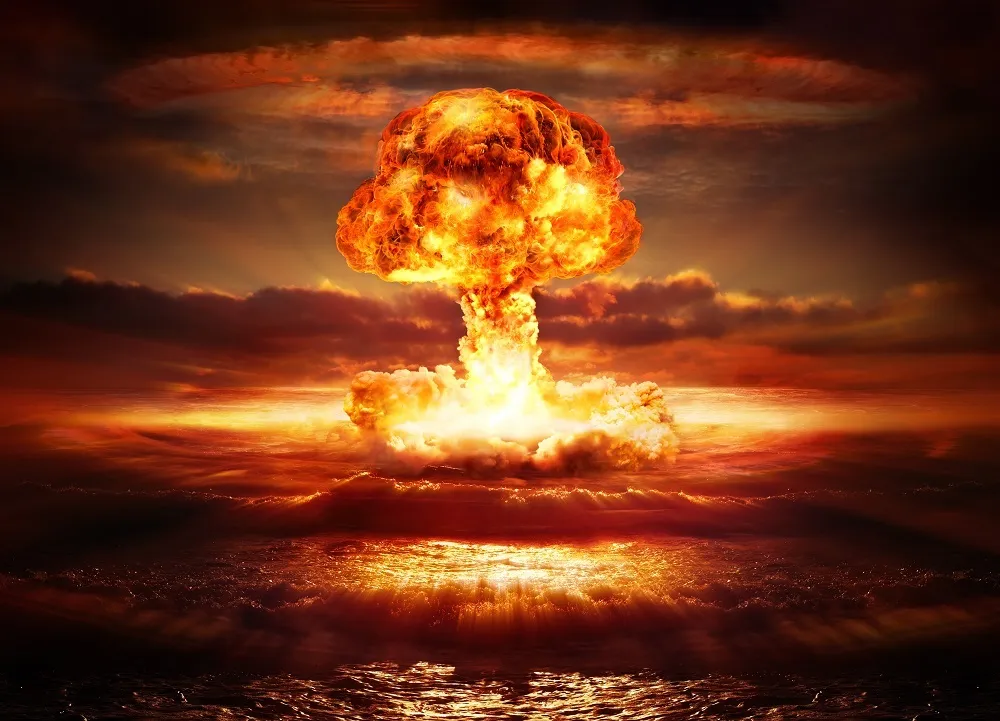
The actual detonation sequence occurs in mere shakes—a “shake” being a Churchillian term for 10-8 seconds. Once supercriticality is reached, an initiator (often a mix of Beryllium and Polonium) provides a burst of neutrons to jumpstart the process. Within microseconds, billions of nuclei split. The energy released is categorized into several distinct forms: thermal radiation, blast pressure, and ionizing radiation. The immediate byproduct of fission is a massive flux of gamma rays and X-rays. These photons are so energetic that they heat the surrounding air to millions of degrees, creating a “fireball” that expands faster than the speed of sound. This rapid expansion of superheated air creates a high-pressure shockwave, or “blast wave,” which carries the bulk of the bomb’s mechanical destructive power. As the shockwave moves outward, it creates a vacuum behind it, leading to a secondary “reverse blast” that can pull debris back toward the center of the explosion.
Parallel to the physical blast is the release of prompt radiation. Neutrons and gamma rays fly outward, penetrating solid objects and stripping electrons from atoms in their path—a process known as ionization. In biological tissue, this causes immediate molecular damage, breaking DNA strands and disrupting cellular function. Following the initial flash, the weapon produces delayed radiation in the form of fallout. The fission fragments, which are highly unstable isotopes, bond with dust and debris sucked into the mushroom cloud. As this radioactive soot cools and falls back to Earth, it contaminates the environment with long-lived isotopes like Strontium-90 and Cesium-137. These elements can enter the food chain, mimicking calcium or potassium in the human body and causing long-term internal irradiation and genetic mutations.
Humanitarian Destruction and the Shadow of the Mushroom Cloud
The humanitarian impact of an atomic bomb is unparalleled because it collapses the distinction between combatant and civilian, and between the present and the future. When a nuclear device is detonated over a populated area, the destruction is categorized into zones of lethality. In the “hypocenter” or “ground zero,” the heat is so intense—reaching several thousand degrees Celsius—ialmost all carbon-based life is instantaneously vaporized, leaving only “nuclear shadows” on stone where bodies once blocked the thermal flash. Beyond the point of vaporization lies the zone of total structural collapse, where the blast wave levels concrete buildings and the thermal pulse ignites a “firestorm.” This firestorm creates a chimney effect, sucking oxygen from surrounding areas and suffocating survivors who may have escaped the initial blast.
The humanitarian tragedy extends far beyond the immediate casualties. The survivors, known in Japan as hibakusha, face a unique form of psychological and physiological trauma. Acute Radiation Syndrome (ARS) manifests as nausea, hair loss, and internal bleeding as the body’s most rapidly dividing cells (in the bone marrow and digestive tract) die off. Even those who appear healthy in the aftermath may develop leukemia or solid cancers decades later. Furthermore, the destruction of infrastructure—hospitals, water lines, and communication—means that medical relief is often impossible. The moral weight of the atomic bomb lies in its “indiscriminate” nature; it is a weapon designed not to defeat an army, but to annihilate the social and physical fabric of a civilization.
Ecological Consequences and the Earth’s Future
On a planetary scale, the detonation of atomic weapons represents a “geological” force. A large-scale nuclear exchange would not only devastate human cities but could trigger a “Nuclear Winter.” The soot and smoke from burning cities would rise into the stratosphere, where it would not be washed away by rain. This black cloud would circumnavigate the globe, blocking out sunlight and causing surface temperatures to plummet. This sudden cooling would disrupt global agriculture, leading to mass famine and the potential collapse of the biosphere. The Earth’s ozone layer would also be severely depleted by nitrogen oxides produced in the fireball, exposing the remaining life to lethal levels of ultraviolet radiation once the smoke finally clears.
The legacy of the atomic age is also etched into the very soil of the Earth. Since the mid-20th century, atmospheric nuclear testing has distributed radioactive isotopes across every corner of the globe. Geologists have even proposed that these “radionuclides” mark the beginning of a new epoch, the Anthropocene, as they create a permanent marker in the sedimentary record that will be detectable for millions of years. The atomic bomb, therefore, is more than a weapon; it is a tool of “omnicide”—the potential killing of everything. It forces a realization that human scientific achievement has reached a point where it can rival the power of stars, yet our social and ethical frameworks remain perilously fragile in the face of such totalizing force.