
May 8, 2026
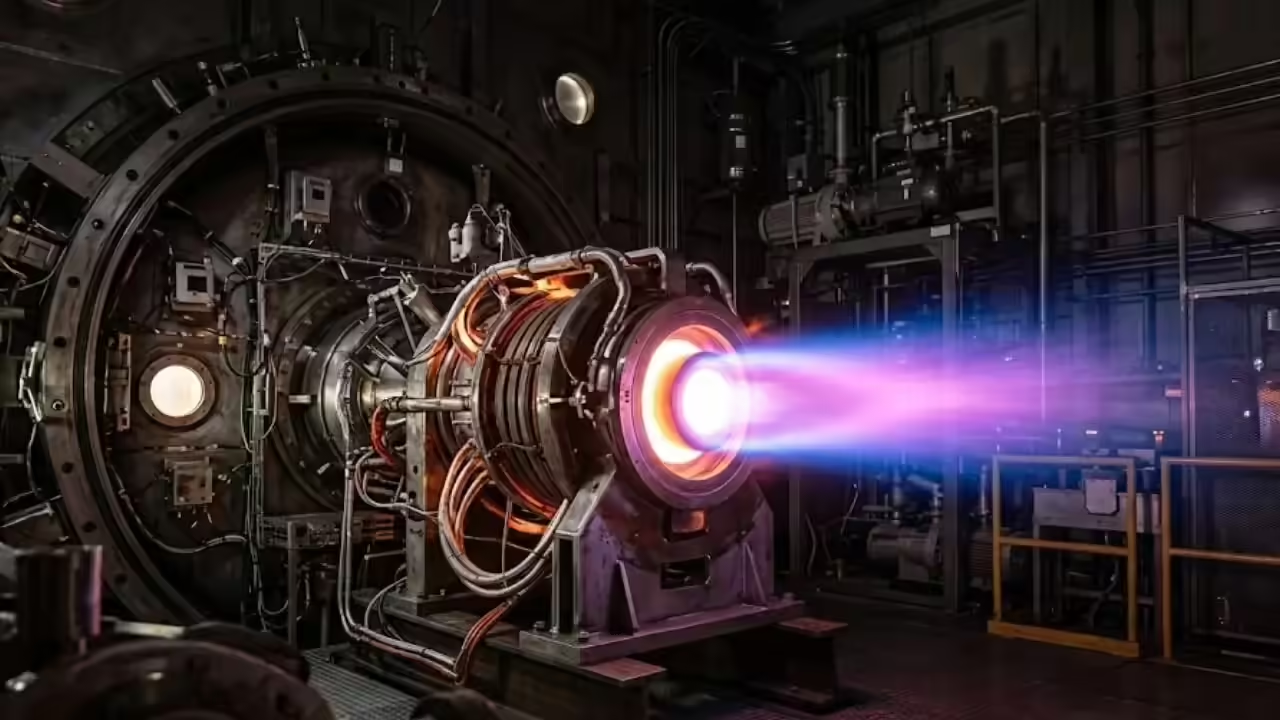
PASADENA, California – In a landmark development that fundamentally alters the trajectory of human space exploration, NASA has officially confirmed the successful high-power testing of a next-generation lithium-fed magnetoplasmadynamic (MPD) thruster, a radical new engine that could slash travel time to the Red Planet and make the dream of a crewed Mars mission a tangible reality. On February 24, 2026, inside a specialized vacuum chamber at the Jet Propulsion Laboratory (JPL) in Southern California, engineers fired the prototype engine not once, but five times, achieving a monumental power output of 120 kilowatts.
Officials confirmed this week that this figure represents a 25-fold increase over the electric propulsion systems currently powering NASA’s most advanced deep-space probes, such as the Psyche spacecraft. Far from the explosive, violent thrust of traditional chemical rockets, this futuristic drive operates on the principles of electromagnetic acceleration.
The engine bombards lithium vapor with immense electrical currents, heating the central tungsten electrode to a blistering 5,000 degrees Fahrenheit (over 2,800 degrees Celsius) to transform the metal into a superheated plasma. This ionized gas is then accelerated through a magnetic field at incredible velocities, generating a “constant push” rather than a brief burst, akin to the difference between a gas-powered car and an infinitely accelerating electric vehicle.
The implications of this technology for interplanetary travel, specifically NASA’s ambitious “Moon to Mars” mission architecture, are staggering. Traditional chemical propulsion, while effective for escaping Earth’s gravity, is notoriously inefficient for long-haul deep-space voyages, requiring massive amounts of fuel that significantly increase launch weight and cost.
In contrast, electric propulsion uses up to 90% less propellant. By converting electrical energy directly into thrust, the MPD thruster allows spacecraft to coast continuously, gradually building up velocity over weeks and months to reach speeds unattainable by chemical means. NASA Administrator Jared Isaacman lauded the breakthrough, stating: “The successful performance of our thruster in this test demonstrates real progress toward sending an American astronaut to set foot on the Red Planet. This marks the first time in the United States that an electric propulsion system has operated at power levels this high, reaching up to 120 kilowatts. We will continue to make strategic investments that will propel that next giant leap.”
However, the road between a ground-breaking laboratory test and a human mission to Mars is still a marathon, not a sprint. While the 120 kW milestone is a record for the U.S., a realistic crewed mission to Mars will require an immense power envelope of 2 to 4 megawatts. To bridge this gap, NASA’s engineers are already eyeing Nuclear Electric Propulsion (NEP) as the inevitable partner for this engine.
While current tests rely on standard electricity, deep-space missions cannot depend on weak solar energy far from the Sun. Therefore, a compact nuclear reactor—such as the proposed Space Reactor-1 Freedom—would provide the continuous, reliable megawatts of power necessary to keep the lithium plasma burning for months on end. James Polk, a senior research scientist at JPL who has worked on ion engines since the 1990s, explained the long-term vision behind the prototype. “Designing and building these thrusters over the past couple of years has been a long lead-up to this first test,” Polk observed, watching the glowing plume through an observation window. “It’s a huge moment for us because we not only showed that the thruster works, but we also hit the power levels that we were targeting. And we know we have a good testbed to begin addressing the challenges to scaling up.”
As the space agency pivots away from solely relying on contractors like SpaceX’s massive Starship—which relies on thousands of tons of liquid oxygen and methane—towards these high-efficiency electrical systems, the focus shifts from raw power to sustainability and endurance. The path forward involves scaling the current prototype to between 500 kilowatts and 1 megawatt per thruster over the next few years.
To achieve a full Mars mission configuration, multiple MPD thrusters would need to be clustered together. Yet, the greatest challenge remains reliability. To send humans safely to the Red Planet, this engine technology must prove it can operate continuously for over 23,000 hours—nearly three years of non-stop fire. For now, the blue glow of the lithium plasma inside the JPL vacuum chamber has signaled a new era; the era where we stop simply throwing flames out of a rocket and start riding the electromagnetic currents of the stars.