
May 6, 2026
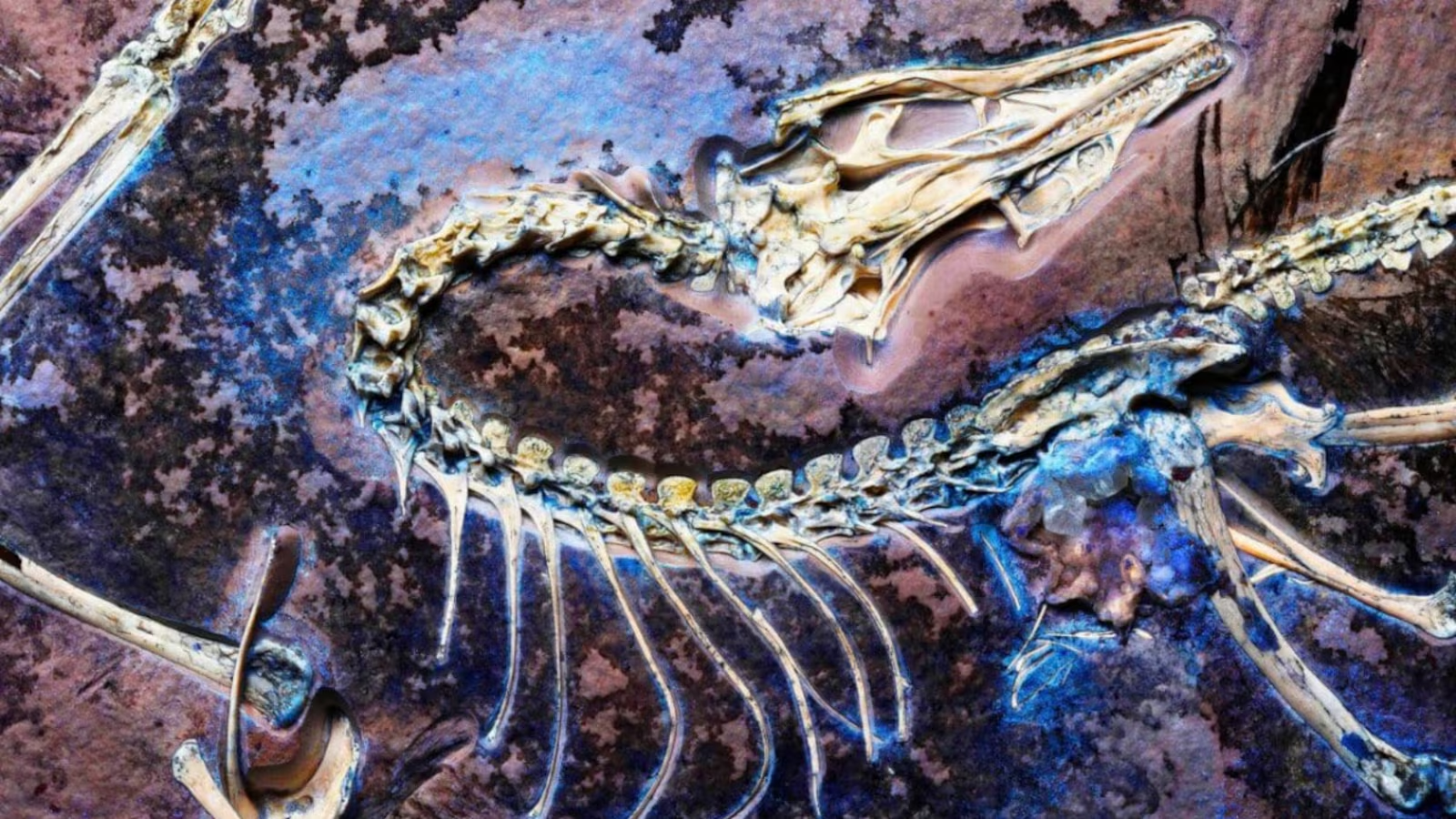
The scientific community is buzzing this week following the reveal of a groundbreaking discovery that appears to settle a 167-year-old debate. When Charles Darwin published On the Origin of Species in 1859, he notoriously lamented the “extreme imperfection of the geological record,” acknowledging that the absence of transitional fossils was one of the greatest objections to his theory. However, the unveiling of a 150-million-year-old fossil from the Solnhofen limestone in Germany—the “Chicago Archaeopteryx”—has provided the most definitive evidence yet that Darwin was, in fact, right.
This specific specimen, although small and roughly the size of a pigeon, is being hailed as the most complete and technologically revealing fossil of its kind. Using UV light imaging and micro-CT scans, researchers have managed to identify soft tissue and specialized tertial feathers that were previously invisible or accidentally destroyed in other specimens. These biological markers prove that the creature possessed the necessary anatomy for powered flight, bridging the gap between non-avian dinosaurs and modern birds.
The preservation of this soft tissue is particularly significant because it fulfills a core Darwinian prediction: that as technology improved and more strata were explored, the “missing links” of evolution would materialize with increasing detail. Scientists explain that the fossil’s incredible state of preservation was due to hypoxic (oxygen-poor) conditions at the bottom of a Jurassic lagoon, which prevented rapid decay and allowed for mineralization of delicate biological structures.
Highlighting the importance of the find, Dr. Jingmai O’Connor, a lead researcher involved in the study, stated: “Our specimen is the first Archaeopteryx that was preserved and prepared in such a way that we can see its long tertial feathers. That tells us Archaeopteryx could fly.” She further emphasized the evolutionary implications, noting, “We think it’s the earliest known dinosaur that was able to use its feathers to fly.” This confirms that natural selection was already refining the mechanics of flight millions of years earlier than some critics had suggested.
Beyond the wings, the fossil’s skull and palate bones provide a “snapshot” of evolution in action. The structural design sits perfectly between the predatory troodontid dinosaurs and the Cretaceous birds that followed. As the TOI Science Desk reported on May 5, 2026, the finding of preserved soft tissues in such an ancient specimen serves to confirm that biological materials can persist much longer than previously believed, providing a molecular roadmap of descent with modification.
Addressing the historical context of the find, experts point out that while Darwin did not have access to micro-CT technology, his theoretical framework anticipated such discoveries. Dr. Mary Schweitzer, a pioneer in molecular paleontology, remarked on the broader significance: “Findings like this indicate that biological materials might be preserved much longer than previously supposed.” This shift in understanding suggests that the fossil record is not a series of empty pages, but a high-resolution archive that we are only now learning how to read.