May 3, 2026
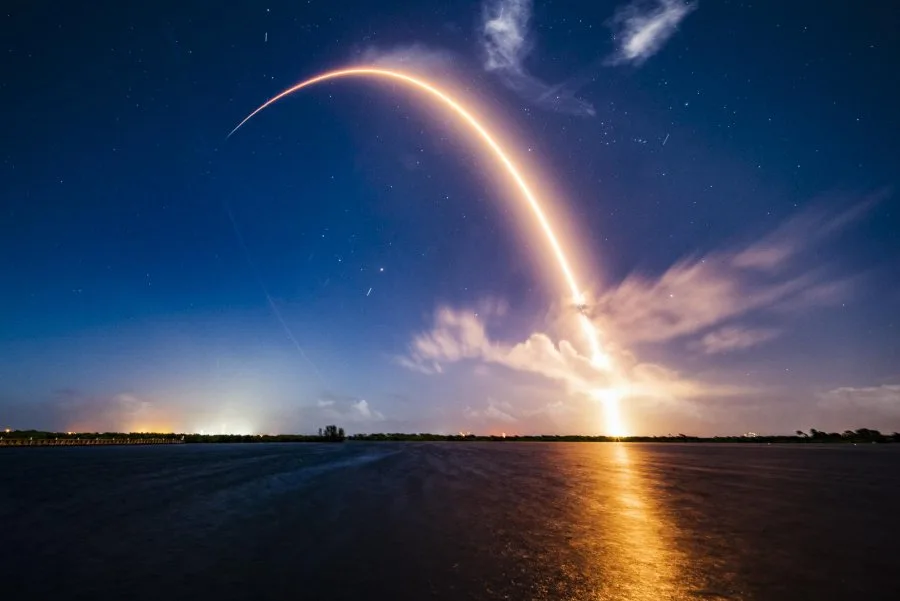
SpaceX Falcon 9 rocket successfully lifted off from Space Launch Complex 4 East (SLC-4E) at Vandenberg Space Force Base in California . The mission, carrying a total of 46 satellites, showcased the increasing capabilities of commercial rideshare programs and international collaboration. The rocket’s primary payload was South Korea’s CAS500-2 (Compact Advanced Satellite 500-2), also known as the Next-Generation Midsize Satellite No. 2, which was accompanied by 45 rideshare payloads from various government entities, commercial companies, and academic institutions .
The Falcon 9 first-stage booster, identified as B1071, flew for a record-setting 33rd time . Approximately seven and a half minutes after liftoff, the veteran booster executed a flawless Return to Launch Site (RTLS) landing at Landing Zone 4 (LZ-4), producing sonic booms heard across the central coast and marking SpaceX’s 608th booster recovery to date . Following the separation, the rocket’s second stage performed a series of four engine burns to place the satellites into a Sun-synchronous orbit (SSO) at an altitude of 528 kilometers and an inclination of 98.1 degrees . The CAS500-2 was deployed approximately 60 minutes after liftoff, with the deployment of the final rideshare payload occurring about two and a half hours into the mission .
The mission represents a significant technological milestone for South Korea. Developed by the Korea Aerospace Industries (KAI) and the Korea Aerospace Research Institute (KARI), the 534-kilogram CAS500-2 is designed to provide high-resolution imagery for territorial resource management, environmental monitoring, and disaster response . A representative from the Korea AeroSpace Administration noted, “This successful launch is a major milestone in opening a ‘private-led new space era.’ It allows us to independently secure ultra-precision images necessary for land and disaster management, greatly enhancing the competitiveness of our satellite industry” . The satellite carries an Advanced Earth Imaging Sensor System (AEISS-C) capable of distinguishing black-and-white objects as small as 0.5 meters and color objects of 2 meters . Once it completes four months of initial testing, it will operate in tandem with its predecessor, CAS500-1 (launched in 2021), orbiting 180 degrees apart to significantly reduce revisit times over the Korean Peninsula . Notably, this launch occurred after a four-year delay due to geopolitical tensions; the satellite was originally scheduled to lift off on a Russian rocket in 2022, but the invasion of Ukraine necessitated a shift to SpaceX .
The Falcon 9’s secondary manifest was managed largely by Exolaunch, a German launch services provider that integrated 39 of the 45 rideshare payloads, bringing its total number of deployed spacecraft to over 740 . “With the advent of quantum computing, more secure encryption is needed to protect information,” explained a scientist involved with the QUBE-II mission, a 6U microsatellite that aims to demonstrate Quantum Key Distribution (QKD) between a satellite and a ground station for the first time. “Due to the nature of quantum particles, data-sharers will be able to detect ‘eavesdropping’” . In another groundbreaking scientific effort, the SNAPPY CubeSat, developed by Wichita State University in partnership with NASA’s Jet Propulsion Laboratory, will attempt to function as the first space-based solar neutrino detector. A researcher on the project stated, “Identifying electrons, protons, and alpha particles within the solar wind is a task that ground-based studies cannot perform as easily. This payload will collect unique scientific data over the North and South Poles” .
The mission also featured significant contributions from the commercial Earth observation sector. Planet Labs deployed three satellites for its high-resolution Pelican constellation, which captures imagery at 50 cm resolution for real-time situational awareness . OroraTech launched four of its Forest satellites, specifically designed for wildfire monitoring, joining a larger constellation aimed at detecting blazes from space . Additional notable payloads included True Anomaly’s ‘Jackal’ , an autonomous orbital vehicle designed for military applications; Italy’s IRIDE constellation satellites (seven Hawk HEO microsatellites); and India’s Mission Drishti, a first-of-its-kind multi-sensor satellite combining Synthetic Aperture Radar with a multispectral imager . The launch reinforces SpaceX’s dominance in the smallsat market, following a similar rideshare mission in March that carried 119 payloads . As the final payloads were successfully deployed, the event closed yet another chapter in the rapidly evolving landscape of reusable rocketry and global space access.