
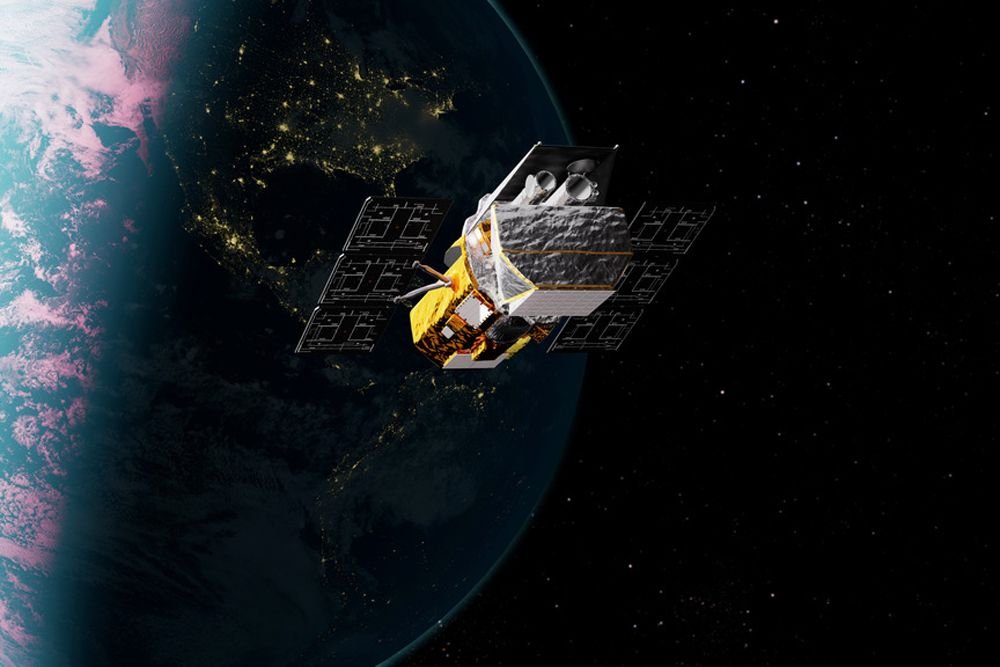
The Neil Gehrels Swift Observatory, a 3,200-pound NASA space telescope, re-entered Earth’s atmosphere over northern Sumatra, Indonesia, marking the definitive conclusion of an extraordinary 22-year mission dedicated to investigating high-energy cosmic phenomena. Originally launched in November 2004 with an initial design lifespan of just two years, the observatory far exceeded all expectations, fundamentally transforming modern astrophysics. Over more than two decades of continuous operation, Swift became humanity’s premier astronomical “first responder”, designed to swiftly pivot toward and analyze sudden, violent flashes of light originating from the far reaches of the universe. Its primary scientific legacy includes the detection and tracking of more than 2,000 gamma-ray bursts (GRBs)—the most luminous explosions in the universe—as well as the observation of roughly 1,400 exploding stars (supernovae), active galaxies powered by supermassive black holes, and even comets and asteroids within our own solar system.
Swift’s unprecedented capability to autonomously detect a transient cosmic event and alert ground- and space-based facilities within seconds made it an indispensable anchor of modern multi-messenger astronomy. It routinely served as an advanced warning system for larger observatories like the Hubble Space Telescope and the James Webb Space Telescope, directing their powerful apertures toward fleeting cosmic targets before they faded away. However, as is inevitable for satellites residing in low-Earth orbit, the continuous, subtle drag exerted by the outer fringes of Earth’s atmosphere gradually degraded the telescope’s orbital altitude over the years. This natural orbital decay was recently accelerated by heightened levels of solar activity, which heated and expanded Earth’s upper atmospheric layers, forcing the satellite downward at a much faster rate than anticipated.
In a final effort to preserve the aging asset, NASA awarded a $30 million contract to private space service provider Katalyst Space Technologies to rescue and extend the telescope’s life using a robotic servicing spacecraft known as LINK. Launched in July, the robotic rescue vehicle unfortunately suffered critical propulsion and communication failures, ultimately ending the rescue attempt and leading to its own uncontrolled re-entry in September. With no viable way to boost Swift back into a safe, stable orbit, mission controllers officially shut down the observatory’s scientific systems in late October once its altitude had dropped to roughly 275 kilometers and normal operations became operationally untenable.
Allowing the observatory to succumb to natural orbital decay triggered an uncontrolled re-entry, meaning mission operators could not actively steer or pinpoint the exact geographical coordinates of its final descent path. As the 1.5-tonne spacecraft plummeted deeper into the thickening layers of the atmosphere, the intense aerodynamic friction and thermal stress generated temperatures high enough to incinerate the vast majority of its structural mass. NASA officials and orbital debris mitigation experts emphasized that most of the 3,200-pound observatory burned up completely during the fiery plunge. Nevertheless, due to the extreme melting point and structural resilience of certain specialized materials, engineers anticipated that dense components—including tungsten parts, segments of its optical mirrors, and attitude-control mechanisms—could survive the heat and successfully reach the Earth’s surface.
Because the debris footprint spanned vast latitudinal regions across the globe, space tracking agencies and international tracking networks closely monitored its final hours. While portions of the potential debris corridor briefly traversed heavily populated regions such as parts of southern India, risk assessments conducted by NASA calculated the statistical probability of injury to any individual on the ground at approximately 1 in 2,100. Consistent with historical trends for uncontrolled spacecraft re-entries—where the vast majority of surviving fragments harmlessly plunge into the world’s deep oceans or desolate, unpopulated expanses—the bulk of any surviving remnants safely dispersed into maritime regions.
The fiery demise of the Swift Observatory underscores a growing reality in modern aerospace: as commercial megaconstellations, operational satellites, and space traffic expand exponentially in low-Earth orbit, at least three large objects fall back to our planet every single day. The loss of Swift leaves a temporary void in high-energy transient astronomy, prompting scientists worldwide to explore how future missions will replicate or expand upon its unmatched capacity to catch fleeting cosmic explosions. Ultimately, while Swift’s physical hardware met a fiery and catastrophic end, its monumental two-decade archive of gamma-ray data has permanently rewritten textbooks on stellar evolution, black hole physics, and the dynamic nature of our universe.