
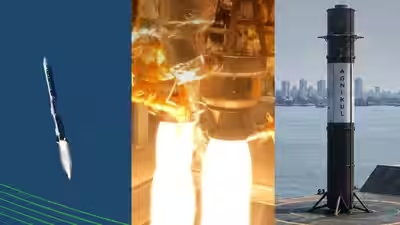
In a significant stride toward establishing a sustainable and reusable space transportation ecosystem, Indian space tech startup Agnikul Cosmos has inaugurated two new, specialized units at its Assembly & Testing Facility in Chennai. The expanded infrastructure, which includes the Stage Testing & Inspection Facility (STIF) and the Pressurant Tank Realization, Over-wrapping and Outfitting Facility (PROOF), is designed to validate reusable rocket stages under flight-like conditions and manufacture critical components in-house . This development marks a pivotal moment for the Indian private space sector, as it positions Agnikul as the only Indian private space company with in-house post-flight requalification infrastructure, a capability essential for the iterative process of reusing launch vehicles . The new facilities were inaugurated in the presence of Group Captain Shubhanshu Shukla, an astronaut-designate for India’s Gaganyaan human spaceflight mission, who commended the startup’s efforts in building capabilities for increasingly ambitious missions .
The centerpiece of this expansion is the STIF, a fully in-house facility that enables the testing of complete reusable rocket stages under conditions that simulate an actual mission . This facility is engineered to support thrust levels ranging from 1 kN to an impressive 200 kN, allowing for full-duration engine burns of up to 150 seconds and liquid oxygen sub-cooling down to 73 Kelvin . Crucially, STIF is designed to conduct tests with fully integrated propulsion and avionics systems, including clusters of Agnikul’s patented single-piece, 3D-printed, semi-cryogenic engines . Beyond its role in pre-flight validation, the facility is instrumental in enabling a “build, test, fly, recover, inspect, requalify, and fly-again” cycle, as it supports the post-flight inspection and requalification of recovered rocket stages . This capability is directly aligned with Agnikul’s vision of developing a reusable launch vehicle, mirroring the operational model of global leaders like SpaceX, and is critical for the company’s upcoming Mission-02 .
The second new unit, PROOF, is dedicated to the in-house manufacturing of pressure vessels—a vital component that stores gases or liquids at pressures different from the ambient environment . This facility is capable of producing more than 10 pressure vessels per month, with the capacity to manufacture vessels as large as 3,500 litres and designed to withstand pressures of up to 350 bar . By bringing this manufacturing capability in-house, Agnikul aims to achieve greater control over quality and production timelines, significantly reducing its reliance on external suppliers . Co-founder and CEO Srinath Ravichandran emphasized the strategic importance of these new facilities, stating that the vision of reusability requires building the capability to prepare a stage for its next flight, and that STIF provides the ability to test complete stages for their entire mission duration and to inspect and requalify recovered stages, while PROOF represents a further step towards achieving end-to-end in-house quality control .
Headquartered in Chennai and incubated at IIT Madras, Agnikul Cosmos has been at the forefront of developing the Agnibaan family of configurable small-lift launch vehicles . The company’s journey began with its pioneering work in additive manufacturing, for which it holds a US patent for its single-piece 3D-printed rocket engines . This technological prowess was demonstrated in May 2024 when the company successfully conducted Mission-01, the Agnibaan SubOrbital Technological Demonstrator (SOrTeD), from its privately built launchpad at Sriharikota . That mission marked a milestone as India’s first controlled flight of a semi-cryogenic engine from a private launchpad . The company has also commissioned India’s first private large-format additive manufacturing facility to produce engines up to a metre in size, drastically reducing production timelines and cost .
The inauguration of STIF and PROOF in Chennai is a concrete step in Agnikul’s ambitious roadmap toward achieving reusability. The company has already completed critical booster engine tests that validate the technology needed for both ascent and descent, a prerequisite for reusable rocketry . Furthermore, Agnikul has committed to investing ₹400 crore to establish assembly and integration operations in Thoothukudi, as part of a larger MoU signed with the Tamil Nadu government, which is expected to create 1,500 jobs . With its enhanced testing and manufacturing capabilities in Chennai and its planned expansion in Thoothukudi, Agnikul Cosmos is steadily building the ecosystem required to compete in the global space economy.