
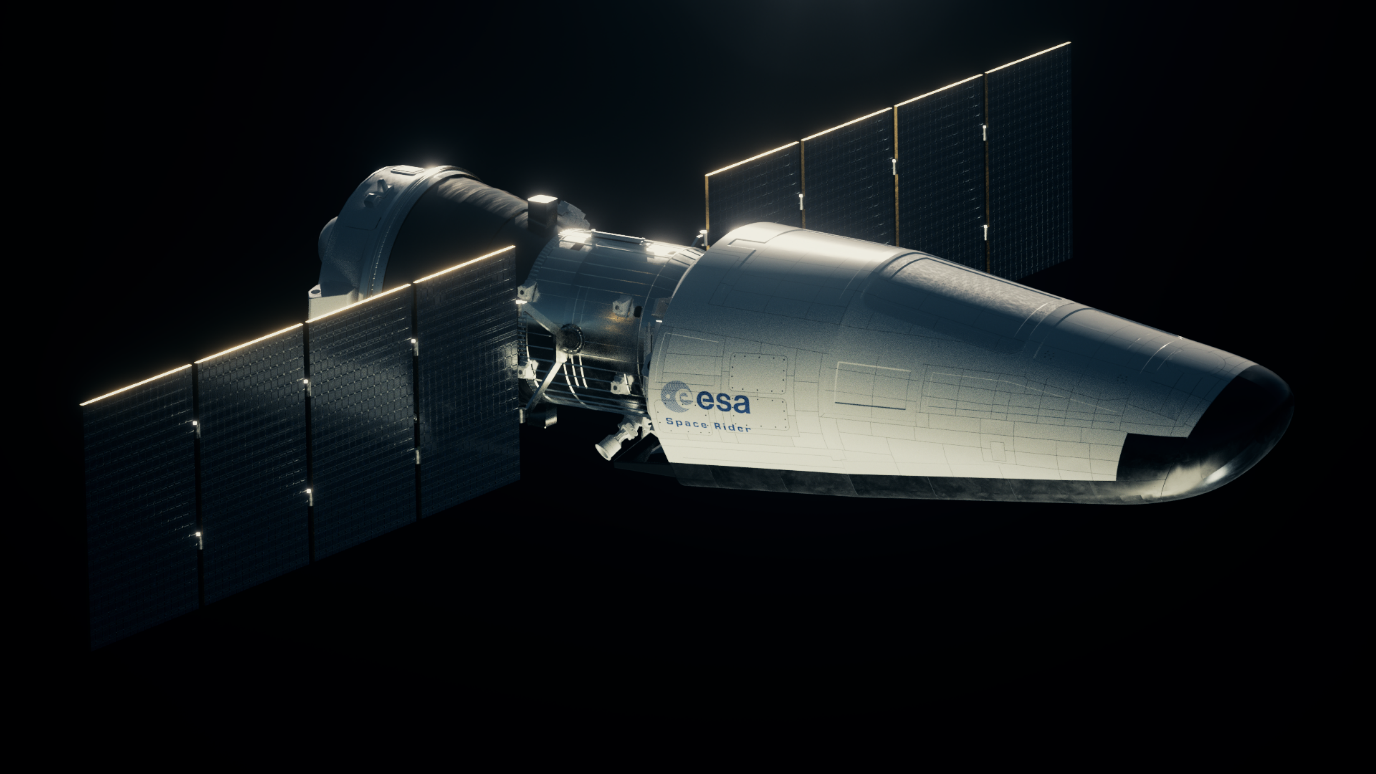
The European Space Agency (ESA) experienced a significant setback in its ambition to secure independent, reusable space transportation when a full-scale development model of the Space Rider spaceplane was destroyed during a drop test. The incident unfolded at the Salto di Quirra military testing range in Sardinia, Italy. Designed as an uncrewed, robotic laboratory capable of remaining in low Earth orbit for months before returning safely to land, the Space Rider represents Europe’s primary leap into reusable orbital vehicles. However, the atmospheric drop trial—intended to validate the final atmospheric descent and landing phases of the spacecraft—ended abruptly when a critical failure in its specialized parachute landing system caused the vehicle to plunge into freefall and collide forcefully with the ground.
The drop test was meticulously designed to simulate the terminal phase of re-entry, during which the unpowered vehicle must transition from supersonic atmospheric entry to a controlled, gentle touchdown. During the trial, the full-scale test craft was hoisted into the sky and dropped to allow its specialized multi-stage landing assembly to deploy under realistic conditions. According to initial reports, the initial sequence began as intended: the drogue parachute deployed successfully to slow the craft’s high-speed descent. Problems arose immediately afterward during the critical deployment phase of the main landing mechanism. The primary, steerable parafoil—a large, wing-like canopy crucial for executing precise autonomous steering and enabling a soft touchdown—suffered a fatal anomaly. Instead of unfurling to glide the vehicle safely, the main parafoil prematurely detached during deployment, stripping the test craft of all lift and steering capability.
Without the drag and control provided by the main parafoil, the multi-million-euro Space Rider prototype plummeted into an unrecovered freefall, hitting the terrain below at destructive speed. The catastrophic impact caused severe structural damage to the test model, rendering the full-scale prototype a complete loss. While no human lives were at risk given the uncrewed nature of the vehicle and the controlled, restricted environment of the military firing range, the loss of the physical prototype and its onboard hardware represents a major hardware setback for the development program. Following the crash, recovery teams deployed to the impact zone secured the site, retrieving all fragmented components and debris to preserve physical evidence for technical evaluation.
In response to the crash, the European Space Agency launched an official, independent investigation into the root cause of the structural detachment and canopy failure. Engineers, safety experts, and prime contractor teams—including key industry leaders like Thales Alenia Space and Avio—are analyzing telemetry data, sensor logs, high-speed camera recordings, and the physical remains of the rigging hardware to understand precisely why the structural connections or lines failed during the opening sequence. Investigators are focusing closely on line tension, canopy deployment dynamics, and release mechanism triggers to determine whether the detachment stemmed from mechanical latch failure, aerodynamic overload, line tearing, or a software logic glitch during the transition sequence.
This tragic drop test failure does not exist in isolation, as it follows a string of schedule difficulties and prior testing interruptions that have plagued the Space Rider timeline. Earlier in the same year, a previous drop test planned for May had to be abruptly aborted moments before the prototype could be released from its transport platform. In that instance, automated onboard diagnostics flagged a sensor anomaly during final pre-drop checks, forcing engineers to call off the test to prevent a potential crash. Subsequent efforts to reschedule the test were repeatedly delayed because the Sardinian testing facility was unavailable from June through September, creating a long bottleneck in testing schedules. Consequently, the October drop was meant to clear the backlog and validate crucial flight systems, making the subsequent crash an even heavier blow to the project’s momentum.
Despite the destruction of the atmospheric drop model, agency officials emphasize that the overall Space Rider program is comprised of multiple testing branches, several of which have achieved milestone successes. Prior to this incident, the program conducted successful subscale atmospheric tests and qualification campaigns demonstrating autonomous trajectory guidance and basic aerodynamic maneuvers. Furthermore, the vehicle’s thermal protection materials performed exceptionally well during separate ground qualification phases, undergoing grueling plasma wind tunnel trials where heat-shield components successfully withstood extreme re-entry temperatures around 2,900°F (1,600°C). These thermal and structural milestones demonstrated that the core thermal protection and aerothermodynamic shape of the spaceplane are sound, even though the low-altitude landing systems remain problematic.
The economic and strategic importance of the Space Rider project makes this failure particularly sensitive for European space policy. Conceived as a reusable, affordable platform launched atop Vega-C rockets, the lifting-body spacecraft is intended to provide European researchers and commercial clients with routine access to space for microgravity experiments, technology demonstrations, earth observation, and satellite servicing. Unlike conventional single-use capsules or rockets, Space Rider’s core value proposition relies entirely on its ability to safely return high-value scientific payloads to Earth without subjecting them to excessive landing forces. A flawless parafoil deployment system is the non-negotiable linchpin of this concept; without a dependable glide-and-land mechanism, payload recovery cannot be guaranteed.
Moving forward, the destruction of the prototype will inevitably push back the overall timeline for the spaceplane’s debut orbital mission. ESA had originally targeted the spacecraft’s maiden flight for later in the decade, but the task of constructing a new drop-test model, implementing system redesigns based on the investigation’s findings, and completing qualification re-tests will require substantial time and resources. Space Agency officials maintain that test failures, while costly, are an inherent aspect of pioneering experimental aerospace hardware. By pushing systems to their physical limits during drop trials, engineers catch fatal design flaws on Earth rather than during an operational orbital return mission. The investigation’s findings will dictate the engineering modifications needed before Europe’s reusable spaceplane takes to the skies again.