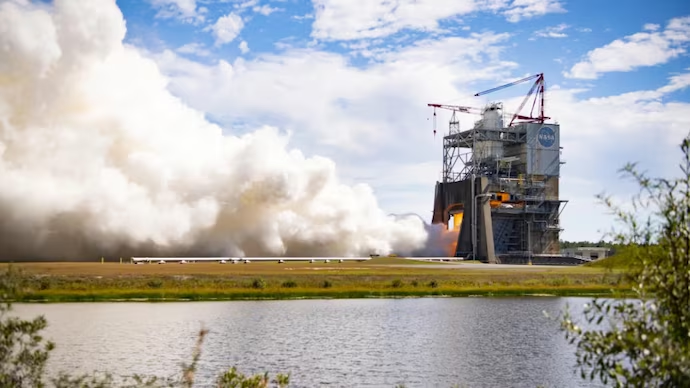
NASA has successfully conducted a critical hot-fire test of an RS-25 rocket engine at the Fred Haise Test Stand located at the Stennis Space Center in Mississippi, marking another vital step forward for the agency’s Artemis campaign. During this rigorous evaluation, test teams fired a developmental engine for a total of 500 seconds, which precisely matches the exact duration that the core stage engines must burn during an actual launch of NASA’s heavy-lift Space Launch System (SLS) rocket. By replicating the exact timeline of a real flight, engineers can thoroughly analyze how the propulsion system handles the intense physical and thermal demands of space flight.
A major milestone achieved during this evaluation was pushing the engine up to a 111 percent power level, matching the maximum thrust required for newly manufactured production engines to successfully hoist the SLS rocket and the Orion spacecraft into Earth orbit and onward toward the Moon. While this specific developmental engine is designated for ground testing rather than space flight, the operation yielded invaluable performance data. The primary objectives centered around acceptance testing flight components intended for upcoming Artemis missions and validating a new thermal protection system designed to shield the engine nozzle from extreme launch environments.
The RS-25 engine relies on liquid hydrogen and liquid oxygen propellant, working alongside a pair of solid rocket boosters to generate the immense power required for deep-space exploration. For every Artemis mission, a cluster of four RS-25 engines works in unison to produce up to 2 million pounds of combined thrust. Rigorous ground testing at Stennis is a mandatory prerequisite for ensuring that every propulsion component can perform reliably under extreme launch conditions, thereby reducing overall mission risks for astronauts traveling to the lunar surface. Through these ongoing tests, NASA and its prime contractors continue to refine engine reliability and pave the way for a sustained human presence on the Moon.