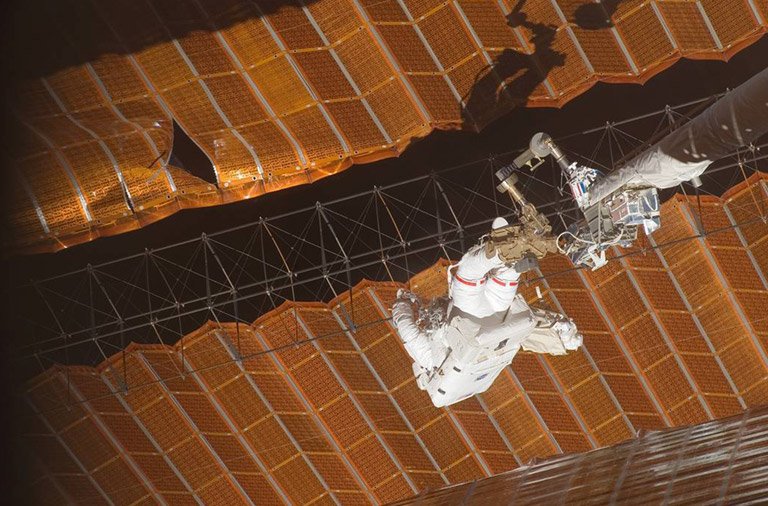
During the STS-120 mission aboard Space Shuttle Discovery in November 2007, NASA faced one of the most perilous, improvisational emergency situations in the history of human spaceflight. Astronaut Scott Parazynski was tasked with performing an unprecedented spacewalk to repair a massive, tearing P6 solar array wing on the International Space Station (ISS). The deployable solar wing had snagged on a guide wire while unfurling, creating a severe tear across its delicate silicon photovoltaic panels. Leaving the panel damaged meant it could tear completely off under dynamic load, permanently degrading the station’s power grid. Worse yet, because sunlight was illuminating the panels, the entire array was active and generating roughly 100 volts of direct-current electricity—a lethal voltage in the vacuum of space, where an electrical arc could burn through an astronaut’s suit or electrocute them instantly.
To pull off this high-stakes orbital surgery, NASA engineers on the ground had to invent a brand-new repair system from scratch in less than 72 hours using only materials already onboard the shuttle and station. The crew improvised five makeshift stabilizing braces dubbed “cufflinks,” crafted out of aluminum strips, heavy-duty wire, and high-temperature polyimide Kapton tape combined with standard gray astronaut duct tape (often referred to in spaceflight as Kapton or space-grade utility tape). The purpose of these cufflinks was to act as structural bridges, taking the mechanical stress off the torn solar hinges so the array could be fully extended without ripping further.
Because the live 100-volt panels could easily short-circuit if touched by metal, Parazynski’s tools had to be meticulously modified to ensure complete electrical insulation. Astronauts wrapped wire cutters, needle-nose pliers, and custom wire-handling instruments in thick layers of insulating Kapton tape and heavy-duty space-grade tape, creating non-conductive barriers around every metal handle and edge. Parazynski was also outfitted with specialized non-conductive mechanical overgloves to ensure no part of his suit’s thermal-conductive outer layer would ground an arc from the live array.
Executing the repair required positioning Parazynski farther away from the airlock than any spacewalker had ever gone before. To reach the damaged panel located at the tip of the station’s truss structure, controllers attached the shuttle’s Orbiter Boom Sensor System (OBSS) inspection pole to the tip of the station’s robotic arm (Canadarm2), creating a wobbly, 130-foot-long improvised crane. Anchored into a foot restraint at the end of this oscillating extension boom, Parazynski was maneuvered directly toward the live, crackling 100-volt solar panel while astronaut Doug Wheelock stood watch nearby on the truss to assist with positioning and communication.
Working with extreme precision to avoid brushing his suit against the live copper contacts, Parazynski carefully cut the snagged guide wire that had caused the original tear. He then threaded each of the five improvised tape-and-wire cufflinks through reinforced grommet holes along the solar array’s seams, effectively stitching the panel back together. Once the cufflinks were secured into place, mission control slowly commanded the solar array to deploy the rest of the way. The improvised tape-and-wire rig held perfectly, taking up the tension and allowing the giant solar wing to lock fully into position. The mission ended in complete success, proving once again that low-tech ingenuity, heavy-duty tape, and world-class training can solve even the most high-voltage emergencies in deep space.