As humanity looks toward long-term space exploration and establishing permanent lunar or Martian habitats, the ability to cultivate crops away from Earth has shifted from a science-fiction concept to a critical necessity. To test how agricultural staples behave outside Earth’s atmosphere, NASA scientists conducted pioneering botanical experiments aboard the space shuttle. Researchers hydrated dry corn kernels (Zea mays) and allowed them to germinate in orbit for five days in complete darkness alongside a matching control group grown under Earth’s normal gravitational conditions. What they discovered was both reassuring and deeply perplexing, shedding light on the fundamental biological mechanisms that govern plant growth.
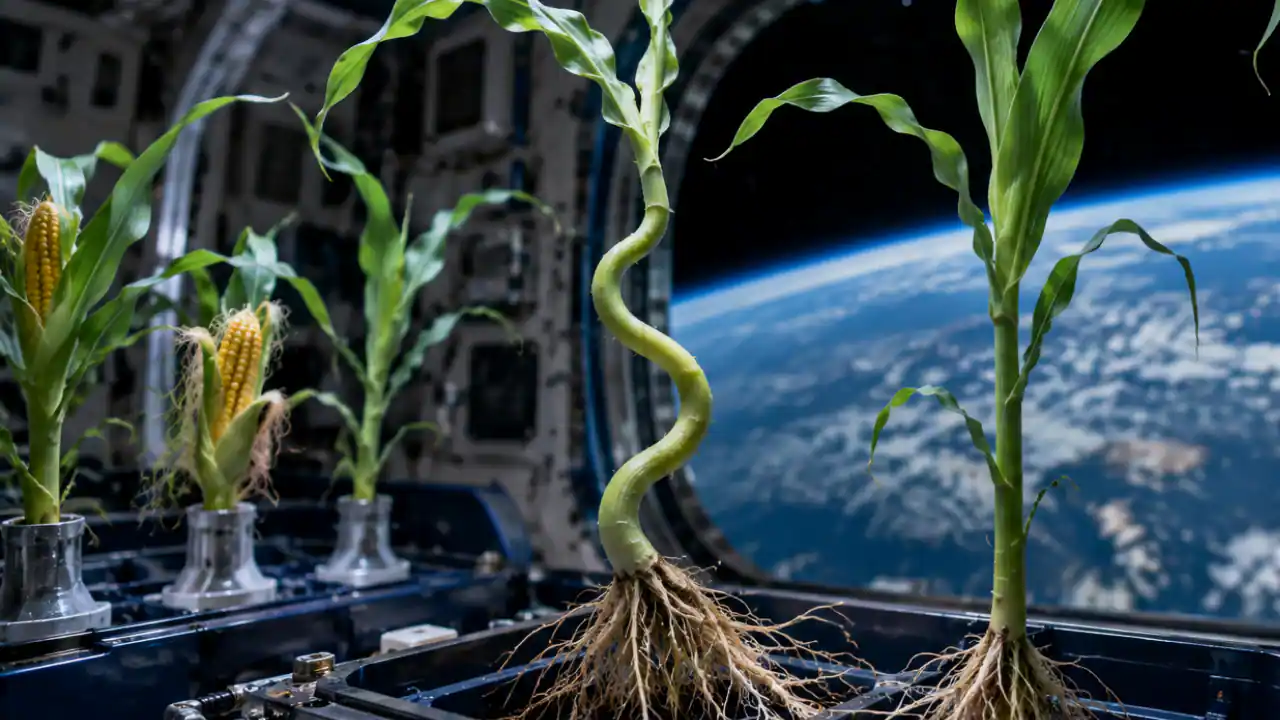
The experiment produced a fascinating contrast between cellular health and physical structural orientation. On an anatomical level, the space-grown corn seedlings appeared exceptionally healthy. Biochemical analyses revealed normal tissue development, expected hormone levels, standard cell differentiation, and overall seedling weights comparable to Earth-grown samples. The corn kernels germinated successfully, proving that gravity is not strictly required for the fundamental biochemical processes of life and early growth. However, macroscopically, the space-grown crops exhibited a complete biological disorientation. Without gravity acting as a spatial anchor, the plants completely lost their internal compass, resulting in roots growing sideways and shoots twisting into surreal, spiral loops instead of following traditional straight growth axes.
To understand why this strange phenomenon occurred, scientists analyzed gravitropism—the natural biological process by which plants align themselves with gravity. On Earth, plants use specialized cells containing dense starch granules called statoliths, which sink to the bottom of root cells due to gravitational pull. This settling triggers a signaling cascade involving the plant growth hormone auxin, prompting roots to extend downward into soil (positive gravitropism) and stems or shoots to push upward toward the sky (negative gravitropism). In the microgravity environment of space, statoliths float aimlessly within the plant cells, depriving the corn seedlings of their primary directional signal. Because the experiment was deliberately conducted in total darkness, the corn plants were also deprived of phototropism—the secondary light-guided mechanism plants use to orient growth toward a light source.
The visual result of this dual sensory deprivation was a chaotic growth pattern. The roots scrambled outward in sideways patterns across their growth substrate, while the emerging shoots curled around themselves in tangled knots. While the individual plant cells were biologically healthy and functioning normally, the overall physical structure was completely disorganized because the plant lacked any external environmental vector to guide its form.
This revelation delivered crucial insights for space agriculture systems, showing that plants can grow perfectly well at a cellular level in microgravity, provided alternative cues are supplied. Researchers concluded that while microgravity removes the gravitational directional prompt, plants can adapt if artificial guiding signals—such as directional LED lighting, targeted moisture gradients, or artificial centrifugal force—are introduced to replace gravity’s role. These early findings on space-grown corn have paved the way for advanced space farming habitats today, such as NASA’s Vegetable Production System (Veggie) aboard the International Space Station, ensuring future astronauts can successfully farm crops during deep-space missions.