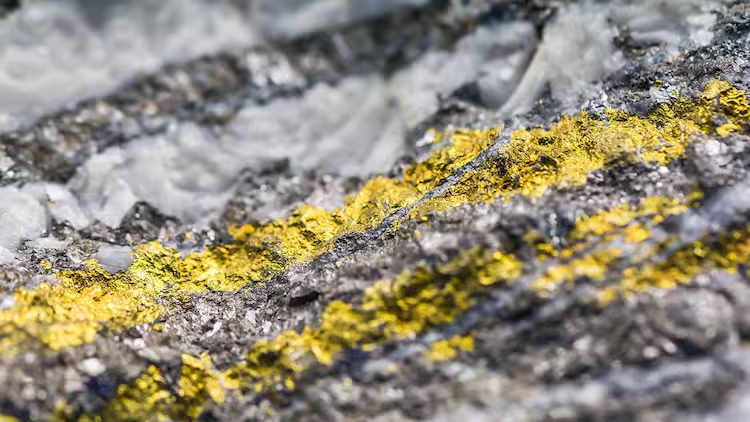
The idea that Earth’s core is “leaking gold” is not a literal image of molten metal pouring out of the planet’s center. Instead, it refers to a striking scientific discovery: tiny amounts of gold and other precious metals appear to have escaped from Earth’s core and migrated into the overlying mantle and, eventually, toward the surface over billions of years. This claim is based on geochemical evidence from rocks, especially ancient volcanic rocks and mantle-derived samples, which show anomalously high concentrations of platinum-group elements and gold in some places. The core is believed to be the planet’s largest reservoir of these metals, so any enrichment in the mantle is puzzling unless material from the core has somehow leaked upward. The phenomenon is important because it challenges the traditional view that the core and mantle are completely isolated from each other and that the core formed early and then remained chemically sealed.
To understand why this matters, it helps to recall Earth’s internal structure. Earth’s core is a dense sphere of iron and nickel, divided into a solid inner core and a liquid outer core. The mantle, made of silicate minerals, surrounds the core, and the crust sits above the mantle. When Earth formed about 4.5 billion years ago, dense metals sank to the center in a process called core formation. Scientists long assumed that this separation was so efficient that gold, platinum, and other siderophile (“iron-loving”) elements were almost entirely stripped from the mantle and locked into the core. Yet mantle rocks and some volcanic rocks contain more of these metals than that model predicts. This mismatch is often called the “excess siderophile element” problem. One explanation is that a late bombardment of meteorites added metals to the mantle after core formation. Another is that material from the core has been leaking into the mantle over geological time.
The strongest evidence for core leakage comes from tungsten and other isotopic signatures in rocks. Tungsten is especially useful because one of its isotopes, tungsten-182, is produced by the decay of hafnium-182, which was present only in the early solar system. During core formation, tungsten tends to enter the metal core, while hafnium stays in the silicate mantle. If the core and mantle had remained perfectly isolated, mantle rocks should have a distinct tungsten isotopic composition. However, some mantle-derived rocks, particularly those associated with ocean island basalts and deep mantle plumes, show tungsten isotope ratios that are best explained by a small contribution of core material. The amounts are tiny—perhaps a fraction of a percent—but the signal is geochemically significant. Similar arguments have been made using platinum-group elements, gold, and other highly siderophile elements, whose relative abundances in some mantle rocks are difficult to explain without core involvement.
How could core material leak upward? The core is not a static ball. The liquid outer core generates Earth’s magnetic field through convection, and the boundary between the core and mantle—called the core-mantle boundary (CMB)—is a dynamic and chemically complex region. At the CMB, temperatures and pressures are extreme, and the mantle side may contain partially molten zones or dense “ultralow-velocity zones.” Scientists have proposed several mechanisms for core-mantle exchange. One is diffusion of atoms across the boundary over billions of years, though diffusion is extremely slow. Another is mechanical mixing, in which bits of core material are entrained into mantle convection. A more dramatic possibility is core-mantle boundary eruptions or “leaks” associated with large-scale mantle plumes. Some researchers have suggested that iron-rich material from the core can be incorporated into mantle plumes, which then rise toward the surface and produce volcanic rocks with unusual chemical signatures. In this view, the “leak” is not a steady flow but a series of rare, localized events over Earth’s history.
Gold is a particularly interesting tracer because it is highly siderophile and strongly concentrated in the core. If even a tiny amount of core metal mixes into the mantle, it could produce noticeable gold enrichment in some mantle domains. However, the story is complicated by the fact that gold can also be delivered by meteorites and concentrated by magmatic and hydrothermal processes near the surface. So when scientists say the core is “leaking gold,” they do not mean that gold is flowing out in economically significant quantities. Rather, isotopic and elemental fingerprints suggest that small amounts of core-derived material have entered the mantle, and gold is one of the elements used to track that process. The quantities are so small that they would not form mineable deposits directly; instead, they provide clues about deep Earth processes.
The implications are profound. If the core is not completely isolated, then Earth’s interior is more chemically open than once thought. Core-mantle exchange could affect the composition of the mantle, the generation of mantle plumes, the evolution of Earth’s magnetic field, and the long-term cooling of the planet. It could also influence how heat is transferred across the CMB and how the core solidifies over time. Some scientists have even suggested that core leakage may help explain why Earth’s mantle contains more gold and platinum than expected after core formation. The idea remains debated, and not all geochemists agree that core leakage is necessary; alternative explanations include late accretion of metal-rich meteorites and inefficient core formation. Nevertheless, the evidence for some core-mantle interaction is growing, and the “leaking core” has become a useful framework for testing how Earth’s deepest layers communicate with the surface.
In summary, Earth’s core is not leaking gold like a leaking pipe; rather, geochemical evidence suggests that tiny amounts of core material—including gold and other precious metals—have escaped into the mantle over billions of years. The strongest evidence comes from tungsten isotopes and highly siderophile element patterns in mantle-derived rocks, especially those linked to deep mantle plumes. Proposed mechanisms include diffusion, mechanical mixing, and plume-related transfer across the core-mantle boundary. The amounts are minuscule, but the implications are large: the core and mantle may not be completely isolated, and Earth’s interior may be more dynamic and chemically interconnected than previously believed.