
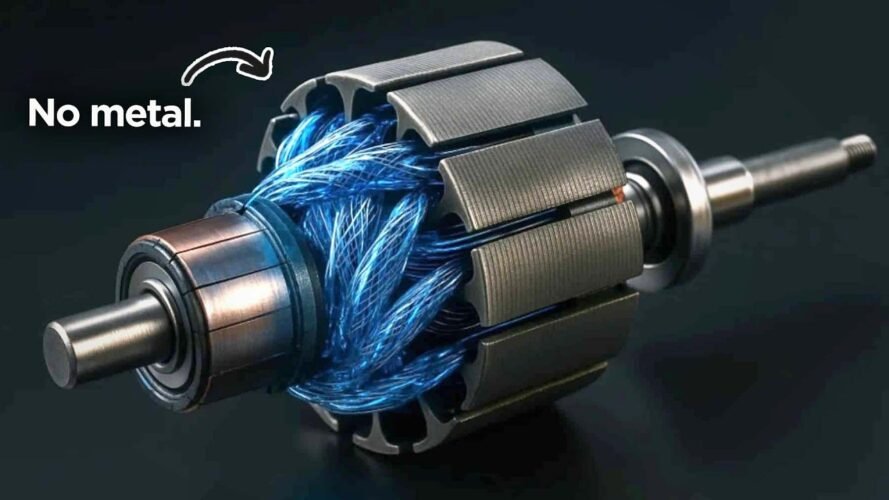
Scientists have built an electric motor that eliminates one of the oldest and most fundamental components of conventional motor design: metal windings. Instead of the traditional copper coils that generate magnetic fields when current flows through them, this new motor uses a conductive plastic or polymer-based material to create the same electromagnetic effect. The breakthrough, reported by researchers working at the intersection of materials science and electrical engineering, could have significant implications for the electric vehicle industry, where weight, cost, and raw material supply chains are constant concerns. By removing metal windings entirely, the motor sidesteps the need for copper, a material whose price and availability have become increasingly volatile as EV production ramps up globally.
To understand why this matters, it helps to recall how a conventional electric motor works. Most EV motors rely on copper wire wound into coils around a iron or steel core. When electricity passes through these coils, they create a magnetic field that interacts with magnets on the rotor, producing rotation. Copper is an excellent conductor, but it is also heavy, expensive, and subject to supply constraints. The new motor replaces those copper coils with a conductive polymer composite — a plastic-like material engineered to carry electrical current while remaining lightweight and flexible. The research team behind the project has demonstrated that this material can generate a magnetic field strong enough to turn a rotor, at least in laboratory conditions.
The significance for EVs is potentially enormous. Electric vehicles are under constant pressure to reduce weight because every kilogram saved translates into more range per charge. Copper windings in a typical EV motor can account for several kilograms of weight, and replacing them with a polymer-based conductor could shave off a meaningful fraction of that. Lighter motors also mean less stress on other components, from suspension to brakes, and could allow manufacturers to use smaller battery packs without sacrificing range. In addition, conductive polymers can potentially be molded into complex shapes rather than wound, which opens the door to more compact and efficient motor geometries that were previously impossible or impractical with rigid copper wire.
Another major advantage is cost and supply chain resilience. Copper prices have surged in recent years, driven by demand from EVs, renewable energy, and grid infrastructure. Mining copper also carries environmental and social costs, and many countries are eager to reduce their dependence on imported copper. A motor that uses abundant carbon-based polymers instead could reduce exposure to commodity price swings and geopolitical supply risks. If the technology scales, it could also lower the overall manufacturing cost of EV motors, making electric cars more affordable for mass-market consumers.
However, the technology is not yet ready for prime time. The researchers acknowledge several hurdles. Conductive polymers generally have lower electrical conductivity than copper, which means they may generate more heat or require higher voltages to produce the same magnetic field. Heat management is already a critical issue in EV motors, and adding a less efficient conductor could complicate cooling systems. Durability is another question: polymers can degrade over time when exposed to heat, vibration, and electrical stress, all of which are constant in a vehicle motor. The team has not yet published long-term reliability data, and independent experts caution that lab demonstrations often fail to translate into durable, mass-produced products.
There is also the question of power density. EV motors need to deliver high torque in a small package, especially for performance models and heavy vehicles like trucks and buses. Whether a polymer-wound motor can match the power density of a copper-wound motor remains unproven at scale. If it cannot, the technology might find its first applications in smaller, lower-power devices — such as drones, e-bikes, or household appliances — before it ever reaches a full-sized electric car. That said, even a niche entry point could provide valuable learning curves and manufacturing experience that eventually lead to automotive applications.
The research community has responded with cautious optimism. Several materials scientists not involved in the project noted that the idea of conductive polymer motors has been discussed for decades, but this is one of the first demonstrations that actually produces usable torque. They emphasize that the real breakthrough is not just the material itself, but the way the team engineered the interface between the polymer conductor and the rest of the motor. Making a plastic that conducts electricity is one thing; making it work reliably inside a spinning electromagnetic machine is another entirely. The team reportedly used a combination of carbon nanotubes or graphene additives to boost conductivity, along with a novel binding agent that keeps the material stable under thermal cycling.
For the EV industry, the timing is intriguing. Automakers are investing billions in new motor designs that reduce or eliminate rare-earth magnets, which are another supply chain vulnerability. A motor that uses neither copper windings nor rare-earth magnets would be a double win for supply chain independence. Some companies are already exploring alternatives like ferrite magnets and switched reluctance motors, but those designs still rely on copper coils. A polymer-wound motor could complement those efforts or even replace them entirely if the performance hurdles are overcome.
What happens next? The research team plans to scale up the motor from a laboratory prototype to a size suitable for testing in a small vehicle. They will need to demonstrate that the motor can survive thousands of hours of operation, that it can be manufactured at low cost, and that it meets safety and efficiency standards. If those milestones are met, the first commercial applications could appear within five to ten years. Even then, copper-wound motors will not disappear overnight; they are proven, cheap, and well-understood. But the existence of a viable alternative changes the strategic calculus for automakers and governments alike.
In summary, the metal-free electric motor is a genuine scientific advance with real potential for EVs. It addresses weight, cost, and supply chain concerns in one stroke, but it also faces serious engineering challenges related to conductivity, heat, and durability. The important points are these: the motor replaces copper windings with conductive polymers; it could reduce EV weight and cost; it may ease dependence on scarce metals; but it is not yet proven at automotive scale. Whether it becomes a transformative technology or a laboratory curiosity will depend on the next few years of development, testing, and investment. For now, it stands as a promising reminder that even century-old technologies like the electric motor still have room for radical reinvention.