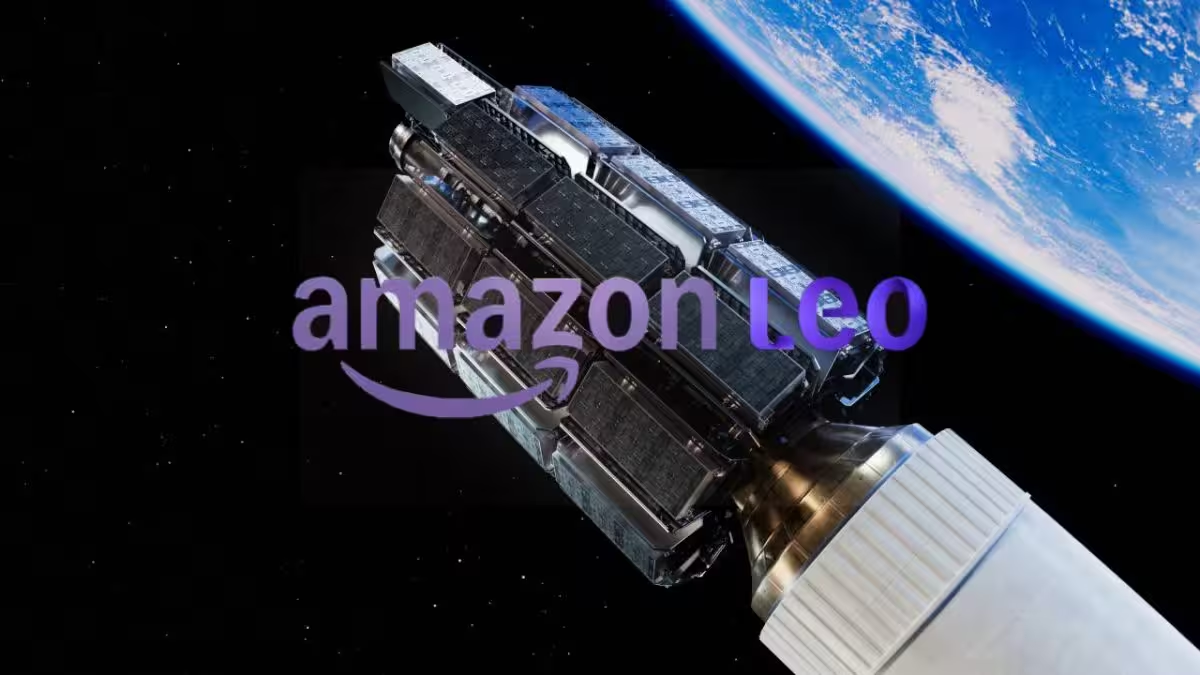
Amazon Leo, the satellite internet constellation formerly known as Project Kuiper, has successfully demonstrated its capabilities for the U.S. Army, marking a significant milestone in the commercialization of low Earth orbit (LEO) broadband services for military applications. The demonstration, announced in a series of tests conducted earlier this year, showcased how Amazon’s growing network of satellites can provide resilient, high-speed, low-latency connectivity to forward-deployed Army units operating in austere and contested environments. This development positions Amazon as a direct competitor to SpaceX’s Starlink in the increasingly crowded military satellite communications market.
The demonstration involved Army units equipped with Amazon Leo user terminals—compact, electronically steered phased-array antennas that can connect to the satellite constellation without the need for a fixed dish. According to Army officials, the tests validated that the system could deliver broadband speeds exceeding 100 megabits per second downlink and 20 megabits per second uplink, with latency under 50 milliseconds. These performance metrics are critical for real-time applications such as live video feeds from drones, secure voice over IP, and battlefield situational awareness tools that require near-instantaneous data transmission. The Army’s Program Executive Office for Command, Control, Communications, and Network (PEO C3N) oversaw the demonstration, which took place at multiple locations, including Fort Bliss, Texas, and a forward operating base in the Indo-Pacific region.
A key highlight of the demonstration was the system’s ability to seamlessly switch between satellites as they passed overhead, a process known as inter-satellite handover. Amazon Leo’s constellation, which currently consists of more than 3,200 satellites in low Earth orbit (with plans to eventually deploy over 3,200), operates at altitudes between 590 and 630 kilometers. This low altitude is what enables the low latency, but it also means each satellite is only visible for a few minutes at a time. The Army test confirmed that handovers occurred without dropping the connection or degrading service quality, even during high-mobility scenarios where terminals were mounted on moving vehicles. This is a critical requirement for tactical operations, where units must remain connected while on the move.
Another important point is the system’s resistance to jamming and electronic warfare. Amazon Leo employs frequency hopping and advanced beamforming techniques that make it difficult for adversaries to detect or disrupt the signal. During the demonstration, Army electronic warfare specialists simulated jamming attempts, and the Leo terminals automatically shifted frequencies and adjusted beam patterns to maintain connectivity. This resilience is a major selling point for the military, which has grown increasingly concerned about the vulnerability of traditional geostationary satellite communications to interference and anti-satellite weapons. The Army has not disclosed the exact location or duration of the jamming tests, but officials described the results as “exceeding expectations.”
The demonstration also highlighted the logistical advantages of Amazon Leo’s user terminals. Unlike traditional military satellite terminals, which can weigh hundreds of pounds and require specialized training to set up, the Leo terminals are roughly the size of a large pizza box and weigh less than 30 pounds. They can be set up by a single soldier in under 10 minutes, according to Amazon. This ease of deployment is a game-changer for expeditionary operations, where rapid establishment of communications is essential. The Army has been seeking a “commercial-first” approach to satellite communications, and the Leo demonstration aligns with that strategy by leveraging off-the-shelf technology rather than expensive, bespoke military systems.
From a strategic perspective, the demonstration signals Amazon’s intent to compete aggressively for Pentagon contracts. The U.S. military is increasingly relying on commercial LEO constellations to supplement its own aging satellite fleet. SpaceX’s Starlink has already seen widespread use in Ukraine, providing critical connectivity for Ukrainian forces. Amazon Leo, however, offers a differentiated value proposition: integration with Amazon Web Services (AWS). The company has emphasized that Leo terminals can directly connect to AWS edge computing services, allowing military users to process data at the tactical edge rather than sending it back to a centralized data center. This “cloud at the edge” capability could enable faster decision-making and reduce bandwidth requirements. During the Army demonstration, Amazon showcased a scenario where drone video was processed locally on an AWS Snowball Edge device connected to a Leo terminal, with only metadata and alerts transmitted back to headquarters.
However, challenges remain. Amazon Leo is still in its early deployment phase. While the company has launched over 3,200 satellites, it has not yet achieved the full global coverage of Starlink, which has more than 6,000 satellites in orbit. Amazon has not announced a firm date for commercial service availability, though it has stated that beta testing will begin in late 2025. The Army demonstration was conducted under a Cooperative Research and Development Agreement (CRADA) , which allows the military to test pre-commercial technology without committing to a purchase. A full production contract would require Amazon to demonstrate sustained reliability, cybersecurity compliance, and supply chain resilience—all of which are subject to rigorous Pentagon audits.