
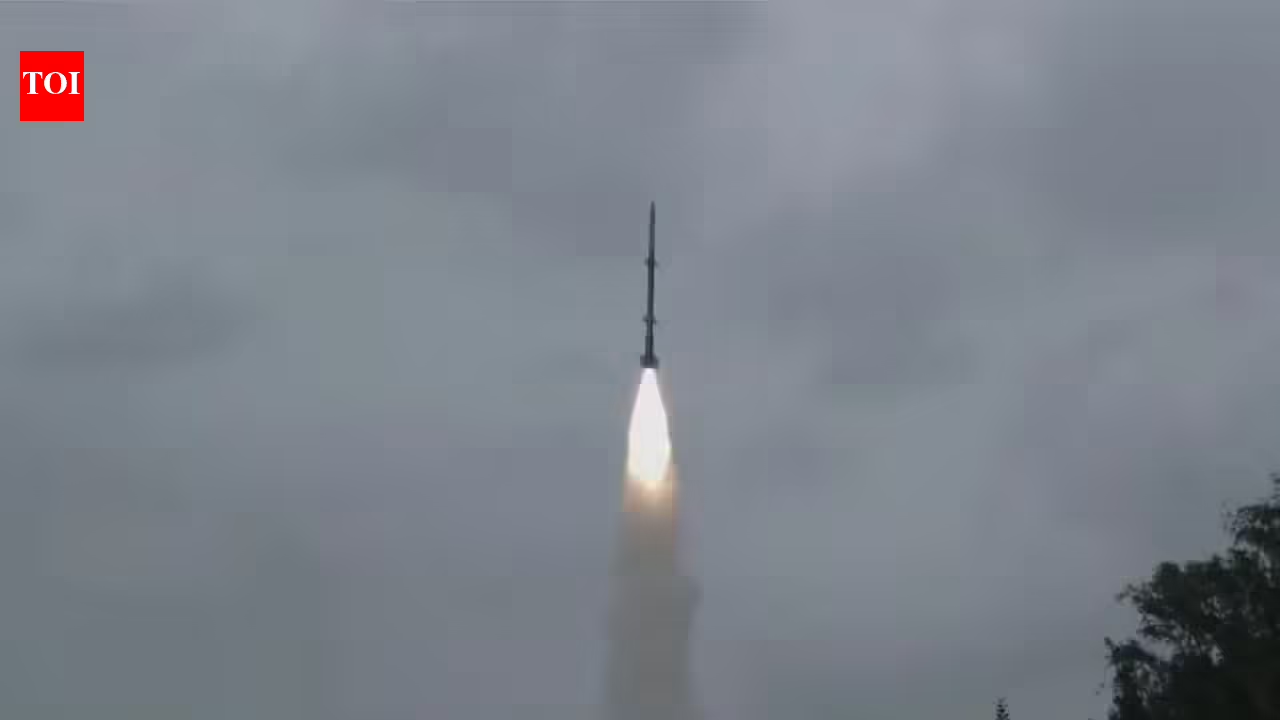
India’s Defence Research and Development Organisation (DRDO) successfully conducted the maiden flight test of the ‘Kusha’ long-range surface-to-air missile on July 23, 2026, marking a monumental leap towards establishing a sovereign, multi-layered aerial defense network. The test was carried out from the Dr. A.P.J. Abdul Kalam Island off the coast of Odisha, where the missile successfully intercepted a simulated electronic target representing a high-speed, high-altitude aerial threat . This achievement was immediately hailed by Defence Minister Rajnath Singh as a “significant milestone” in India’s defence capabilities, underscoring the nation’s entry into an elite club of countries capable of designing and developing such advanced indigenous systems. The success is a major boost to the national “Aatmanirbhar Bharat” (Self-Reliant India) initiative, signaling a decisive move away from dependence on foreign equipment for critical national security .
At the heart of this development is Project Kusha, officially termed the Extended Range Air Defence System (ERADS), which is designed to be the cornerstone of India’s future air defence grid . The program is structured around a family of three distinct interceptors, each built to provide comprehensive, layered coverage across vast distances . The first variant, the M1, is designed for a range of approximately 150 kilometers; the second, the M2, extends its reach to about 250 kilometers; and the crown jewel of the system, the M3, boasts an impressive range between 350 and 400 kilometers, putting it in direct competition with premier global systems . This three-tiered architecture is intended to fill the existing gap in India’s air defence umbrella, which currently exists between the 80-kilometer range of the medium-range MRSAM and the 400-kilometer reach of the imported Russian S-400 system . While the S-400 remains a formidable asset, Project Kusha is pivotal for strategic autonomy; the entire system, from software and mission algorithms to future upgrades, will remain under complete Indian control, freeing it from the geopolitical constraints and foreign permissions associated with imported hardware .
The technological specifications of the Kusha missile system are world-class and designed to counter a wide spectrum of modern aerial threats, including fighter jets, cruise missiles, large aircraft, and even stealth platforms . The missile is reported to achieve speeds approaching Mach 5.5 and can intercept targets at an altitude of up to 30 kilometers, with the capability to engage ballistic missiles travelling at speeds as high as 4 kilometers per second . Its advanced guidance suite is a key feature, incorporating a combination of radio frequency (RF) and infrared (IR) seekers alongside mid-course data-link guidance, ensuring high accuracy and a high single-shot kill probability . The system is further bolstered by a state-of-the-art, indigenously developed Gallium Nitride (GaN)-based Active Electronically Scanned Array (AESA) radar, which is capable of detecting threats at a range of up to 600 kilometers, providing crucial early warning and tracking data . This radar network is seamlessly integrated into the Indian Air Force’s Integrated Air Command and Control System (IACCS), creating a unified, AI-driven operational picture for real-time decision-making and coordinated responses .
Project Kusha is not an isolated weapons program but is the central component of the larger, more ambitious Mission Sudarshan Chakra . Envisioned as a comprehensive, multi-layered national defence shield to be fully operational by 2035, Mission Sudarshan Chakra aims to create an impregnable security grid covering the entirety of India’s airspace, integrating a vast array of sensors, satellites, and weapon systems . The 2026 test of the Kusha interceptor, therefore, represents a critical validation of the technologies and capabilities that will form the backbone of this future national shield. The Indian Air Force has already cleared the procurement of five squadrons of the Kusha system, with the project valued at an estimated ₹21,700 crore . The phased induction of the different variants is expected to commence between 2028 and 2030, with subsequent phases already exploring a naval variant for warships and an even longer-range 600-kilometer interceptor version, further solidifying India’s position in the global strategic landscape and significantly enhancing its deterrence posture .