April 24, 2026
In a significant move to accelerate the development of next-generation missile defense architecture, the U.S. Space Force’s Space Systems Command (SSC) has officially awarded SpaceX a $57 million contract to demonstrate advanced satellite-to-satellite communications. The award, officially announced on April 22, 2026, but detailed further in financial filings released this morning, tasks the Hawthorne, California-based company with developing and fielding a space-based data relay system utilizing the Link-182 waveform. This specific technology is widely regarded by defense analysts as the critical linchpin for the Pentagon’s ambitious Golden Dome initiative—a space-based layer of interceptors designed to detect and destroy hypersonic missiles and other advanced threats shortly after launch. Unlike traditional satellite communications that route data through vulnerable ground stations, the Link-182 demonstration aims to establish a resilient mesh network in orbit, allowing military satellites to talk directly to one another without human intervention, thereby slashing latency and reducing the risk of signal jamming or interception by adversaries.
The firm-fixed-price contract, valued at precisely $57,303,302, represents a strategic move by the Department of Defense to leverage commercial innovation for classified national security purposes. According to the terms disclosed by the SSC, the demonstration project must reach completion by April 30, 2027, utilizing fiscal year 2026 research and development funds that were fully obligated at the time of the award. The competition was robust, drawing six separate bids from various defense contractors, underscoring the intense interest in the military’s transition toward proliferated low-Earth orbit (pLEO) architectures. Central to the agreement is the integration of Link-182, a government-developed communications protocol operating primarily in the L- and S-band frequencies. These specific bands are highly valued for their resilience in contested environments, offering superior performance against atmospheric interference, severe weather, and electronic warfare attacks such as jamming.
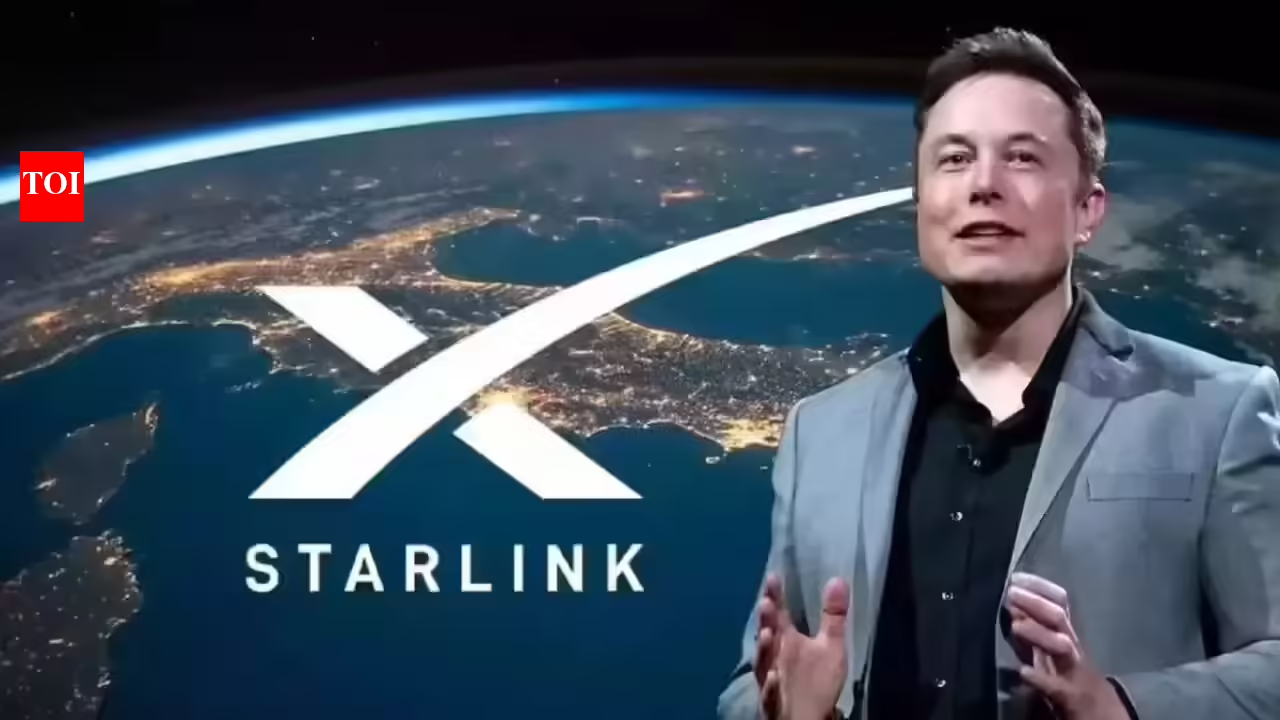
The contract vehicle specifically mandates the acquisition, development, and demonstration of resilient space capabilities for pLEO—the dense band of space roughly 100 to 1,200 miles above Earth where both commercial Starlink satellites and military assets now operate. SpaceX is already intimately involved in this architecture as the builder and operator of the MILNET constellation, a classified network of more than 480 Starshield satellites. Under this new contract, SpaceX will not simply build a radio; it must demonstrate a seamless space-to-space link that can support the operational handover of targeting data between satellites. Dr. Emily Carver, a former defense analyst with the RAND Corporation, stated in an interview following the announcement: “This is not just about building a faster modem. The Space Force is trying to solve the ‘get-home’ problem. Currently, if you shoot a missile at a satellite, you have to wait for that satellite to pass over a ground station to tell you it got hit. With Link-182 on SpaceX hardware, the satellite tells its neighbor instantly, which tells the constellation. It cuts the kill chain from minutes to milliseconds.”
While the public contract announcement focuses broadly on enhancing “U.S. warfighting capability,” previous solicitations from the Space Systems Command—specifically a September 2025 broad agency announcement—explicitly connected Link-182 to the Golden Dome initiative. That earlier document specified a requirement for compact Link-182 terminals capable of fitting aboard space-based interceptor vehicles (SBI). The forthcoming demonstration by SpaceX is expected to act as the technological pathfinder for this interceptor communications network, proving that a low-latency, space-based data relay network can function autonomously without constant oversight from operators at Schriever Space Force Base in Colorado.
General Marcus Howell (Ret.), former commander of Space Operations Command, explained the urgency: “The battlefield of the future is transparent. If you can’t share data at the speed of light between platforms, you are blind. SpaceX has proven they can mass-produce satellites faster than anyone. This contract asks if they can make those satellites talk to each other like a silent, flying fiber-optic cable. If they succeed, Golden Dome shifts from a PowerPoint slide to a physical shield.”
The timing of the April 2027 deadline is aggressive by military procurement standards, reflecting the urgency driven by the Trump administration’s executive orders prioritizing missile defense. Unlike cost-plus contracts that shield contractors from budget overruns, the firm-fixed-price nature of this deal places the financial burden squarely on SpaceX, incentivizing the company to utilize its existing Starlink bus technologies and manufacturing efficiencies. The SSC has also signaled that while SpaceX secured the initial demo, the government does not intend to rely on a single supplier for operational deployment; the 2025 solicitation indicated a desire to eventually buy Link-182 radios at scale from multiple vendors. However, for now, SpaceX’s proven track record of rapid iteration and their control over the MILNET infrastructure gives them a unique edge in demonstrating how a proliferated network of low-cost satellites can form the hardened backbone of America’s defense against next-generation hypersonic threats.